A Realism of Fools: Iranian Propaganda and Campist Anti-Imperialism
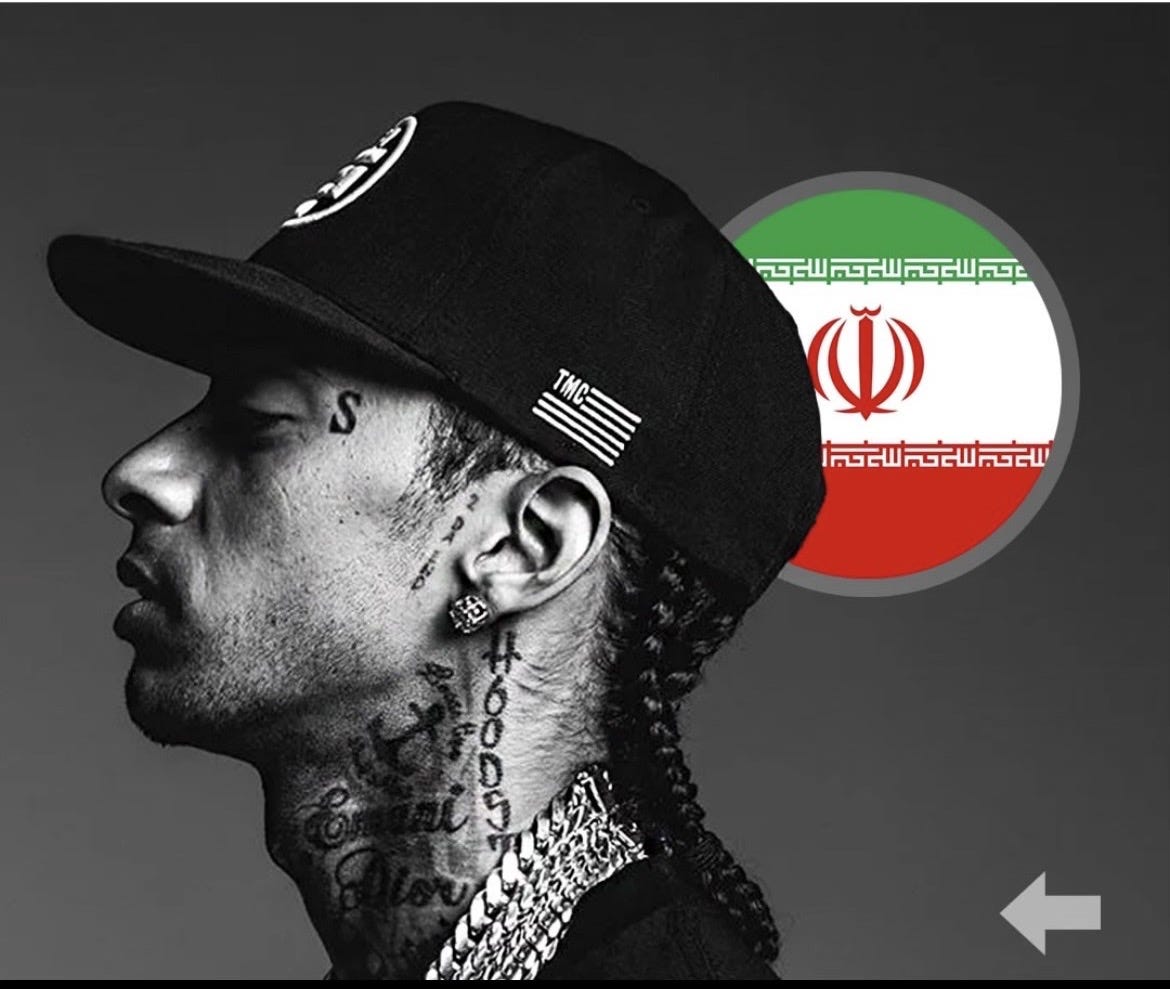
Instagram’s algorithm has been pushing me a strange kind of video combining a critique of the Iran War with Nipsey Hussle, one of my favorite rappers. Here’s an example video:
I found myself getting sucked in. They put the video to a Nipsey song in the background, “Last Time That I Checc’d,” a high-energy celebration of the independent hustle. The guy in the video calls Nipsey “the honorable martyr.” He then speaks in a vernacular that hits people like me a certain type of way:
Not many know that he’s representing the culture of resistance and martyrdom. We the Iranian people are in the middle of war with the United States and Israel. And we gather here tonight to show you that we have way more in common than you think. One god, one blood, and one enemy. Peace!
The call to solidarity. The celebration of a beloved hip-hop figure. Acknowledging the US state’s repression of its black and poor. The assertion that the Iranian people have much in common with the American people. All of this rings true to me in a way that I find appealing. And I wasn’t alone. I could see that many people I know—including celebrities and athletes who are not especially political—were liking and sharing the viral video.
But something about it sat uneasily with me. After watching it a few more times, I identified three specific things. One was the reference to the Iranian people being at war with the US and Israel. It’s not wrong, but it’s an interstate war that happens to slaughter civilians; the invocation of “the people” erased the distinction between the state and its people. If there was no separation between the state and the people, then why did the Iranian state have to violently put down mass protests in January?
Then I recalled that, contra the video’s claim, Nipsey Hussle was not a martyr. Nipsey did become a low-key Black Nationalist in the last decade of his life, but he never talked about or visited Iran; he was largely ignorant of geopolitics (I’ve read his biography). More importantly, Nip got murdered by a jealous nobody in 2019, outside a Crenshaw clothing store he owned. The state was Nipsey’s opposition throughout his life, but it did not murder him. He did not die for a particular cause, nor at the hands of a shared enemy. The video, therefore, was inaccurately manipulating Nipsey’s fans’ desire to have his death mean something greater than mere human tragedy.
The most problematic statement came at the end—“one god, one blood, and one enemy.” One enemy? I quickly realized this was meant to arouse and exploit Black American—and hip-hop lovers’—hostility to the US government and its war on Iran. It placed the current war in a long line of American crimes against humanity (some legal, some not). The video was tapping into a historical perspective that Malcolm X and the Black Panthers had also championed, which helps explain why the Malcom X Foundation was posting multiple of these Iranian hip-hop propaganda videos.
Here was the problem: The video appealed to the darker aspects of American history to recruit oppressed Americans to side with the Iranian people, which the videos conflates with the reactionary Iranian government.
What is Campism?
The slick packaging belied what the social media content was selling: Campism, pro-Iranian-regime propaganda. Campism—which reduces socialist politics to supporting a specific geopolitical “camp”—has existed since the Bolshevik Revolution as a peculiar brand of self-proclaimed anti-imperialism.1 During World War II, campists were self-identified socialists who refused an international socialist “Third Camp” in favor of the Soviet imperialist or capitalist imperialist camps.
When the Soviet Union violently suppressed the Hungarian Revolution in 1956, campists became synonymous with “tankies,” those who rationalized or supported Soviet violence. In recent decades, “campist,” which remains an analytical category, has doubled as an epithet for anyone who sides with any enemy of Western capitalism or imperialism—thus, a pro-Chinese, pro-North Korean, or pro-Iranian socialist who sides with these states against Western empire gets labeled a campist. It’s a complicated label, but one we need to retain because it describes a tendency within international left circles that has always been there but appears to be getting more common.
The slipperiness of our moment is troubling. The West really is crashing out and engaging in rampant imperialism, and any people on the receiving end of military aggression have a right of self-defense—including Iran. And as outsiders to a conflict, we don’t really have the moral standing to say how a people being attacked should or should not defend themselves.
And yet! All of that can be true at the same time that the state defending itself from Western attack makes choices that put its people in dangerous geopolitical positions or denies its people basic rights, which can range from the means of subsistence to free speech to non-arbitrary arrests and disappearances.
Campism is a zero-sum moral absolutism—“one enemy!”—that depends on analytical oversimplification. People gravitate to a campist position because they want to feel that there’s an agent out in the world exercising power on their behalf. And in a world of national states, the state form still represents the greatest territorial concentrations of power in the world.
The Problem With Campism
I want to be delicate because I understand the impulse from which the campist view arises and I agree with a chunk of its analysis. But it’s too simplifying, too narcissistic—a Third-World equivalent of vulgar Marxism that subordinates any liberatory ideal to a state-based counter-hegemonic power struggle against Western imperialism. The campist lines up with the state that’s doing the fighting, because it’s the most fertile concentration of force against empire.
In the Iran context, the campist wants to label any leftist who might criticize Iran’s theocratic, reactionary regime2 as doing a liberal’s “bothsidesism,” policing public opinion on Iran’s behalf.
But Frantz Fanon would’ve had harsh words for campist reasoning. Any close reading of Fanon would refuse the claim that Third World sovereignty is inviolable or beyond critique. Nationhood itself was only meant to be a way station on the path to liberation, and the only way to get to the destination (liberation) was to avoid the myriad reactionary potholes along the way. In fact, most of The Wretched of the Earth was spent decrying what he derisively called the “national bourgeoisie,” the imperialist who looks like the local but who rules in a manner that might as well be the foreign oppressor. Fanon thought national consciousness was “nothing but a crude, empty fragile shell.” He worried about reactionary regimes controlling Third World governments in the name of anti-imperialism.
The truth, that states are amoral vessels for elite power that sacrifice regular people as they clash with other states, is uncomfortable and leaves us searching for refuge in a world of clashing national militaries. But truth is better than lies. States are mechanisms for pushing abstract justifications down and siphoning resources up. The hope of leftist parties and movements is simply that those “resources up” can be used to restore power to the people in a way that makes humanity’s liberation possible.
Yet Another Realism of Fools
We would all be a lot better off if we proceeded with the starting assumption that—with few exceptions—states are bad, because they’re ruled by self-interested elites who share little in common with those they govern. We should then judge states without rose-colored glasses. To what degree does a state immiserate and/or deny the rights of people? That’s the metric that matters. If you find yourself cheering for one state or another—or policing political conversations to avoid having your preferred state condemned—chances are you’ve lost sight of that crucial question.
I have tended to think that the kind of foreign-policy “realism” that prevails in Washington—contra realism in the critical or even classical IR sense—is simply militarism; the realism of fools. It is unrigorous; it subordinates domestic politics to its power-amassing fetish; it has a zero-sum bias; and the power it cares about most is the crudest, camouflage-colored kind. In all these ways, foreign-policy realism—militarism—amounts to nothing but an ideology of military buildups that struggles to avoid the wars such buildups encourage.
Campism espouses a similar type of realism insofar as it sees the one true anti-imperialism as matching force against the force of empire while everything else takes a back seat. That’s pretty cynical, and realism is nothing if not cynical.
But even if a realist recognized the need for someone to check American domination, and even if they thought that was Iran’s function, they would neither cheer nor moralize about it. The campist, by contrast, imposes a moral valence on the exercise of its version of cynical anti-imperialism, which leaves it in a contradictory trap—amoral in its use of power, self-righteous in the morality that justifies its amoral actions. Ends, in other words, justify the means. And that sounds a lot like how the enemy thinks.
Hey, friend! You might have noticed that I’m offering more of Un-Diplomatic without the paywall; I’m trying to keep as much as possible public. But to do that requires your help because Un-Diplomatic is entirely reader-supported. As we experiment with keeping our content paywall-free, please consider the less than $2 per week it takes to keep this critical analysis going.
The single best history of campism I’ve read is Dan La Botz, “Internationalism, Anti-Imperialism, And the Origins of Campism.”
Reactionary regimes are, by definition, not liberatory. And even if you wanted to dismiss Iranian ethnoreligious patriarchy as part of national identity-making, you can’t escape what Amnesty International describes as Iran’s record (in 2025 alone!) as “Enforced disappearances and torture and other ill-treatment were widespread and systematic. Corporal punishments amounting to torture, including flogging and amputation, were implemented. Trials remained systematically unfair. The death penalty was applied arbitrarily and was used disproportionately against minorities. The highest number of executions since 1989 was recorded. Systemic impunity prevailed for past and ongoing crimes against humanity and other crimes under international law. Authorities failed to address environmental degradation which contributed to thousands of deaths.” Sounds similar to life under MAGA rule. Any socialist, any anti-imperialist should be able to criticize such a track record.


