Breaking the First Rule of Imperial Warmaking
In response to the attacks of September 11, 2001, George W. Bush opened up a world-altering Global War on Terror that cost $6 trillion and counting, and destroyed 900,000+ lives.
But if you watch The O.C.,1 a drama that depicts Southern-California life at its finest and was launched five months after the Iraq invasion, you’ll see no sign of that disastrous war. No depictions at all of the feds visiting terror upon Muslims in America. No wrestling with the massive expansion of the US security state or the lives it stole abroad. Foreign policy simply didn’t exist in the world of The O.C. It’s a perfect visual representation of Americans’ relationship to what their state did during these years.
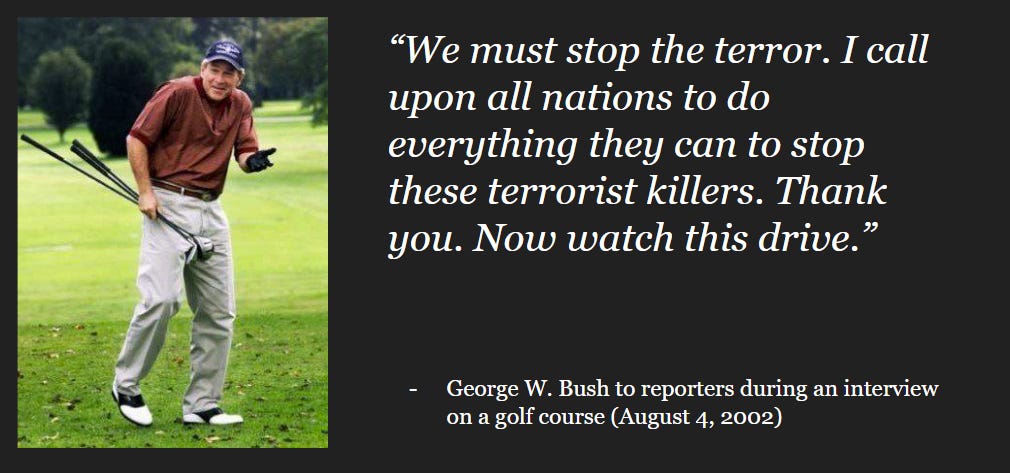
That aloof relationship to the state was by design. Only two weeks after 9/11, Bush told Americans:
Get down to Disney World in Florida. Take your families and enjoy life, the way we want it to be enjoyed.
And enjoy life we did.
Everyone agrees now that Bush’s strategic judgment was quite poor, and that Americans were not well served by either Iraq or the Global War on Terror. But Bush—as someone trying to exercise US power on behalf of American hegemony—got one thing very right: He preserved an alternate reality in which Americans could spend their time submerged in consumerism and home renovations, reality TV and culture-war jousting.
By avoiding a war tax, racking up deficits to pay for a military buildup, and relying on an “all-volunteer force,” Bush preserved the illusion that war is other people’s problems. Americans could not only avoid acknowledging the imperial warmaking that was tied to their mode of living, but also fail to see the degraded quality of life they endured so that their government could continue dehumanizing criminality abroad. Bush followed the lineage of every president since the Vietnam War in preserving this state of unconsciousness, which is rapidly falling apart.
I first learned of Zbigniew Brzezinski’s rules of primacy working in Obama’s Pentagon, because some of my military counterparts had it quoted and pinned to their cubicle walls.2 Zbig argued that American primacy required using state power to achieve three things:
to prevent collusion and maintain security dependence among the vassals, to keep tributaries pliant and protected, and to keep the barbarians from coming together.
What Zbig did not address was the domestic sphere. The polis. The home front. His imperialist aims necessitated imperial warmaking (“wars of choice”), and that necessitated something that politicians had instinctually understood, if only to avoid an electoral death blow or sagging poll numbers.
What Zbig failed to articulate in his otherwise morbidly candid manifesto is the real first rule of imperial warmaking: Never let voters connect the experience of pain at home to either wars done abroad or to the permanent war economy. A domestic social order that sustains global domination depends on obscuring the cause-and-effect of American death dealing (and who profits from it).
This is Trump’s greatest fuckup.
Invading Iran is the geopolitical equivalent of grabbing the world by the p****y and expecting not to get slapped. He thinks they let you do it. And how could he not when Washington was complicit in a genocide before he even came back to the White House, or after world leaders let his illegal war on Venezuela slide?
But we live in a world of consequences regardless whether world leaders acknowledge it.
Americans are paying a steep and growing price for Trump’s imperial misadventures. Americans always pay a price, even when their politicians encourage them to believe they’re offloading the cost of war onto foreign others (allies and enemies alike). The nous of previous presidents in observing the first rule of empire meant tailoring war so that the consequences for Americans were hard to perceive. But now, voters can’t help but notice they’re being soaked.
When the military budget soars to $1.5 trillion in order to sustain a series of illegal wars—and simultaneously cuts welfare programs, Medicaid, higher education funding, and the federal workforce to offset the expense—the guns-butter tradeoff tells on itself. “Productivity” rises to unprecedented levels, alongside unemployment. Gas costs too much. Food costs too much. Electricity costs too much. Signs demanding “No War With Iran” in everything from ICE protests to #NoKings rallies are signs that the first rule of imperial warmaking has been broken:
American empire was always predicated on the idea of a “spatial fix”—violence, domination, and extraction over there so as to preserve what we’ve got going on over here. The grand strategy of primacy is a strategy-washed version of the same—forward military basing in “key regions” is thought to keep enemy violence quarantined in those regions. The myth of the American frontier embodies this same spatial reasoning, giving rise to a mistaken belief that American empire abroad revitalizes American republicanism at home. The exceptionalism at the root of the American frontier myth is common to all empires and, in that sense, pathologically unexceptional.
But the spatial fix is fake. The home front has never been immune to the consequences of the imperial form of warmaking; certainly not in an interdependent world. MAGA’s global vision refuses to acknowledge the deep economic inter-penetration of the capitalist world-system that ought to induce in Washington a measure of prudent restraint, caution. Instead, Trump has succumbed to the imperialist impulse to illegally and unconstitutionally bomb country after country. Joke’s on us, because it turns out one of those countries has a military strategy capable of inducing a global financial crisis and controlling a key strategic chokepoint—the Strait of Hormuz. This is the very reason past imperial presidencies didn’t bomb Iran, whatever their other crimes. It would visit pain on Americans in ways too undeniable to obfuscate.
Americans have been suffering in many ways for years. But even the most Bravo TV-addled minds know that the burgeoning fuel and food crisis is the consequence of the gratuitously elective Iran War. Trump has violated the first rule of imperial warmaking.
To be sure, much of the world will suffer worse than the average American. But it’s the ruling class’s strange indifference to the world’s suffering that ensures the American people too will suffer. Because the world is connected after all.
Hey, friend! You might have noticed that I’m offering more of Un-Diplomatic without the paywall; I’m trying to keep as much as possible public. But to do that requires your help because Un-Diplomatic is entirely reader-supported. As we experiment with keeping our content paywall-free, please consider the less than $2 per week it takes to keep this critical analysis going.
The O.C. is a personal favorite, for many reasons. For a loving but critical engagement with its politics, listen to Remember Shuffle’s recent episode covering the series.
Zbig was Jimmy Carter’s national security adviser and a Washington influencer for the remainder of his life. The quote comes from his 1997 book, The Grand Chessboard, which was a full-throated defense of US global imperialism, written in a language primacy and national security. Not everyone in DC had read it, but most everyone had internalized it all the same.


