Chinese Hegemony is Not Happening...
...at least not on the terms that we’re used to debating it.
Harvard realist Stephen Walt just came out with a piece titled, “Chinese Hegemony Might Be Happening.” His argument is more modest and muddled than the title suggests, but the question/fear/hope of “Chinese hegemony” has underpinned everything in how the US has approached China for the last decade and a half.
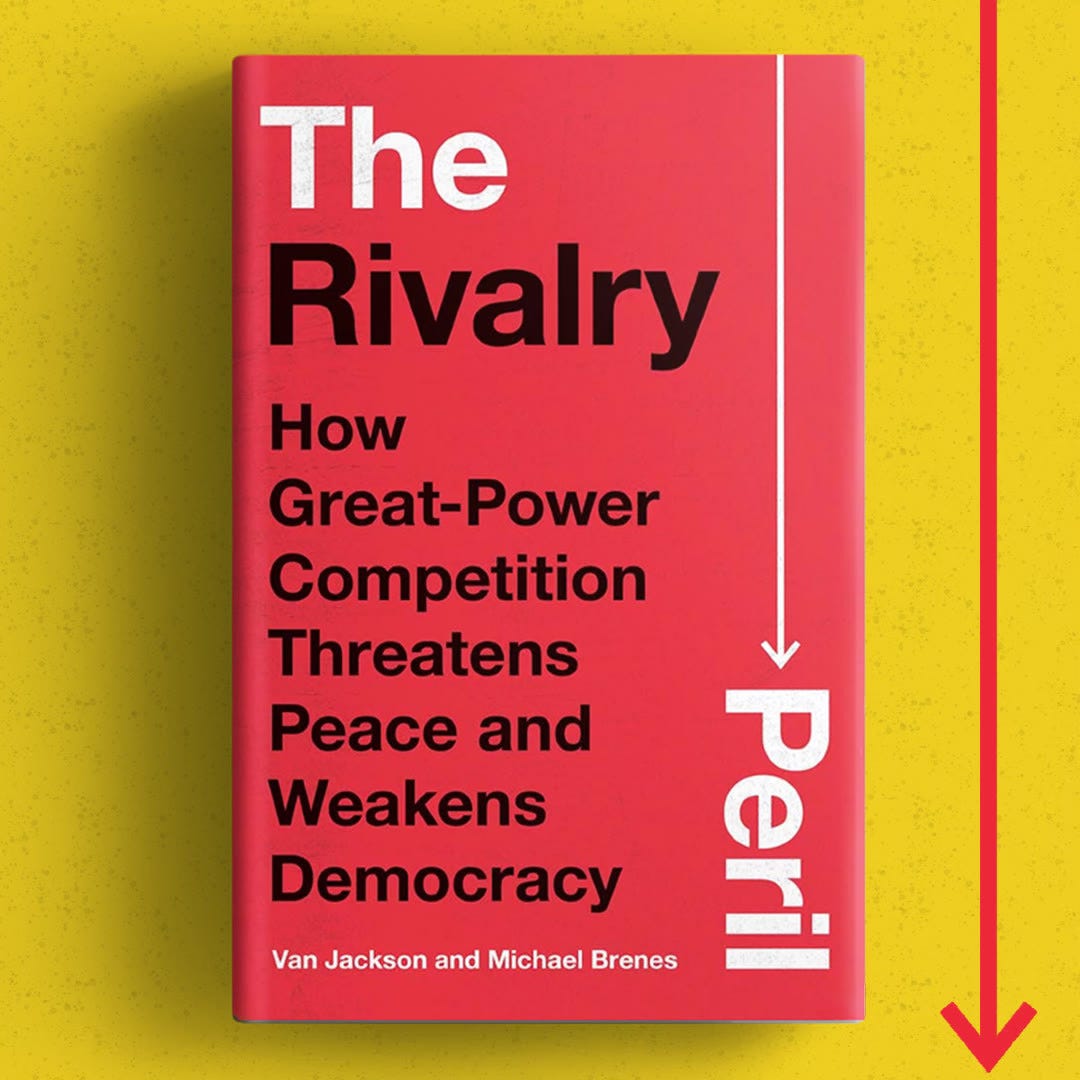
It’s also something my co-author Mike Brenes and I seriously considered in our book The Rivalry Peril (which for some reason is available on Amazon right now for only $3!). Contrary to what much of Washington assumes, we came to the conclusion that China cannot achieve global hegemony even if it wanted to, which we believe it does not want at any rate. It’s not even clear China could achieve hegemony within East Asia.1 And that means that much of Washington’s “strategic competition” fetish is unwarranted and counterproductive.
Walt’s point was that US alliances can’t prevent Chinese dominance…and that’s true. But alliances are not a constitutive feature of hegemonic order and much hinges on what people mean by dominance and hegemony. The key is not allies but rather global public goods.
Chinese scholars sometimes write and talk about “global public goods” as infrastructure investment, AI regulation, a global green transition, and global South debt—all issues we refer to in The Rivalry Peril as areas ripe for great-power collaboration. But these are not global public goods that we’re used to associating with hegemonic ordering. When Western scholars talk about hegemonic order—a global or regional order constructed around a single dominant power—the defining feature is the provision of global public goods, usually mediated through international institutions that the hegemon dominates.
A hegemon is only “necessary” when the goods it provides are non-substitutable (that is, things only the dominant power can provide): The stability of an economic order; the stability of a norm-based political order (sovereign borders); and the stability of open shipping lanes/open commons. Those are things that China is not providing and cannot provide at a global scale. They are also things that the US actively menaces (even before Trump) and now rhetorically repudiates too. So the way that China might be conceiving of global public goods is just different from the public goods that we’re used to expecting as part of a hegemonic order.
What this means is that China cannot be hegemon and likely never will be—that’s just an anachronistic way of thinking about the world. Alternatively, it’s possible to argue that China is coming into a quasi-hegemonic role that redefines what’s expected of a dominant power…assuming it doesn’t crash into a declining superpower on a meth bender in the meantime.
But in either case, we’re undoubtedly in a post-hegemonic world.
The sources of order are elusive, but they were always illusory to a degree anyway—America-furnished public goods were not good for all, nothing was as open as the rhetoric supposed, and the entire package functioned as the legitimation of so much violence and predation at any rate. International orders do not require hegemons, and a world without empire—my project—presupposes a world without hegemon. So goodbye to all of that.
ICYMI, we covered the US-China summit in the latest episode of the pod:
If we’re translating things into what Westerners can understand, my best read is that China wants something like an FDR “good neighbor” policy but at scale. With a couple key exceptions, we should be able to work with that.


