Epistemic Collapse
If nobody knows anything about the Iran war, then there is no accountability for it. Or for anything.
I’m struggling not to lose my mind. Follow me, if you dare, down a vortex of insanity.
First the US entered a war with multiple contradictory pretexts, without any kind of approval from Congress or the people. Everyone knows that. But then we learned that an Iranian strike against Bahrain was actually a detonation of a US Patriot missile. Hmm. Then the US relocated 5k Marines from Okinawa to the Middle East without explaining the purpose.
Then we’re told Iran launched two medium-range ballistic missiles 3,800km (which is technically possible) at a nuclear bomber base on Diego Garcia, only to learn that Iran denies having launched the missiles, spawning two competing theories about the missile launch: One, that there was no launch at all, and the other that Israel launched the missile as a false flag. In either case, neither the Israeli nor US government has denied that Iran launched the missile, so the media reports are impossible to sort.
It gets much weirder still.
As I went to bed on March 22 (US time), I saw four different trending headlines from stories that the US and Israel had just struck Iranian “infrastructure,” including a power plant. Four! Those headlines occurred in the context of Trump having issued a 48-hour ultimatum to Iran (to “re-open” the Strait of Hormuz) the previous day, making it seem like Trump’s threat to attack Iran’s energy infrastructure had started to be implemented.
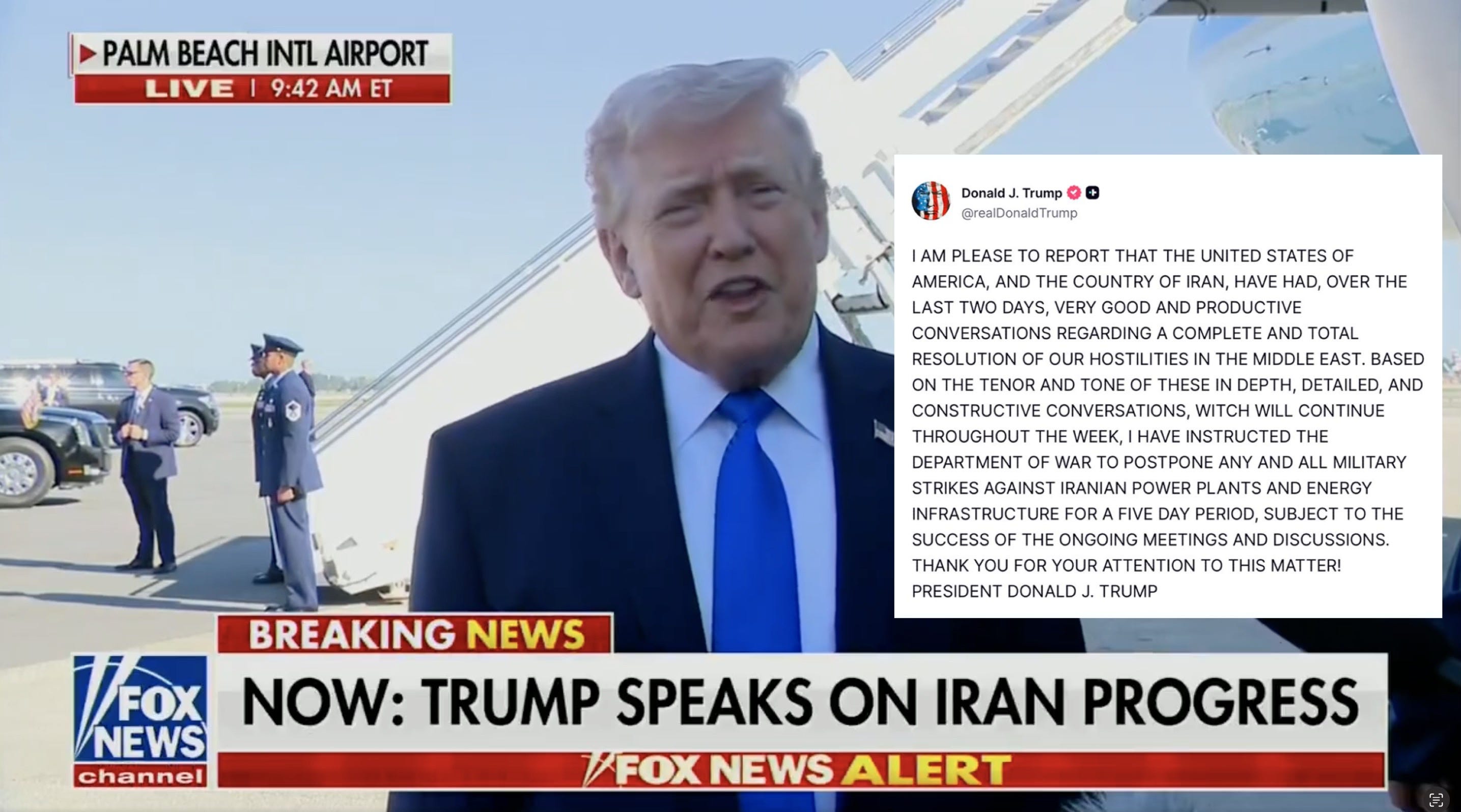
But as I woke up on March 23 (US time), I’m greeted with stories of Trump TACO—he announces via a screenshot of a Truth Social post that he’s had good talks with Iran and that he’s going to postpone the destruction of Iranian energy infrastructure for five days.
Put aside that what Trump is threatening and/or done constitutes yet another war crime. Bracket off too that the stock market rebounded on Trump’s news, with reports of gargantuan levels of insider trading, which reminds of my hypothesis about the geopolitics of primitive accumulation. Had any Iranian power plants been struck by the US and Israel? I don’t freaking know! I can’t find verification of it anywhere, and Google’s Gemini seems to think that the US has only bombed Iranian civil infrastructure (a war crime), but not yet its energy infrastructure (a different war crime).
I track militarized violence and geopolitics as part of my vocation. I’m in the sense-making business. If I have trouble parsing what’s going on, I certainly can’t explain why it’s going on, which is normally where I excel.
The thing to worry about here is that Iran denies that any talks have been happening. Trump appears to be lying to justify backing down from his illegal war, and people don’t care because they’re just glad he’s showing signs of not doing the war anymore. The bond market appears to have won again, for now. In a perverse way, that’s a relief. There’s one scenario that averts a global financial crisis in the next 12 months, and it requires that the US and Israel simply stop the war.
But the thing is, Trump made no promise to suspend Israeli attacks, and if Iran has not been negotiating with the Trump administration, then the Strait of Hormuz will not be open for oil and gas passage except by those who negotiate safe passage with Iran. If that’s the situation, then folks are celebrating a fake ceasefire.1
I worry that we’re going to be living in a public narrative that the war in Iran is somehow “over” while it very much continues. Other than nuclear annihilation, I can’t think of anything worse than having a war proceed while the world remains aloof to the fact of it.
And there are signs of precisely that. Not only did Politico just report that the US in the process of assassinating Iran’s potential political leaders as they test and vet various puppets; what ceasefire? There are also a large number of flights from US military bases destined for Israel and Jordan—where they would need to be to launch a ground operation inside Iran. Such a setup is leading to some very plausible conspiracy thinking that the Trump one-sided ceasefire is just a way to quietly mobilize an invading force of some kind:
Even in the best case, Trump is mobilizing a large military force for something in the Middle East—but TBD whether it’s the futile hunt for WMD, the seizure of Kharg Island that would make US Marines cannon fodder, or some kind of Iraq-style quagmire. All bad scenarios. Meanwhile, even run-of-the-mill mainstream pundits are confident Trump’s ceasefire is minimally an attempt to calm global markets.2
So what is even happening, and why? The confusion compounds because, as Ken Klippenstein just reported, private companies (which are the only kind that generate news now) are collaborating with the US national security state to censor and “curate” how the news about the war is being presented. We are being lied to by our governments, and that’s to be expected, but we’re also being spun—often times unintentionally—by major news media and news wires reporting on events.
The stakes could not be higher, but we appear to be in a state of epistemic collapse. Any shared reality we can cultivate exists only within particular epistemic bubbles—as someone on Twitter, BlueSky, AND Substack Notes, I see the distance both across and within bubbles widening every day.
We exist in a highly degraded information environment. Good analysis has always been rare, but so too, now, are good facts. And that trend redounds to the benefit of tyrants.
Hey, friend! You might have noticed that I’m offering more of Un-Diplomatic without the paywall; I’m trying to keep as much as possible public. But to do that requires your help because Un-Diplomatic is entirely reader-supported. As we experiment with keeping our content paywall-free, please consider the less than $2 per week it takes to keep this critical analysis going.
Trump did exactly this move after his first summit with Kim Jong Un in 2018; I wrote a book about him taking a nuclear crisis as far as it could go, and then once the summit happened, declaring peace and that the nuclear problem had been solved even though nothing had changed.
Interestingly, gradual escalation never works on its target. Terrible track record. But gradual escalation does tend to prevent market instability.


