

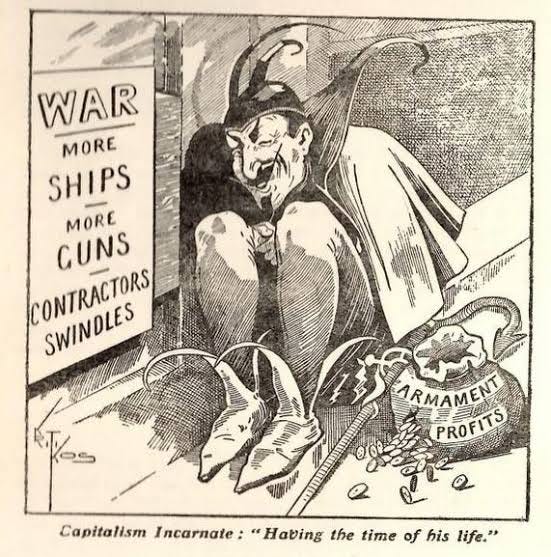
The US state is fusing with the permanent war economy:
Defense Innovation Unit (DIUx) is an Obama-era creation meant to expedite the sale of commercial technology to warfighters.
The Pentagon’s Office of Strategic Capital started under Biden is as terrible as it sounds, directing public resources toward private capital in ways that grow the capacity of the permanent war economy.
The Army quietly established a “Strategic Capital Initiative” that not only aims to braid together government and private investment in every part of the war fighting supply chain; it’s also explicitly meant to fund the Army at higher levels than Congress provides: “Army leadership recognized it could not solely rely on congressional appropriations – it needed creative solutions to address its funding, infrastructure and modernization bottlenecks.”
The Pentagon has just launched an office for industrial sabotage and supply-chain disruption—methods of inter-imperial rivalry justified on the grounds of securing US primacy while functioning as a means of engorging the surpluses of American capitalists allied with the US security state.
The Trump administration has given tech executives military commissions and the Secretary of War is creating an “autonomous warfare command” that promises to expand the use of AI into every part of the military.
In the span of five years, the US state has taken partial ownership of more than 30 companies, all, of course, on national security grounds. Just last week the US Navy agreed to transfer $2.9 billion to war profiteer Anduril for a project in Maryland meant to produce…wait for it…submarine parts.
The supposed upside of this last change is that the US government now has a 40% equity stake in the Anduril project. That same upside also means that the US state literally, explicitly, and directly profits from the permanent war economy, making anything resembling economic democracy impossible without first accelerating mutual ruin.
Private equity and venture capital are increasingly vested in military-tech industries. Somewhere between 58-80% of the US discretionary budget goes to the Pentagon now. For a certain section of the capitalist class, forever wars are a precondition for growing wealth in a depressed fiscal environment. As Shana Marshall concluded in a recent report: “The cycle of militarization, violence, public austerity and private accumulation is self-reinforcing.”
When large AI firms with contracts with the national security state fail to service their debt payments or have their investors flee in a moment of rational panic, the US state will come in to bail out the billionaires with taxpayer money at a scale that will make the Global Financial Crisis look small. The difference of the coming crisis with the last one is that we now have growing precedents for the state to effectively nationalize AI on security grounds, but without actually exercising the control that nationalization should imply.
All of this puts efforts to make peace, abandon primacy, and kill the forever-war industrial complex out of reach for voters and politicians alike. Military Keynesianism was always a way of sneaking a poison pill into the economy so that any attempt to make a world of peace would harm the pocketbooks of people with capital. What’s happening now is much harder to reverse.
Hey, friend! You might have noticed that I’m offering more of Un-Diplomatic without the paywall; I’m trying to keep as much as possible public. But to do that requires your help because Un-Diplomatic is entirely reader-supported. As we experiment with keeping our content paywall-free, please consider the less than $2 per week it takes to keep this critical analysis going.
Senior Fellow for Mass Murder and Colonial Relations

When I kicked around the DC think-tank scene, I worked with several younger guys I really related to even though I was a notch higher than them in the pecking order. Every Washingtonian in their 20s aspires to suit-and-tie life and they were no different, showing up for work everyday dressed for the job they wanted.