Multipolarity, Diego Garcia, and the PGM Revolution
Iran’s precision-guided munitions prove what even the most stubborn policymakers must concede: The world is multipolar. Adapt peacefully or fight high-casualty wars.

There are many valid ways to make sense of the illegal Iran war:
A case study in the limits of coercive bombing;
The latest indicator of US hegemonic decline;
Evidence of imperialist foreign policy;
A signpost about drones as the “future of war”;
Proof that MAGA ideology is imposing a “clash of civilizations” on the world;
An example of getting chain-ganged into war by a client state;
A price the world now has to pay for the corruption of the US political system.
At least as important as any of these angles is a warning I’ve expressed many times over the past decade: If the US insists on its own global primacy in a multipolar world, the result is reckless wars of choice that the US will almost certainly lose.
In 2024, I delivered a public address to the New Zealand Fabian Society. In it, I laid out my reasoning why pursuing American primacy in a multipolar world was going to bring us to World War III:
Primacy is a strategy that seeks security in a predatory way—it tries to preserve and prolong an extreme imbalance of power…for those of us who take our image of America from the long unipolar moment…we’ve taken for granted that American primacy is always in the background and not especially onerous or dangerous…
But times change. Technology changes. Distributions of power shift. Political economy has shifted…What I’m saying is that it was easy to believe that primacy was a global public good when Uncle Sugar had all the power and there were not even imagined alternatives. But that’s not the world we live in now.
To clarify key terms here, primacy is a strategy that seeks to hoard power in the extreme, even using force and global policing to ensure it retains a favorable imbalance of power. Polarity refers to the global distribution of material power. The distribution of power can be understood as unipolar, bipolar, or multipolar and each makes certain forms of world-political ordering possible/impossible. Hegemony is a form of political ordering solely compatible with a unipolar distribution of power, which is what a primacy strategy seeks to preserve and impose.
The world today is obviously multipolar. It should be beyond question that the world is multipolar now. Occasionally a scholar disputes that, and US policymakers act as if it’s not, but there’s too much evidence in favor it. That necessarily means US hegemony is a defunct project, incompatible with the world’s actually existing distribution of power. Which Canada’s prime minister recently declared (two decades too late) with much fanfare.
But this whole thing about multipolarity and primacy is not abstract. It’s very real shit with real consequences, and those consequences are currently taking the form of the illegal war with Iran. I don’t want to get bogged down in a measurement controversy that loses site of reality, so let me ground my assertions here in something that most scholars and the public simply don’t grasp: There has been a technological shift toward precision-guided munitions (PGMs, drones and missiles) over the past 30 years. It’s a global shift that the US spearheaded. And it makes every clever military capable of cheaply countering traditional techniques of power projection.
This matters because the US way of war—guided by primacist ambitions—requires global power projection. The US remains more than capable of winning wars to defend the continental United States, and it might even be able to win some imperialist adventures in Central America, given the geography. But the further away from the homeland US forces get, the more intrinsically sketchy the proposition of “victory” becomes.
Some call this military-technical shift a “revolution in military affairs,” but I think it’s better understood as a shift toward a multipolar distribution of global power. And we’re seeing what that looks like in two aspects of Iran’s military strategy.
The first is the ease with which a highly degraded Iranian military has been able to exercise control of the Strait of Hormuz.
Using precision-guided munitions (drones and short-range missiles), Iran struck only 16 ships and was able to declare itself in control of the Strait, holding at risk enemy ships and allowing safe passage of ships that met their terms (which were, incidentally, denominating transactions in Chinese Yuan, thereby routing around US dollar supremacy, which has historically been a pillar of US primacy). Without PGMs, Iran could not exercise control over the Strait. It could not degrade US air defenses. It could not harass US ships. It’s all counter to American power projection and anathema to American primacy.
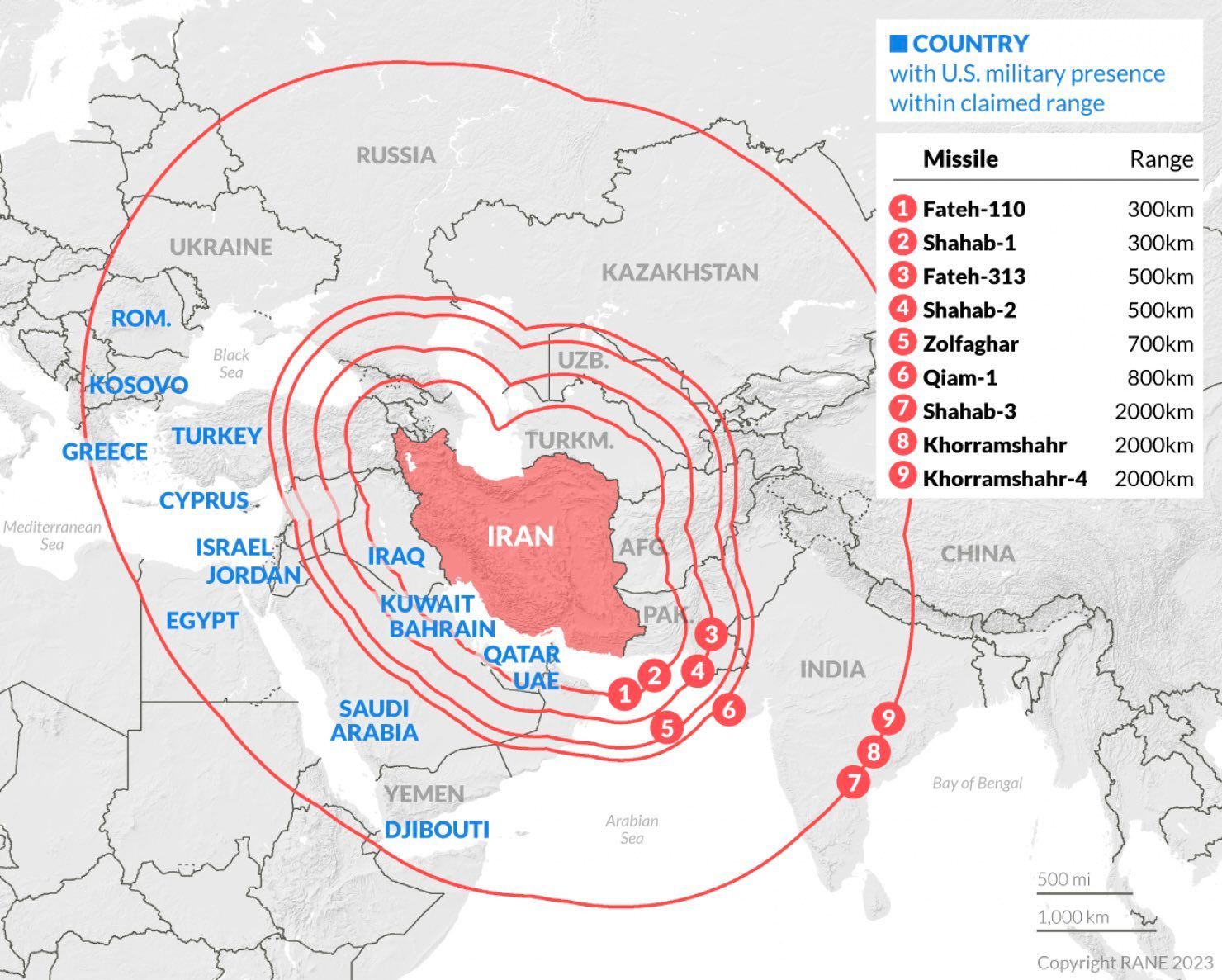
The second aspect of Iranian military strategy that illustrates the price of primacy under conditions of multipolarity is the latest news: Iran launched two intermediate-range ballistic missiles at Diego Garcia, a base that hosts US B-52 nuclear-capable bombers some 3,800km away.1 As Israeli Chief of Staff Zamir just reported:
Yesterday, Iran launched a two-stage intercontinental ballistic missile [should say IRBM] with a range of 4,000 kilometers toward an American target on Diego Garcia Island. These missiles are not intended to strike Israel. Their range reaches European capitals—Berlin, Paris, and Rome are all within direct threat range.
“These missiles are not intended to strike Israel” is right. They’re intended to hold at-risk outside powers who have enough hubris to project power from far away lands into the Middle East. The US can’t fight from standoff range with impunity if enemy IRBMs can potentially hit something as strategically valuable as B-52 bomber bases 3,800km away.
The world is awash in drones, missiles, sensors, lasers, and GPS technology. That fundamentally affects the ability to “dominate” and changes what kind of politics are possible. The technological landscape has shifted the distribution of power in concrete ways.
My point is this: America’s share of global power is less than at any point since the Cold War. The reality of multipolarity does not permit US primacy, even though that’s unambiguously what the United States continues to pursue. The US can adapt to multipolarity peacefully, or it can fight in (and probably lose) high-casualty wars.
As Kenneth Waltz warned back in 1997, statesmen:
are free to do any fool thing they care to, but are likely to be rewarded for behavior that is responsive to structural pressures and punished for behavior that is not.
The United States truly is doing any fool thing it cares to. And it’s being punished accordingly.
Hey, friend! You might have noticed that I’m offering more of Un-Diplomatic without the paywall; I’m trying to keep as much as possible public. But to do that requires your help because Un-Diplomatic is entirely reader-supported. As we experiment with keeping our content paywall-free, please consider the less than $2 per week it takes to keep this critical analysis going.
The better military wonks have pointed out that smart people have always known Iran’s missiles could reach 4,000km away, and that the previously assumed 2,000km limit was a political limit that Khamenei (now assassinated by the US) and imposed. But the technical limit was always higher.


