“Multipolarity Isn’t a Hypothesis”
Only a few months ago, Canadian Prime Minister Mark Carney gave a viral speech about the rupture of global order. It was notable primarily for admitting decades of Western hypocrisy and narrating a shift away from comfortable old Shibboleths about a “rules-based international order”—sweet words that the world’s wealthy bathed in while everyone else gradually ate more shit.
The speech echoed around the world partly because it was coming from Canada, which had been one of the leading shock troops of American hegemony. With a little distance though, we can see now that the speech was cynical; failed to match prescriptions to its diagnosis of how the world had changed; and offered no direction toward anything other than a world in which “middle powers” would be more self-interested.
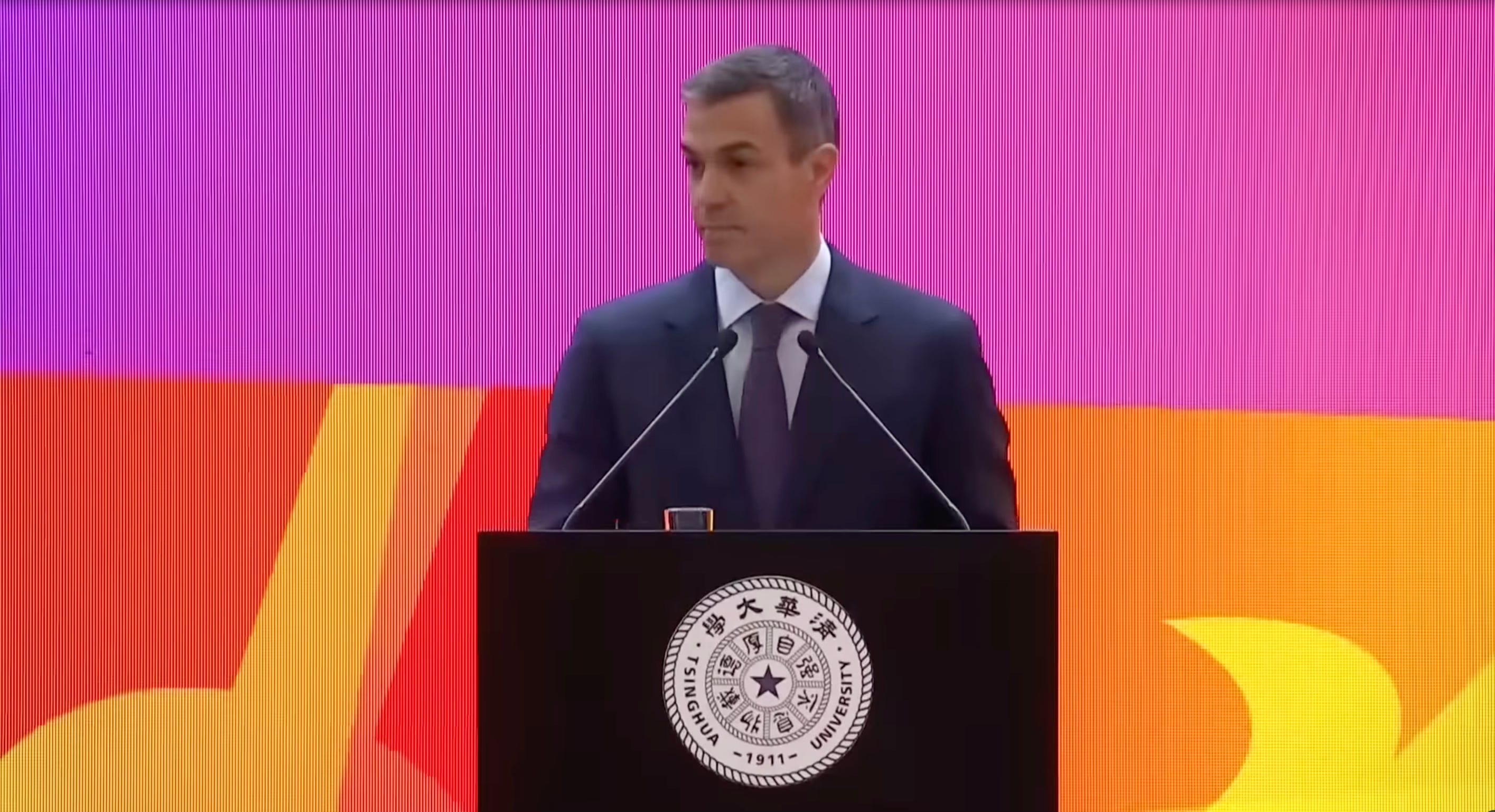
This week’s speech by Spain’s prime minister, Pedro Sánchez, at Tsinghua University in Beijing is infinitely more important than Carney’s in both describing the world as it is and charting a course toward peace and away from empire. I’ve seen almost no coverage of the speech in mainstream/Western media but it’s viral within global South media—a pattern that is itself revealing.
I’m including the full transcript below, but it’s worth highlighting just how tightly Sanchez’s remarks mirror ongoing Un-Diplomatic themes: positive-sum statecraft; economic inequality as a chief problem, alongside American militarism; multipolarity as a material reality that strategy must accommodate; and a diagnosis that what we are experiencing is not a hegemonic transition but rather a post-hegemonic world. An excerpt:
There are those who stubbornly cling to interpreting reality in zero-sum terms. To narrating the growth of some as a loss for the rest. Or to arguing that deepening certain relationships implies giving up others. But I believe this interpretation is not only wrong, it’s also dangerous because it is stagnant…what is happening today is not a transfer of hegemonies. It is a multiplication of poles. Not only of power, but also of prosperity. And this is great news for Europe. Because for the first time in contemporary history, progress is germinating simultaneously in many places around the world…
The multipolarity I’m describing isn’t a hypothesis. Nor is it wishful thinking. It’s already a reality. The new reality in which the world lives…And the Spanish government, and Spanish society as a whole, chooses to embrace it. It does so with realism, pragmatism, and, undoubtedly, a sense of responsibility.
…for a multipolar order to function [we need] greater involvement from major and middle powers in the management and provision of what academics call global public goods. These include, for example, combating climate change, security, defence, and fighting inequality.
My only critical comment is that multipolarity is a distribution of power, not a form of political ordering. What’s needed is a vision for political ordering that matches a multipolar moment. That vision is what Sanchez, contra Carney, offers in his speech. He seems to be dubbing it a “multipolar order,” which is fine but might make IR scholars’ heads explode.
If I disagree with anything here tonally, it’s that it’s stubbornly optimistic about a conjuncture whose defining forces are urgently negative.1 Entrenched oligarchy; repressive national security states; an AI bubble waiting to pop; a looming food and fuel crisis; a swelling global precariat; a lawless predatory former hegemon trying to hoard wealth and security at the world’s expense; nuclear war as a very real prospect that nobody has the time or mental clarity to take seriously.
It all gives reason for gloom…until political elites decide to confront them. And I guess that’s reason for optimism: All the darkness is happening within a context of multipolarity, and what we do—as people and governments—can address these manmade problems, if we can begin to think differently about them. There’s at least one prime minister out there who is.
Hey, friend! You might have noticed that I’m offering more of Un-Diplomatic without the paywall; I’m trying to keep as much as possible public. But to do that requires your help because Un-Diplomatic is entirely reader-supported. As we experiment with keeping our content paywall-free, please consider the less than $2 per week it takes to keep this critical analysis going.
Full text of the remarks by Spain Prime Minister Pedro Sánchez at Tsinghua University in Beijing, China, on April 13, 2026.
Respected President and Chancellor of Tsinghua University. Teachers. Students of Tsinghua University. Da jia hao.
It is a true honour to be in this temple of knowledge. A global benchmark for teaching and research. A place where human beings explore the limits of science and our imagination. And where we also find new ways to cooperate and thrive.
Let me begin by talking about precisely that: science and imagination. With a story that took place not far from here, more than four centuries ago.
In 1583, an Italian Jesuit named Matteo Ricci arrived in China. In his meagre luggage, he brought with him some books, an astrolabe, and a world map.
It was a European map. Correct in its proportions, highly advanced in its level of detail, but biased in its perspective. Because what it did was show the world as the West saw it: with Europe at the centre and Asia on its right edge. At the ends of the earth. Upon seeing it, the cartographers of the imperial court asked the Jesuit why China appeared at that extreme end of the map. And the European scholar understood for the first time that the Mediterranean Sea was the centre of his world, but not of others. Every world had its centre, and so Matteo Ricci completely redrew his map. This time, using the Pacific Ocean as its axis and encompassing the entire Eurasian continent within it.
More than 400 years have passed since then, more than 400 years. But unfortunately, there are still people who see the world as it appeared on that first map distorted by Ricci. I say distorted because I know the world wasn’t like that. I know that, in 1583, China was already a great power, representing a quarter of the global population and GDP. That it traded with half the planet. And that it led in science and technology in many fields.
I know this because, as the University President has rightly reminded us, Spain was also a great empire at that time. An empire that traded raw materials and manufactured goods with the Ming Dynasty through the Manila corridor. And that sailed the oceans with magnetic compasses, muskets, and stern rudders. In short, with technologies of Chinese origin.
Spain at that time was aware of China’s greatness. It knew that Beijing was not on the periphery of the world, but one of its centers.
And present-day Spain knows this too. It knows that China is rebuilding its greatness. That it is already the world’s leading exporter of goods and the fourth largest in services. That its industry and science are transforming the fight against global warming and also reducing poverty. And that, as such, China is destined to play a vital role in the future of the world.
That is why, dear president, professors, and teachers, it is a true honor for me to be able to address this centre of thought as a Spaniard and also as a European.
There are those who stubbornly cling to interpreting reality in zero-sum terms. To narrating the growth of some as a loss for the rest. Or to arguing that deepening certain relationships implies giving up others.
But I believe this interpretation is not only wrong, it’s also dangerous because it is stagnant. It makes us prisoners of the past and limits the possibilities the future offers. It makes the mistake of assuming that the world we see, the world of old maps, is the only possible world.
In my opinion, what is happening today is not a transfer of hegemonies. It is a multiplication of poles. Not only of power, but also of prosperity. And this is great news for Europe. Because for the first time in contemporary history, progress is germinating simultaneously in many places around the world. Places, moreover, that are not alike. That do not have the same culture. Nor the same political system or the same social conditions. And that do not need to ask anyone’s permission to grow. This is happening here in China, in Asia. But also on the African continent, and also in a region very close to Spain, such as Latin America.
The multipolarity I’m describing isn’t a hypothesis. Nor is it wishful thinking. It’s already a reality. The new reality in which the world lives. And therefore, we must accept it. We can’t change it. We can only choose between denying it or embracing it.
And the Spanish government, and Spanish society as a whole, chooses to embrace it. It does so with realism, pragmatism, and, undoubtedly, a sense of responsibility. But I would like to emphasize that we also do so with hope. Because we believe that if Spain, Europe, and China were able to prosper together in the past, there is no reason to think that we cannot do so again.
Obviously, it won’t be easy. We know that. There are also issues that divide us. Matters on which we don’t share the same opinion. Issues on which we compete. We also disagree. Points on which we won’t agree. Perhaps we’ll never agree.
But humanity progresses when we build on what unites us, not when we deepen the chasms that divide us. It is in this spirit that we work from Spain with many other countries, such as Brazil, India, South Africa, and Mexico. And, of course, also in our relations with China.
Spain’s proposal, therefore, is clear: to build a relationship based on mutual respect. A respect that allows us, among other things, to cooperate in all possible areas, to compete where necessary, and to manage our differences when they are unavoidable.
And Spain defends this same vision in every corner of the world and in every capital city. It does so in Madrid, our capital. In Brussels, the capital of Europe. And it does so in the rest of the world in the same way.
But for that vision to work, and for the world to prosper under the new multipolar order, we will need to develop three very important things in the coming months and years. Three elements that I would like to share with you all.
The first is that efficient multilateralism is not possible without strengthened multilateralism.
There are those who believe the multilateral system is dead. Unfortunately, we are seeing many cases in the media of crises and wars happening around the world. They think that, indeed, this multilateral world is dead, that it’s a thing of the past. And I want to say here that I profoundly disagree with that analysis. And I do so emphatically.
I believe that global governance instruments worked in the 20th century and are more necessary today than ever before. Rules and cross-border cooperation are the only tools that will allow humanity to overcome the climate emergency and the other challenges of this era.
I believe that a multipolar world needs a robust multilateral system, not to impose a single vision, but to transform the crucible of our perspectives into a strength for all humanity. Not to eliminate our differences, but to address them peacefully and respectfully.
Because multipolarity without rules leads to rivalry, and from rivalry only come wars, trade conflicts, and ruin.
That is why we in Spain are calling for a profound renewal of the multilateral architecture. It must be made more efficient, more transparent, more accountable, and also more inclusive and pluralistic.
Because if multilateralism is to remain useful, it must change and better reflect the balance of power and the sensitivities of today’s world. We cannot allow the past to stifle the future of multilateral organisations.
That is why I think the West should relinquish some of its representation quotas in favour of global stability and the confidence of countries in the south.
That is why I think we must transform the United Nations as soon as possible with a much stronger General Assembly, a more representative Security Council, and a more democratic decision-making system in which all regions truly have a voice and a vote, and middle powers can also play a unifying and harmonising role, which is what is expected of them.
And we in Spain also think it would be good if, for the first time in history, a woman led the United Nations Secretary-General.
The second point I would like to share with you all is that this new multipolar order must work, and it must do so with balanced and reciprocal trade relations. We cannot simply move from the imbalances of the 20th century to a different one in the 21st century.
And for that development to be stable, sustainable, and healthy, the multipolar order will need a more horizontal and fairer economy, in which there are no losing regions and winning regions, but truly global supply chains that create employment and wealth in all latitudes of the planet and share negative externalities proportionately.
Why do I say this? Because the European Union is doing its part. Whether it’s doing so quickly or slowly, and with difficulties, I certainly acknowledge that, is debatable, but it is doing its part.
In the last decade alone, we have signed trade agreements with 25 countries. We have increased our imports from the so-called Global South by 80% and created more than 25 million jobs annually outside our borders.
We need China to do the same. To open up so that Europe doesn’t have to close itself off. To help us correct the current trade deficit we have with them.
A deficit that is not balanced, that grew again by 18% last year alone, and that is unsustainable for our societies in the medium and long term. It is unsustainable because of the isolationist movements it fuels and the social grievances and suffering it causes. To give you an idea, our trade deficit with China now accounts for 74% of our country’s total deficit.
Therefore, I believe it is important that we correct this, cooperate, and jointly build a balanced, globalised economy that generates shared prosperity.
The third element we will need for a multipolar order to function is greater involvement from major and middle powers in the management and provision of what academics call global public goods. These include, for example, combating climate change, security, defence, and fighting inequality.
In short, emerging powers and established powers must provide these global public goods.
Size doesn’t just imply power; it also carries a responsibility that cannot be delegated. Because the major problems of the 21st century don’t need visas, they cross borders, and they affect us all.
I’m thinking, for example, of the fight against climate change or the challenges posed by global health, the development of responsible artificial intelligence, nuclear weapons control, the eradication of poverty, and, as I mentioned before, the safeguarding of global health. Funding in these latter areas has fallen by 23% in the last year alone – 23%.
Without the cooperation of the major powers, and of course China as well, these goals are not just difficult, they are simply unattainable. I know that China is fully aware of this and is doing a great deal, which I applaud. But I believe that China can do more. For example, by demanding, as it is doing, that international law be respected and that the conflicts in Lebanon, Iran, Gaza, the West Bank, and Ukraine cease. Because international law is the foundation of everything. By sharing its technology with the most disadvantaged countries, by forgiving debt, and by contributing to the financing of the system through participation in swap programs.
Naturally, Europe will also have to redouble its efforts, especially now that the United States has decided to withdraw from many of these fronts. Europe’s contribution is and will be essential. Therefore, I humbly ask that you also see this and not fall into the error of Matteo Ricci and be misled by maps.
Because Europe may seem small on a world map, but in reality, it’s quite the opposite. The facts are these: the European Union is currently the world’s largest trading bloc and the second largest economy. It is also the leading recipient of Foreign Direct Investment. It has the second most innovative ecosystem. It also boasts a highly skilled workforce. It is the second most productive economy on the planet and ranks first in terms of life satisfaction, social cohesion, and well-being.
I don’t mean to boast or hide our many shortcomings, which we certainly have. What I mean is that Europe is a key player in global stability, prosperity, and peace, and that without a united Europe – and therefore without fragmentation – there cannot be, nor will there be, a stable international order or a prosperous future for humanity, just as there cannot be without the participation of this great country, China. That is why we are called to understand each other and cooperate.
Dear teachers and students, I’ll conclude now. Four centuries after Matteo Ricci arrived in China and had to correct his map, humanity continues to search for the fairest perspective to see the world as it truly is, and not as dictated by power or prejudice.
A few days ago, four American astronauts traveled farther from Earth than any other human being has ever done. And from there, they perhaps gained that perspective. From there, they saw Earth as it truly is: a sphere without edges or boundaries.
A unique, unrepeatable blue sphere in the most hostile environment imaginable. We humans are the result of that miracle. Perhaps the only one in the universe. And therefore, it is our duty to understand each other and cooperate to ensure that this miracle continues to thrive.
Thank you very much. Xie xie.
For my most thorough analysis about multipolarity, world order, and World War III, see my speech to the NZ Fabian Society.


