

Washington policy reports rarely garner attention, but last month one blew up because it made heterodox recommendations about the US military position in Asia.
The author, Jennifer Kavanagh, is seen as a “right-restrainer,” and the report was published at Defense Priorities, a libertarian-leaning military think tank that has been intellectually aligned with JD Vance.1 Her recommendations amount to substantial military withdrawal from East Asia and consolidation in the Pacific Islands. That’s wholly incompatible with the liberal conception of primacy that the national security state and its technocrats have made common (Beltway) sense for two generations.2 Given the political auspices of the report, that might be the point.
I dedicated an episode of the pod to parsing each of the report’s recommendations by applying a three-part test:
Does it make any attempt to deal with the root causes of regional insecurity?
Does it treat military threats as symptoms of deeper causes of insecurity?
Does it adhere to a principle of least-harm?
You can check out the episode and its transcript for the full breakdown, but the thumbnail sketch is:
Do the recommendations make any attempt to deal with the root causes of regional insecurity? (NO)
Do the recommendations treat military threats as symptoms of deeper causes of insecurity? (for some recommendations YES, for some NO)
Do the recommendations adhere to a principle of least-harm? (NO, they redirect harm and risk generating further harm)
To be clear, I think this report is an improvement on the status quo in some ways; I even endorse some of its recommendations. But it’s not exactly a document that progressives or socialists should make their own. I would not put it in front of AOC, for example, and if for some reason she wanted to see it, I would have to include annotated commentary identifying where we dissent, what’s missing, and why the framing favors the national security state rather than the people.
Dead-End Imperialism
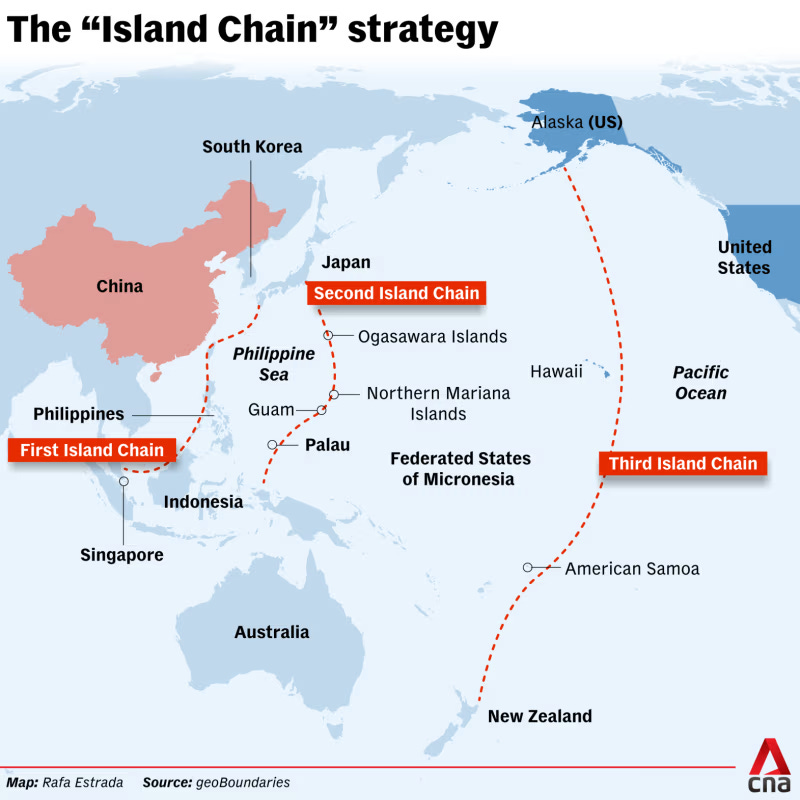
That leads me to my most profound reservation about the report: Its analysis is framed in terms of “island chains” stretching across the Pacific Ocean—a conceptual language that forecloses on any ability to generate meaningful Asian, US, or Pacific security. These “chains” are elite, militarist social facts of relatively recent vintage. Working within them as if they are eternal reference points for military control constitutes an antagonistic security trap that, as a byproduct, justifies the permanent subjugation of the Non-Sovereign Pacific.
The first, second, and third island chains exist as reference points in the imaginations of a small, transnational group of naval imperialists. As naval imperialists and war profiteers did with the American “preparedness” project paving the way to World War One, today’s imperialists have spent two decades spreading their gospel, especially on Capitol Hill and in ally governments. They are committed to securing geopolitical advantage by constructing invisible “walls at sea,” building up military power for the sake of enclosing the global commons and “winning” hypothetical future wars pregnant with apocalyptic potential (because they involve nuclear-armed states).
I was once a military strategist. I once treated the island chains as real lines worth preparing to fight for because the US navy uses them as artificial boundaries that it tries to secure in the event of war. If you secure the first island chain, the thinking went, you secure “defense in-depth,”3 which helps you win war and prevent the forced closure of sea lanes around China.
But defense in-depth does not have the military value it historically did because modern warfare is saturated with precision-guided weapons—drones, rockets, hypersonic missiles—that can cover vast distances in minutes. Accelerating the speed of war erases the advantages of controlling space. And any scenario where China decides to physically block American access to sea lanes is a fevered one where the US would’ve had to make a sequence of self-defeating choices to even be plausible.
More importantly, there is no prospect of making anyone more secure by taking a military warfighting concept and elevating it to being a vortex for scarce national resources. Should a dotted line that half-witting planners of Armageddon use in their vocation be allowed to swallow statecraft?
No reasonable person would answer yes. Yet, plenty of people in Washington do.
Confusing Militarism With Statecraft
I said something along these lines while scrolling through the sewage dump of social media. The best disagreeable response to my post was:
In Admiral Liu Huaqing's 1980's "Offshore Defense" (近海防御) doctrine, the island chains serve as geographical milestones for the PLA Navy's development—focusing initially on the First Island Chain before expanding capabilities out to the Second Island Chain and beyond.
I’d been told this factoid in my Pentagon days and it was funny to see it wielded now in defense of island-chain military reasoning. The question that it obscures is whether US statecraft should be drawn into the practice of military boundary-drawing in international waters to justify an eye-watering military buildup that leaves its rival needing to reciprocate, thereby leaving both sides less secure—a classic security dilemma.
The navalists will tell you, as I once would have, that if China is scheming to project power within or assert maritime control of a space whose perimeter is defined by the invisible lines, the US must do the same.
But 1) the US doesn’t have to choose negative reciprocity even if China does (what is actually worth killing for?) and 2) we cannot conflate PLA military planning with Chinese statecraft.
In 1954, the US Joint Chiefs of Staff Advance Study Group proposed to Eisenhower that the US consider “deliberately precipitating war with the USSR in the near future”—a moment when the Soviets already had nuclear weapons but not enough to establish mutually assured destruction. Members of the Joint Chiefs wanted preventive nuclear war. Maniacal.
Mercifully, the US did not follow the Chiefs’ advice. Does the fact that senior American military leadership advised something world-ending mean that governments should’ve treated the US like it was actually going to end the world? Great powers are going to have military strategists, and military strategists are going to fantasize about mass death in ways that require geographical benchmarks. That is all the island chains are—geographical benchmarks for imperialist designs.
Making a Pacific Powder Keg
But the most blinkered part of island-chain reasoning is the way that it redirects insecurity without concern for why insecurity existed to begin with; it distracts from the purpose of state power.
If the point of statecraft is not domination but reducing insecurity for Asia and the Pacific (and by extension for the US), then relocating US forces from the first-island chain to the second is a loser without some drastic accompanying changes (which I talk about in the podcast). If US military power falls back to a more technically defensible position in the second- or third-island chain (Oceania), that would simply shift the line of inter-imperial competition, substituting a new Pacific-Island powder keg (that still ensnares Japan) for an East Asian powder keg (that used to center on Japan).
Chinese officials have read Kavanagh’s report, and have a similar concern, which they package in the language of seeking “constructive strategic stability”: A stability grounded in great-power relations with a positive valence.4 Combining retrenchment with a detente-like relationship of collaboration is the only way to avoid a future that ends in great-power war.
The goal of statecraft should be to end great-power rivalry, not relocate it. As long as the capitalist world-system has declining growth prospects, the US refuses to relinquish its formal sphere of influence in the Pacific Islands, and US oligarchy requires a permanent war economy that plans for war with China, the main site of inter-imperial conflict simply moves but does not disappear.
Hey, friend! You might have noticed that I’m offering more of Un-Diplomatic without the paywall; I’m trying to keep as much as possible public. But to do that requires your help because Un-Diplomatic is entirely reader-supported. As we experiment with keeping our content paywall-free, please consider the less than $2 per week it takes to keep this critical analysis going.
Killing Empire, Abandoning Asia, or Rescuing the Asian Peace? A Radical Rethink of the US in Asia’s Balance of Power
Depending on when you discovered my writing or one of my shows, you may not know that I was a fairly prominent defense intellectual on the Asia beat who, over the course of Trump 1.0, got radicalized against imperialism.
Defense Priorities, despite not sharing my politics, does good work taken on its own terms.
I read her recommendations as still seeking a version of global primacy despite the call for retrenchment.
Defense in-depth is a nerdy way to talk about trading physical space for time in a conflict. If your enemy has to travel a further distance to reach you, it takes them longer and that gives you a chance to either preempt, counter, or limit the damage that happens when they reach you.
The way the Chinese talk about great-power relations happens to have a lot of convergence with our analysis in The Rivalry Peril.