

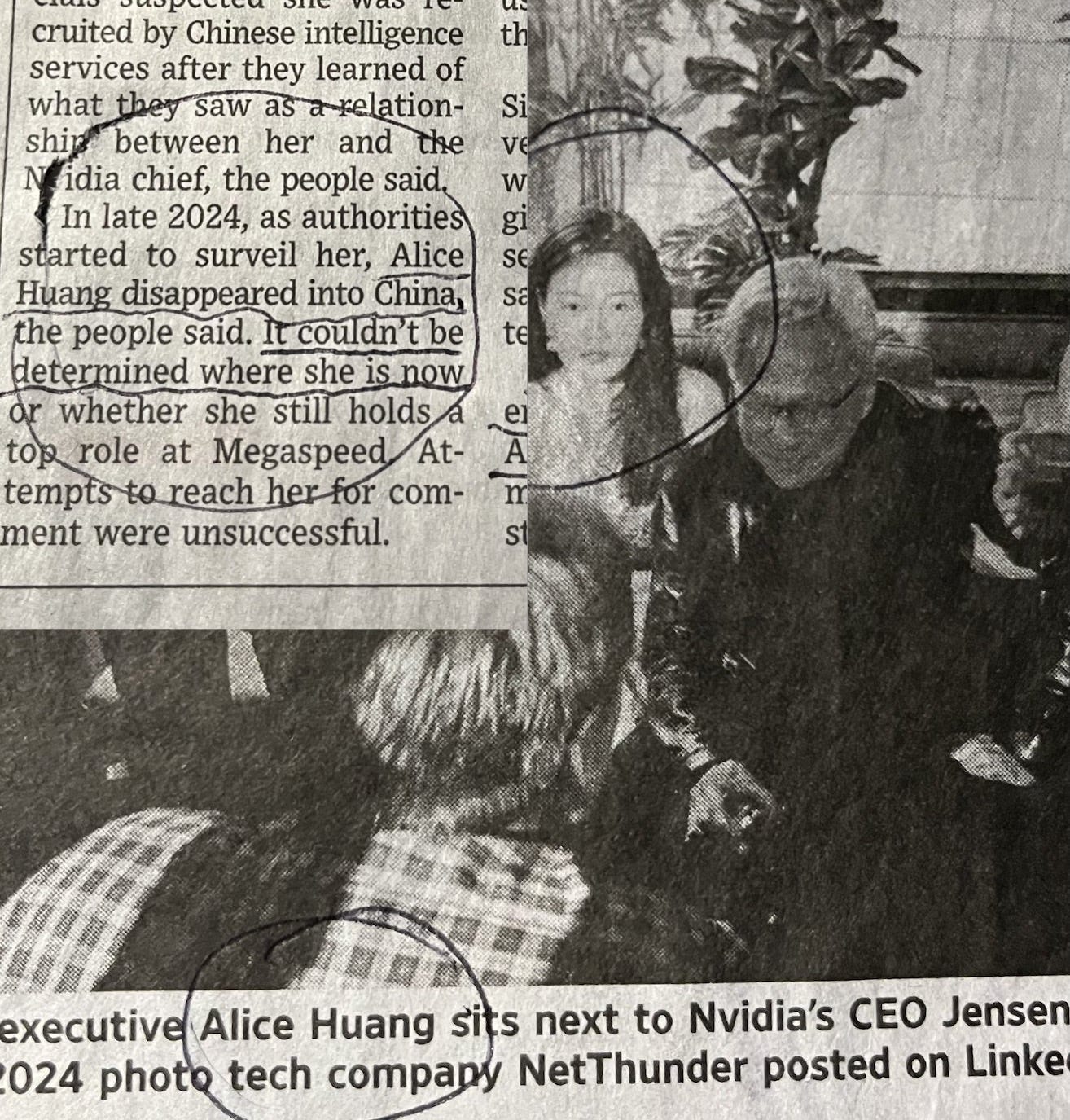
The following guest post comes from my friend Tobita Chow, one of the great China analysts in the progressive foreign policy space. In some ways, what he’s writing here is a logical extension of the insights in The Rivalry Peril but applied to the ongoing Nvidia scandal. As always, we must ask “Who benefits?” In this case from the substance and timing of the Jensen Huang scandal?
I mentioned last week that national security leaders / China hawks in both parties were hoping that the midterms might give them a chance to reassert themselves against a newly weakened Trump. This didn’t take long. This is what the Jensen Huang / alleged spy scandal is about.
Many in the national security state and the AI oligarchy are eager for a merger. The natsec leaders hope AI will yield the US an advantage in an arms race against China and possibly also that fabulously wealthy tech capitalists can provide a big new source of political support in the face of rising discontent with US national security elites. For AI oligarchs the natsec state is an essential source of protection against both rising populist opposition and competition from China; they want a bailout in the event the AI bubble crashes and the Pentagon could be the source.
More so than other top tech oligarchs, Jensen Huang has resisted this natsec-AI merger, and the formation of an exclusionary tech-industrial-military bloc entailed by it. This is because Huang’s position in the US-China AI race is contradictory: most of Nvidia’s profits come from the US AI giants, but (unlike most of the US tech sector) Nvidia also has the potential to earn major profits if it can access markets in China; they can even sell chips at massively inflated prices if given a bit of access. Thus Huang has lobbied Trump to weaken the chip export controls that block China from accessing the most advanced chips (and he is incentivized to do so even setting aside any supposed influence from an alleged spy). Trump, who is independently interested in maintaining warm relations with Xi Jinping, has been very responsive to Huang’s lobbying.
This has made national security leaders pissed at Huang for lobbying Trump. They are also pissed at Trump for listening to Huang, but this is part of a broader set of grievances that they have about how the Trump admin has been too soft on China. They see the spy story as an opportunity to attack both. Huang is a great target because there are so many reasons to want to see him taken down a notch, and the vast majority of people in the US who don’t care that much about US-China competition would probably be happy to see that.
So while there are lots of reasons to hate on Huang, this is the play right now: national security leaders aim to discipline Nvidia as a step towards the creation of the new tech-military-industrial complex that so many in Silicon Valley and DC yearn for. They hope that by purging Huang they can make the tech sector as a whole more subservient to the national security state, and they hope to push the Trump administration to be more hawkish against China. And a number of progressives who have bought into the current natsec-led freakout are inadvertently jumping onto this train.
It should be noted that the US chip ban, which the spy scandal is meant to strengthen, has been highly escalatory in the eyes of China’s leaders. It is the worst China policy to come out of the Biden administration (and I give them partial credit for getting some other things right regarding China). China’s leaders see advanced chips as key to future economic development and condemn the chip ban as a violation of China’s “right to development”. One official statement put this on a short list of red lines along with the “Taiwan question”. China reacted by developing its own export controls, modeled in part on the US chip controls, for example on rare earths, which are an existential threat to a number of US industries including arms manufacturers, further escalating tensions on the US side.
It’s probably true that Jensen Huang can’t be trusted with US national security. I would say the same about the rest of the AI oligarchs. The real solution is to build a new economy that isn’t dependent on AI as the sole source of growth, and an approach to US security that isn’t dependent on a US-China tech-driven arms race.
One last gripe about this news cycle: stories about female Chinese spies are a big hit among a lot of dudes in Silicon Valley and DC for transparently racist and sexist reasons and right now they are trading jokes based on the premise that every woman who looks Chinese wants to sleep with them to steal their secrets.
Hey, friend! You might have noticed that I’m offering more of Un-Diplomatic without the paywall; I’m trying to keep as much as possible public. But to do that requires your help because Un-Diplomatic is entirely reader-supported. As we experiment with keeping our content paywall-free, please consider the less than $2 per week it takes to keep this critical analysis going.
Why Anti-China Economics is Failing

Trump’s transition team is putting a knife in the crown jewel of Bidenomics. Specifically, they’re recommending rolling back emissions and fuel efficiency standards, eliminating the consumer EV tax credit, and producing more gas-powered vehicles, according to a new document obtained by
12 Readings for Seeing China Differently

I don’t consider myself a China hand (or any other kind of hand). But I pay a lot of attention to anything that I deem important, including China, and I’ve been dialed into the country one way or another my entire career.
This does strike me as a reasonable read onthe timing of the Huang news drop. Thought provoking post.
That said, a billionaire that subverts export controls by getting sweetheart exceptions will also be a problem for any progressive trade policy (more the straw buyers here, the chip lobbying i disagree with but is fair play politics albeit backed by capital).
Likewise, Bill LaPlante was pointing out on stage not so many years ago that tech bros didn't save Ukraine and Elon Musk has been highly criticized for his actions regarding Russia.
The chip export controls may be a good or bad idea. So in Grand Strategies of the Left terms, I support them, but I respect that Peacemaking school has a range of concerns. That said subjecting billionaires to a rule of law agenda is core to the progressive pragmatism school and I think should be a place for fairly wide agreement.
So I would suggest this is an area for finer parsing, what did Huang do that's objectively wrong? To what extent should the tech sector be subservient to larger democratic governance choices, right or wrong, and where should we keep room for some subversion (e.g. Jeffrey Sachs targeted by Orban). Export controls are admittedly an executive branch power, so maybe tgat's why the rule of law case is weaker here, but it is worth spelling out. I don't have perfect answers here, but I think it's worth thinking through some overarching principals on this specific topic while identifying places where the schools are just going to disagree.