Organic Intellectuals and Toilet-Paper Fire
“All you had to do was pay us enough to fucking live."
I never thought I would write about toilet paper but here I am.
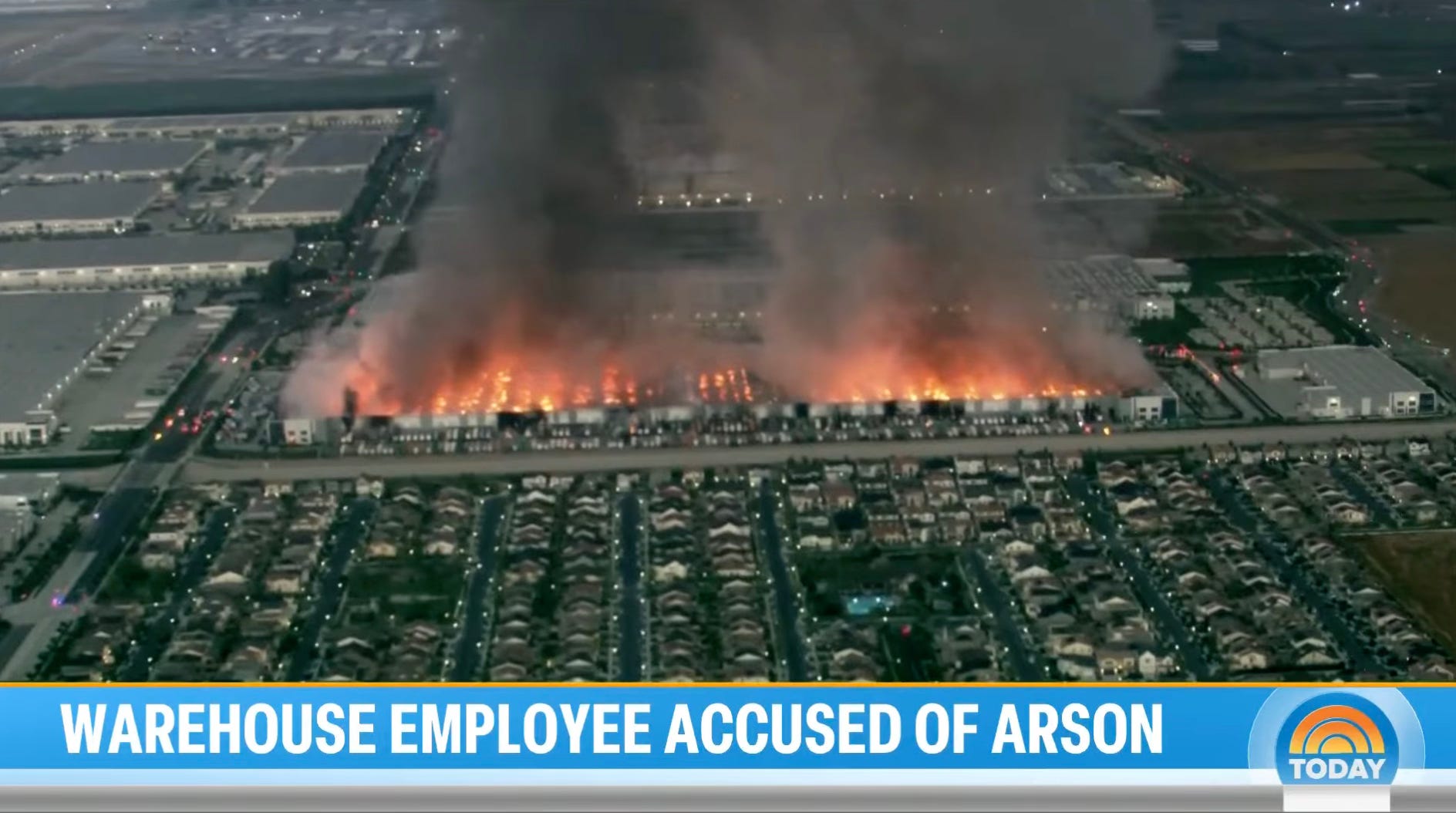
A 29-year old worker in an Ontario, California toilet-paper warehouse had his kettle of desperation finally boil over into a massive arson. A video posted online shows the accused arsonist holding up a lighter while the toilet-paper blaze spread, commenting:
You may not pay us enough to fucking live, but these bitches are dirt cheap. There goes your inventory. All you had to do was pay us enough to live.
Joker-core is merely the wounded mutation of what could’ve been a righteous rebellion of the people against the ruling class, and still might be. Nobody was hurt but the massive (1.2 million square foot) facility burned to the ground. The warehouse was supposedly worth $156 million and the damage wrought has been estimated at $500 million. His slogan is also proliferating:
Violence Without Harm, or Alienation?
The arson is being portrayed in the news as a random act by a disgruntled employee, nothing more. And the national security state is likely to treat it as an act of “terrorism,” a term that has actually lost all meaning except that it indicates the state will use extreme anti-democratic measures against the offending party. But this is a smoke signal that reveals a mystified aspect of our conjuncture.
We’re made to believe that the world just is what it is. If you suffer anything, it’s not because of government choices or people with power; it’s because of weird personal shit or bad luck. They tell you that unions are weak because America is anti-union, not because oligarchs have collaborated with politicians since the 1970s to use state power and legislation to destroy the labor movement. They tell you there is no alternative.
But this is what makes the arson a smoke signal: It’s of a category with Luigi Mangione’s assassination of the UnitedHealthcare CEO and the Molotov cocktail that made its way to Sam Altman’s house recently.
Workers have leverage against capital—they can shut shit down in more ways than one! This act of arson—which, based on its popularity online will surely inspire similar types of direct action—harkens back to a militant strategy of “violence without harm” promoted by Bhagat Singh in the fight for Indian independence. The Weather Underground during the Cold War didn’t use that phrase but employed similar tactics, destroying buildings but not taking lives.1
But the arson was not an act of strategy; it was a cry of desperation. In a different version of the multiverse, the arsonist would’ve had a union that was strong enough to secure his living wage and a government that ensured he didn’t have to worry about getting sick or having a roof over his head. The source of pain leading to arson would simply not be there. But this version of the multiverse isolates man and woman. Without association, we have no collective power. Or at least we’re made to feel that way.
But if the system of exploitation keeps ratcheting its squeeze on the wages and working conditions of labor for the sake of maximizing profit, eventually you hit a breaking point. You can only sheer a sheep so deep before you’re actually skinning it. I’m talking about capitalists cannibalizing the very labor that produces the surplus value that keeps capitalism going. When you’re cutting into muscle, you’re going to get spasmodic reactions.
Immiseration in the Data
The toilet paper warehouse was owned by a firm called Kimberly-Clark, which produces toilet paper, Huggies, Kleenex, Q-Tips, Depends, and on and on. Last November, Kimberley-Clark committed $40 billion to acquire Kenvue, a similar health-products company, promising in the same press statement to reduce its 22k-person workforce by 3.5%.
Last month, workers filed a case with the National Labor Relations Board accusing Kimberly-Clark of refusing to bargain with unions. In 2018, a global trade union meeting publicly condemned Kimberley-Clark for “heavy-handed tactics,” cutting worker jobs, and closing plants without prior consultation. Since 2000, the company has had to pay $81 million in penalties for labor-law violations.
My point is that the company generates huge profits from low-margin products, it has a history of immiserating the labor that produces its surpluses, and its current strategy sees it simultaneously 1) refusing to bargain with workers, 2) cutting jobs, and 3) nevertheless mobilizing $40 billion to acquire another profit center for its business.
This is all normal capitalism shit! But it’s not happening in a vacuum. Ever heard of the K-shaped economy? Since the dawning of the neoliberal era in the 1970s, capital’s share of national income has grown at the expense of labor’s share of national income. Many scholars have pronounced neoliberalism a dead doctrine since 2020, but the share of income going to workers is at its lowest in 50+ years:
There’s also been a “k-shaped recovery” from the Great Recession of the Obama years. Most workers have lived precariously since ’08 but the wealthiest households have both benefited most from state interventions (eg, Inflation Reduction Act), and now account for most consumption buoying the economy, leading to a reality that America does not have one economy but two:
Like George Carlin said, “It’s a big club and you ain’t in it!”
Organic Intellectuals Wanted
I know what it is to collapse into delirium from overwork. To become dead-eyed just so that you can get through your shift. To sleepwalk through a life that becomes unreal, where everything gets fuzzy around the edges and people almost stop being people. To feel the existential claustrophobia that sets in when you realize poverty has robbed you of any future at all. If you don’t understand that, I don’t know if you can understand the severity of the crisis bearing down on us all.
The toilet-paper arson is a byproduct of the oligarchy reflected in the data. And yet the policy wonks who make and interpret k-shaped data charts are not trained to grasp the pain of living on the losing end of the data; it’s all abstractions and logic puzzles and, somehow, “great-power competition.” And most wonks do not come from social circumstances that would have exposed them to what it’s like to eat shit in the real economy anyway.
Public policy—especially foreign policy—is sterile and its makers are aloof of the active harm it’s doing to growing numbers of Americans. The problem is reaching absurd levels under Trump but was already a growing global crisis of the precariat under Biden and Obama too.
One aspect of the problem, or at least one aspect of why precarity is so difficult to fix, is that policy intellectuals are traditional intellectuals of the status quo. They are churned out by elite finishing schools that reproduce the social order that sustains a worsening oligarchy at home and empire abroad. Such people, even if they have good intentions, don’t know the taste of immiseration and probably think they don’t need to in order to do their jobs.
This is why the working class needs what Gramsci called “organic intellectuals” of its own—people who can articulate the interests of the masses, who can explain how and why the people share an objective solidarity of position as exploited, surplus, and repressed labor. Organic intellectuals must be by and for the class whose interests they represent. They must know the taste of pain that makes the working class more unified in its interests than workers themselves might realize. It is the role of the organic intellectual to express into being what makes it possible to even speak of a working class. And in bringing about the consciousness of the worker in a shared project, it makes collective action possible. And collective action is the opposite of random acts of arson and assassination.
Our moment is calling out for organic intellectuals of the working class. A flaming warehouse full of toilet paper is the demand signal.
Hey, friend! You might have noticed that I’m offering more of Un-Diplomatic without the paywall; I’m trying to keep as much as possible public. But to do that requires your help because Un-Diplomatic is entirely reader-supported. As we experiment with keeping our content paywall-free, please consider the less than $2 per week it takes to keep this critical analysis going.
I’m skeptical of “violence without harm” as a tactic in strategies of liberation or class conflict. The modern national security state, and the language of “terrorism” that justifies state repression, has historically treated “violence without harm” as the same as mass slaughter.


