Perils of Liberal Anti-Imperialism: A Kat Abughazaleh Story
A congressional candidate in Illinois has stirred up a huge controversy in my world. Kat Abughazaleh is a progressive Gen Z YouTuber and journalist. I had been quietly rooting for her through most of the campaign, having seen her stake out very populist positions.
Kat has been most visible on representational and symbolic issues (public performances, identity-politics), but she talks like an antifascist, supports a wealth tax, and has called to abolish ICE, suspend military aid to Israel, demand a ceasefire in Gaza, and fight for Palestinian sovereignty.
All these positions are populist and go together logically. They’re also why she’s done surprisingly well in Illinois, where she’s second in polling and within single digits of the lead, held by Daniel Biss, a bland democrat who was initially thought to win the seat unopposed.
But something about Kat’s candidacy left me uneasy, even though I couldn’t quite put my finger on it. Eventually, I realized she had been very quiet about foreign policy and American militarism outside of her sound positions on Gaza and ICE specifically.1 She shows up in my feeds a lot, mostly in ICE protests, but I had a nagging feeling that maybe her positions were an assemblage of what’s popular on the left, not necessarily policies that follow from a diagnosis or clearly articulated worldview.
Admittedly, most politicians are mere assemblages of what they can get away with, not representatives of a coherent philosophy. But that’s what makes left populists different: Their politics are defined not by the vibes they cultivate but the problems they diagnose and the solutions they propose. Graham Platner—an anti-imperialist, anti-fascist, anti-oligarch, Generation GWOT vet—is the best example of this; his diagnosis and prescriptions are the very reason he’s about to be Maine’s next US senator. But there are others, from Zohran Mamdani in New York to Abdul El-Sayed and William Lawrence in Michigan to Mark Moran in Virginia:
I had placed Kat in this group. And while that may or may not have been appropriate (judge for yourself after reading what follows), Kat’s recent foreign policy controversies highlight some problems with what you might call liberal anti-imperialism.
Militarist Controversies
Kat’s foreign policy adviser on the campaign—who recently resigned—was someone with quite hawkish (and some say rabidly pro-Israel) views. Drop Site News obtained an email from that adviser to a progressive foreign policy activist in which the adviser described Kat as “firmly an interventionist” who believes “the world is better off when America takes a leading role” and “won’t stop until Russia is made to pay for its crimes.” He goes on to say about Kat’s foreign policy:
an obligation to support pro-democracy movements around the world, from Iran to Venezuela…Kat wholly supports the National Endowment for Democracy, as well as its affiliated organizations (NDI, IRI, and the AFL-CIO’s Solidarity Center)…hold the line [on Russia]…funding the Ukrainian war effort to the hilt…[including] air, naval, and ground assets…She supports the seizure and redistribution of Russian assets in Europe and the United States, for the purpose of financing the war effort.
And that:
on Taiwan she would amend the Taiwan Relations Act by “dropping our strategic ambiguity” and make clear the U.S. would counter Chinese aggression “with force,” arguing the region now requires “a firmer hand.”
Where to begin…
I guess first is the controversy about the adviser himself, Ben Mermel. The anti-imperialist left freaked out when this information leaked—so much so that the campaign had to immediately remove Mermel. As it happens, I’m friends with a guy who went to school with Mermel, and he relayed to me:
…he always described himself as a literal out and out neocon, to the point where I had a colleague run into him at a party and he said the same thing to him like a year and a half ago. I think my last interaction with him was him arguing why annexing the West Bank shouldn’t be illegal under international law…He graduated from high school in 2019 and clearly speaks only in Beltway hawk pablum. Just the shadest sort of careerist hawk operator…this is a dude who basically idolizes Chuck Schumer of all people.
I had never heard of this kid before, but the above testimony vibes with some of the characterizations circulating on social media.
So you can knock Kat’s campaign for inadequately vetting this guy whom the campaign now disavows.
But the next day, Kat issued a short video trying to clarify where she stands on foreign policy, saying, in part:
The email describes me as an interventionist, which is not true…I’ve never described myself as an interventionist. I am antiwar, anti-genocide, anti-imperialism, and anti-intervention…I have always believed and said that we should lead with diplomacy and humane foreign policy.
I firmly denounce Trump’s moves to militarily intervene in Venezuela, Canada, Greenland, Iran and elsewhere…military intervention is an absolute last resort…we shouldn’t force regime change…We need humane foreign policy. This means public diplomacy, the reinstitution and expansion of USAID, and reparations for the global South, particularly focused on renewable energy and infrastructure. Now my leading principle in international affairs is the right to self-determination.
This much of her statement is inoffensive, even admirable. To be sure, there is no “theory” here, no argument; the rhetoric of self-determination is indeterminate as a guide for what to do in most instances. Nevertheless, if the statement only went this far, I would’ve said there’s work to be done here but that Kat has the makings of a sound progressive/socialist foreign policy advocate.
But the controversy grew rather than diminished on Ukraine and Taiwan, where she said:
When it comes to Ukraine, I believe we should continue arming the Ukrainian people. Wars of aggression are illegal. Russia’s invasion of Ukraine is a war of aggression. That is an international crime. Putin is a despot and he will not stop with Ukraine.
This is a stock liberal/NAFO answer on Ukraine. No endgame, no emphasis on diplomacy or accommodation or ceasefire or even the limits of military aid (eg, types of weapons); only personal convictions that Putin is Hitler. Personally, I think this statement is fine except for her last sentence; she’s not in a position to make predictions about what Putin will or won’t do, and the fact that she thinks she can make such a claim indicates she’s imbibed the liberal version of anti-imperialism—more about that below.
Where I took issue with her updated statement is on China:
Politically, we should adhere to the One China Policy. But we should also eliminate strategic ambiguity when it comes to aiding Taiwan so that way it can defend itself without putting US boots on Taiwanese soil…we need to reinvest in those diplomatic solutions, not just between China and Taiwan but the US and China as well. We live in a globalised world, we need to work toward being partners with China, in trade and innovation. But that’s only possible through diplomatic solutions and international law.
This shows a lack of expertise, which is why politicians have advisers. Strategic ambiguity is about the commitment to defend Taiwan militarily, not about providing aid to Taiwan. The Taiwan Relations Act codifies in law a requirement for the US to provide military assistance to Taiwan; there is no ambiguity about that. So what she’s saying here makes no sense. Either she needs some progressive foreign policy experts in her circle (I know many for anyone seeking such expertise) so that she doesn’t contradict herself, or she really does want to end strategic ambiguity on China and that is basically the uber-hawk position: Even most Bidenistas wanted to retain strategic ambiguity.
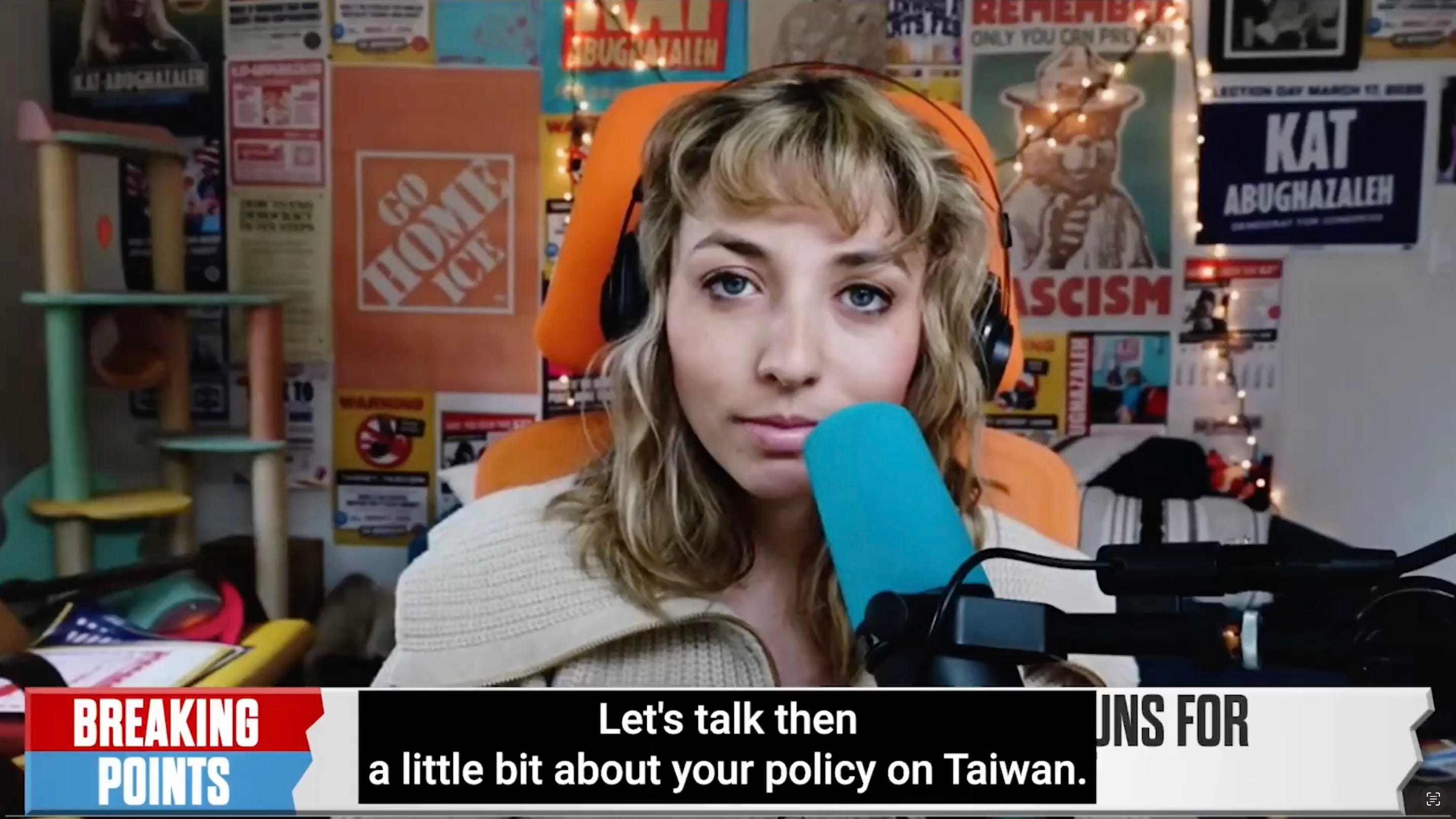
But last Tuesday, Kat clarified herself again with an appearance on Breaking Points, saying in part:
Any sort of military aid to Taiwan is an absolute last resort. We need to be reinvesting into diplomacy between Taiwan and China. If the Taiwanese people pass a referendum for reunification with China, I’m supportive of that. That is their choice. But invasion is where we draw the line.
The interviewer sought clarification:
does military aid [to Taiwan] mean shipping weapons or actively participating in and assisting in the defense [of Taiwan]?
Kat said:
Shipping weapons. We should not have US troops deployed on Taiwanese soil.
Is Kat an Anti-Militarist?
I thought Kat mostly redeemed herself in this final interview, but I’ve seen some pretty searing critiques of it from parts of the left. There were eyebrow-raising moments for sure—she said some bullshit, for example, about how “appeasement doesn’t work” (which is often untrue and merely a red-flag statement of ideology). But she reiterated her commitment to international law (good), self-determination (good), human rights (good), AND opposition to the military-industrial complex and the need to cut the military budget (very good).
On top of all of this, Kat was pressed about whether to fight China militarily if it invaded Taiwan—she effectively said no. No troops. That’s a rational position to take and it’s not the hawk position. So ultimately, I think she misunderstood what “strategic ambiguity” meant in the China context. She could’ve prevented all this trouble simply by having some progressive foreign policy cadre in her camp.
Kat’s politics are evolving. She grew up in a Reagan-loving family. Backed Rubio in 2016, then Buttigieg in 2020. Now she wishes she had been a Bernie bro all along. But I of all people can appreciate that we are always learning and growing. I also understand the skepticism of anyone with socialist or anti-imperialist convictions evaluating a Johnny-come-lately convert.
Here’s my assessment.
She’s both capable of growing and being co-opted; much will depend on the types of advisers she surrounds herself with and how popular populism becomes. She does not appear to be a class warrior (yet), has said little about worker power relative to the owners of capital, and is not a member of DSA. Rather, Kat believes in the American liberal creed of equality and justice for all, and she wants everyone to live up to that. My commitment to the same is what put me on the path to intellectual radicalization. In our fallen world, an authentic commitment to liberalism will force you to become a radical. Class consciousness is where you end up, not where you start.
Anti-Militarism, Anti-Imperialism, and “Anti-Imperialism”
In the meantime, there are signs in Kat’s statements that she’s influenced by the liberal version of anti-imperialism. This leads her to atomize Russian aggression as if Putin-as-bad-guy was a sufficient explanation for the war. She says nothing about root causes or using a green transition to undercut Putin’s war economy. Send missiles to Ukraine but nothing about sovereign debt forgiveness or the promise of an Independent post-NATO Europe for stabilizing European relations with Russia. And silence about the curdling of Ukraine’s government into a despotism all its own because of having to endure a seemingly unending war.
Liberal anti-imperialism is hypocrisy; it amplifies the imperialism of foreign despots but not American ones, and it fails to see the despotism of US allies. Liberal anti-imperialism treats imperialism by foes as a permission slip for Western militarism, misapplying a World War II analogy to every moment.
As I explain in Grand Strategies of the Left, two things separate progressive from liberal foreign policy: a commitment to antimilitarism and a belief that foreign policy ought to deal with the root causes of military insecurity, which are political and economic inequities of various sorts. Kat is stronger on vocalizing the former (anti-militarism) than the latter (root causes of insecurity) and that risks signing onto policies that could box an antimilitarist into military solutionism.
The distinction between progressive and liberal on foreign policy carries into claims about imperialism. For left anti-imperialists—democratic socialists—empire is a political form that arises in response to a crisis of capitalism.2 It’s a label for a diagnosis whose prescription requires, among other things, rebalancing power in favor of workers domestically while resisting nationalist wars abroad that sacrifice those very same workers. For liberal anti-imperialists, imperialism borders on an epithet, a synonym for evil and at best a description (not diagnosis) of relations of violent exploitation and conquest.
A lot of mainstream analysts take issue with a version of leftist anti-imperialism that aligns with China or [insert America’s enemies] as a force against American hegemony. They are always on the lookout for “tankie”-ism. Fair enough, I went through a phase of taking out my anguish on tankies too. But tankies are pretty harmless considering that they never have power over policy while liberal anti-imperialists often do; that makes the latter far more pernicious than the former.
Maybe none of this matters. Kat might not win the congressional primary after all.3 But liberal anti-imperialism is becoming the default position of the Democratic Party, and that means we need to be smart enough to critique militarism when we see it, regardless of its garb. Because without peace among nations, our various struggles for democracy simply won’t matter.
Hey, friend! You might have noticed that I’m offering more of Un-Diplomatic without the paywall; I’m trying to keep as much as possible public. But to do that requires your help because Un-Diplomatic is entirely reader-supported. As we experiment with keeping our content paywall-free, please consider the less than $2 per week it takes to keep this critical analysis going.
As the brilliant readers of this newsletter know, my theory of everything comes down to checking American militarism and imperialism. No peace, no democracy. Everything that agitates against peace agitates against democracy and equality. Every populist who isn’t fake believes the same.
I don’t want to weigh down my own prose too much with caveats so I’m footnoting this, but just to say that there is also a view on the left that empire is a mode of exploitation on which capitalism has always relied. Political hierarchy that defines the relations of unequal hierarchy and exchange. That means anti-imperialism is inherently anti-capitalism.
Accounting for everything, Kat would be much better than the leading candidate. Bushra Amiwala would also be great but she has lower polling numbers.


