

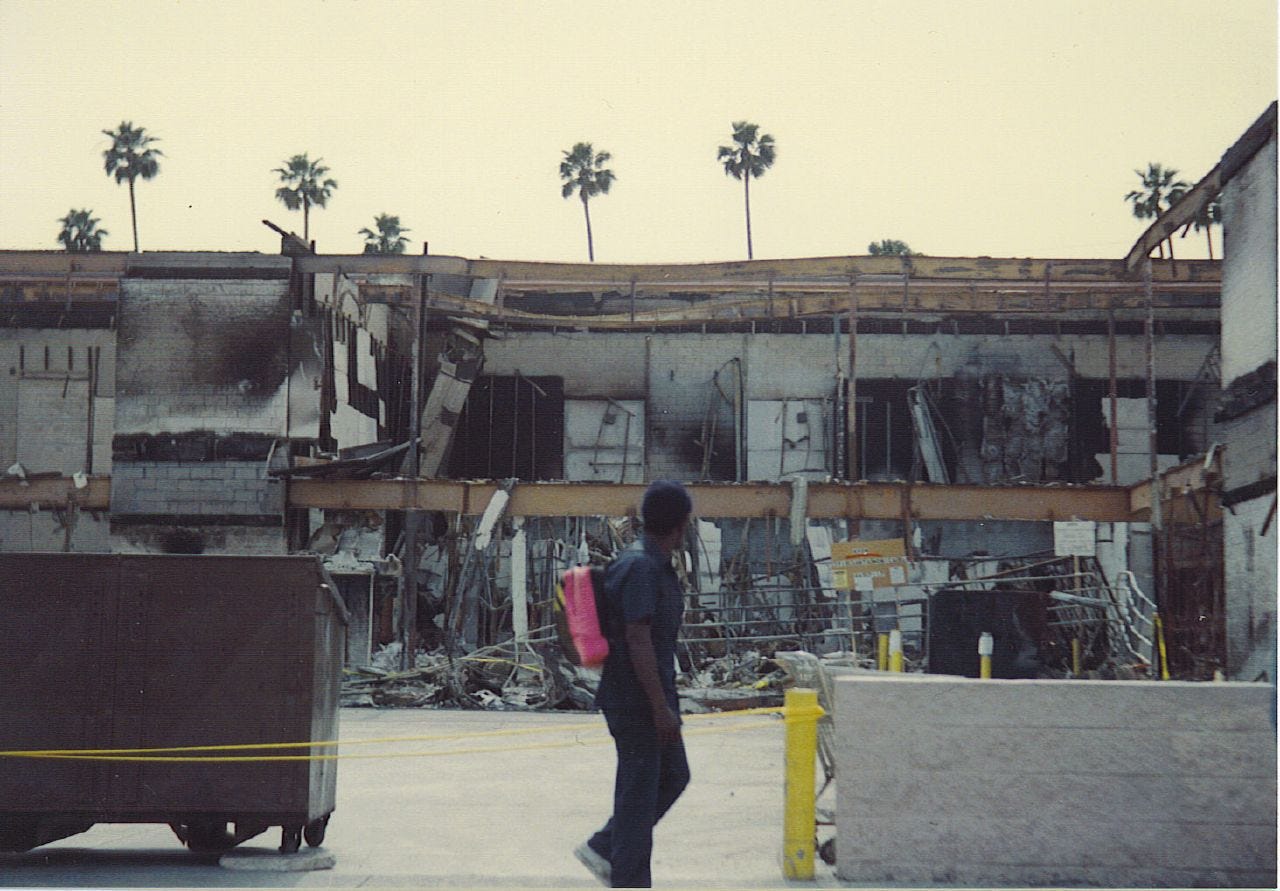
My first political memory was as a kid watching the LA riots on the news.
I wouldn’t say I enjoyed seeing the burning chaos, but its vivid stakes awakened rather than horrified me. What could have unleashed property destruction, looting, and the occasional casualty in a city I’d spent part of my childhood in? Why did people suddenly seize control of their neighborhoods, and why did it have to take the form of ransacking them? And the most jarring question of all: How could people make the police scared to do their job?
I would find most of my answers a couple years later, when I discovered hip-hop. The kind of root-cause thinking that I champion in my work today really started with these riots and the accounts I heard of them laid over a righteous boom-bap. Ice Cube’s “We Had to Tear This Mothafucka Up.” Tupac’s “To Live and Die in L.A.” Damn near every song on Dr. Dre’s The Chronic.
The acquittal of the police who beat Rodney King on camera was the spark that spread into a fire. But as Mike Davis wrote in The Nation at the time, the riot “was as much about empty bellies and broken hearts as it was about police batons and Rodney King.” Certain conditions have to be in place for a spark to cause a wildfire. A single moment of brutality against one man has to represent a larger travesty embodied in the population. As a member of the Bloods from Inglewood told it:
Rodney King? Shit, my homies be beat like dogs by the police every day. This riot is about all the homeboys murdered by the police, about the little sister killed by the Koreans, about twenty-seven years of oppression. Rodney King just the trigger.
But race is the modality through which class is lived, as Stuart Hall tells us. Causes come in layers.
If you go one layer deeper than the racialized violence that people rebel against, the riot, according to Joshua Clover, is always a surplus population responding to its abjectness, demanding “to set the price of market goods [featuring] participants with no necessary kinship but their dispossession.” Looting, Clover notes, sets the price for goods at zero. That makes the riot an outlaw companion to the more respectable strike, which is workers (not surplus populations) demanding to set the price of labor power. Riot is a problem of circulation; strikes are a problem of production.
Cut to an incipient student-led revolution in France, playing out right now, as you read this.
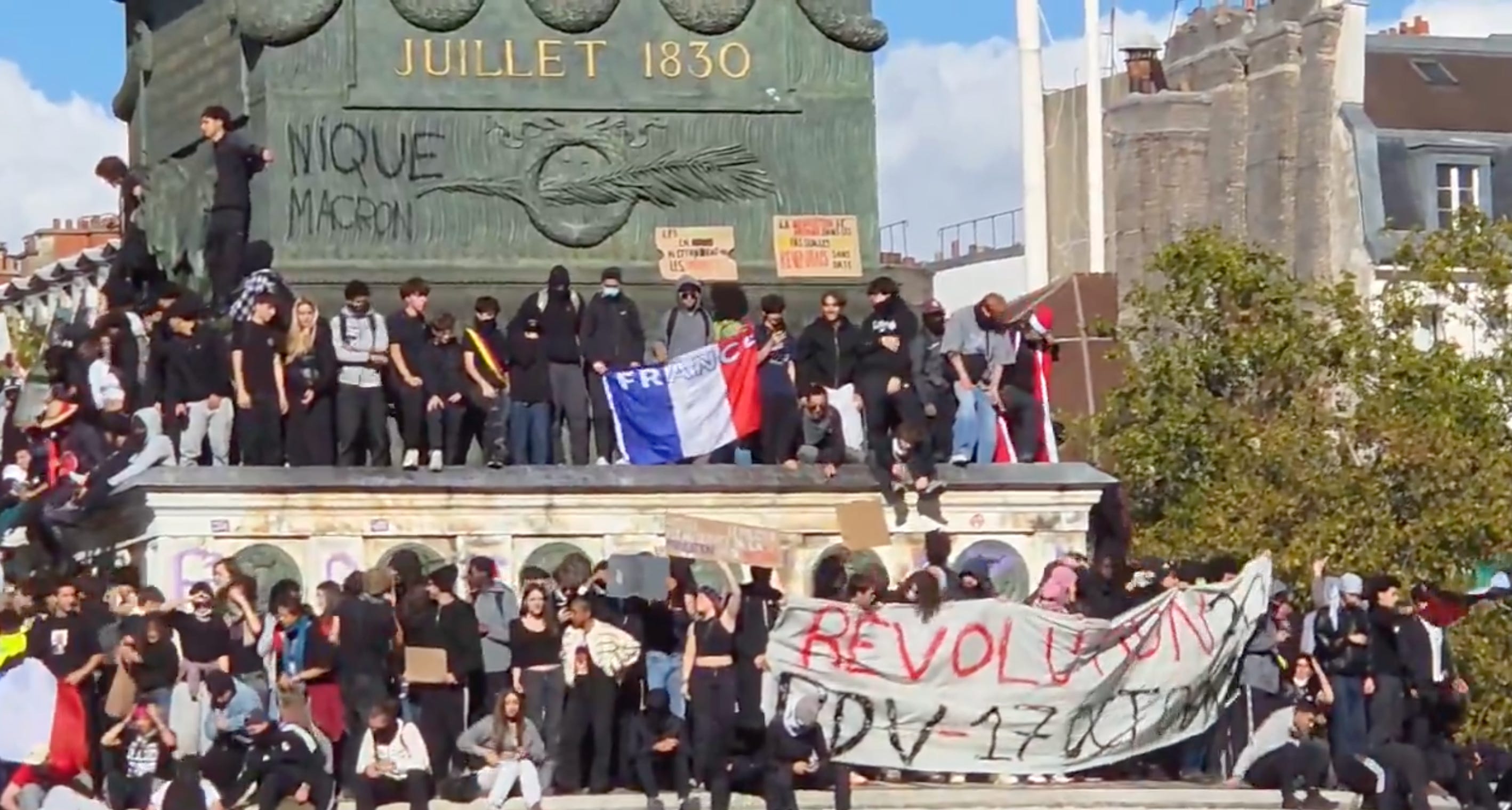
The BBC and New Yorker will tell you that the students want better conditions for their education, more teachers. That’s not wrong, but it amounts to a surface level take that justifies a pathetic policy response—France should hire a few hundred more teachers as a sop to the riotous students.
But the shortfall of teachers in the classrooms of poorer schools is simply the Rodney Kindling. The leaders of the French riots admit to deeper causes:
The “gangs” [bandes] of students from working-class neighborhoods constitute the actual driving force both within and against the current youth movement. In a sense, this force is less a part of the student movement than it is a continuation of the Nahel1 revolt. It has neither demands nor representatives; it does not conform to the codes of the Left and rejects bourgeois politeness. It wants revenge…the left aligns itself with the other political forces in their efforts to restore peace.…Unlike the left, we have neither flags to wave, nor a tempo to set, nor lessons to teach.
Riots are not a left-right thing.
You might have heard that subscriptions to newsletters have fallen off a cliff. It’s true, and it’s making me rethink the economics of this entire project. I really don’t want to bring back the paywall, and I also don’t want to abandon the project altogether. So if you value Un-Diplomatic and have the means to keep it going, please consider the less than $2 per week that it takes. And if you can’t, please consider sharing the post with others.
This riot, like the LA riots, is a riot of refusal—a refusal of the abject conditions of the have-nots, the policed, the socially marginal. And so the riot’s vanguard may be its racialized surplus population—inevitably the most oppressed in society—but the ranks of the precariat swell by the day. Growing numbers of people face grim prospects for health, employment, affordability, and community security.
That energy engorges the riot, gives it sympathy and strength. And if no policy can remedy what makes the riot potent in the first place, then no policy will pacify.
The riot is an early stage of revolution. The riot puts the powerful on the back foot. The riot forces the comfortable in a crouched corner where they must choose between reflecting on how liberalism led to this or quietly hoping the state will repress the masses by any means necessary so that this nastiness goes away. France’s riot is in full swing.
How far will the student revolution go? Probably not much farther. Why not? Because it amounts to a war of maneuver.
Antonio Gramsci used military metaphors to describe strategies of political struggle. He distinguished wars of maneuver from wars of position. Scholars have fruitlessly debated the meaning and applicability of these two forms of war making in Gramscian thought.
The key distinction is that wars of position strategize toward favorable structures; they generate advantages at the moment of clashing forces. An arms buildup is a war of position that relates to the battlefield campaign as a war of maneuver. Protests, riots, and forms of direct action are wars of maneuver too.
Anyone who’s spent even the slightest amount of time in left spaces has heard the cliche about what is to be done in answer of every problem: Organize! It’s funny because it’s true. But it’s true because organizing—in its thousand meanings—always aims at generating structural or positional advantages, so that when the time comes for a campaign, the deck is stacked favorably. Organizing is a way of waging a war of position. The war of maneuver succeeds because successful wars of position preceded them.
And that’s why the French riots are unlikely to go much farther. It’s the same reason anti-ICE protests have reached their limit; the same reason the #NoKings protests did not metasticize into a more militant movement.
Oligarchs are either winning or have already won the war of position in so many ways. Letting them kill union density took away civil society’s greatest leverage. The repressive capacity of modern national security states serves those with power and in oligarchies, that’s owners of capital.
Without effective wars of position preceding wars of maneuver, mass movements of refusal signal so much revolutionary energy but do so from a position of deep, deep structural disadvantage. And so what will eventually meet the student or the anti-ICE protestor or the anti-monarchist or the peace activist is the baton and the rubber bullet and the police raid.
The importance of understanding the riot as a politics of refusal, though, is to know that the repressive power of the state will neither cow nor deter the next riot. Or the next. You don’t have to win liberation for humanity. You have to refuse defeat.
“Nahel” refers to the police murder of Nahel Mazouk, a 17-year old French Algerian in June 2023, which sparked within France riots akin to the George Floyd uprisings—riots that were put down but whose sources were never addressed.