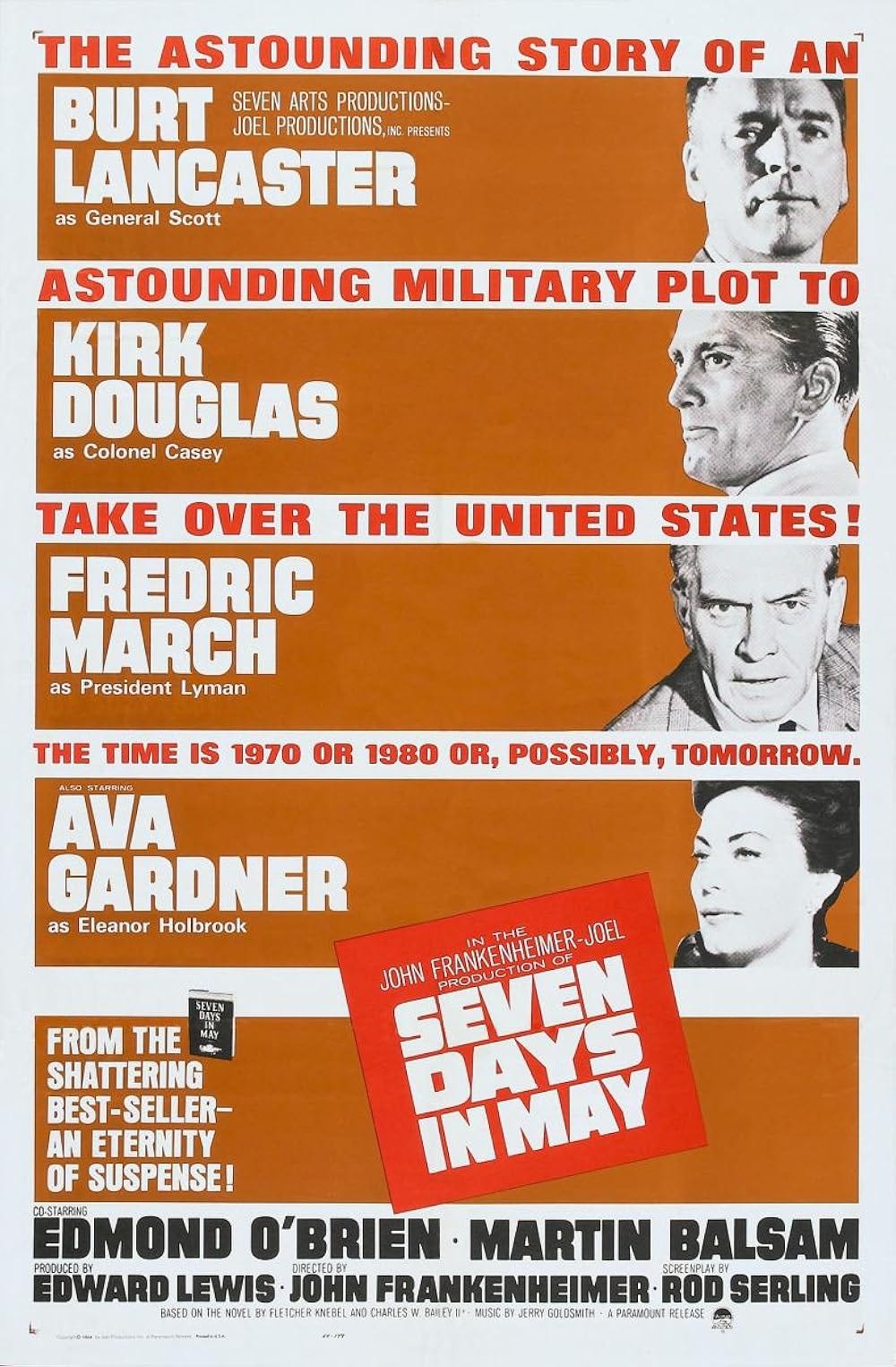
Seven Days in May (1964) w/ Paul Adlerstein
On my other show, The Bang-Bang Podcast, we just released an episode on Seven Days in May, a shockingly entertaining and critical film that imagines a four-star general nearly toppling an American president. The slow-ish pacing reflects its era, but I found it gripping in a way that other paranoid thrillers of the time simply weren’t.
The difference, I think, is its radical-liberal politics; a willingness to think the unthinkable on the big screen.
The premise of the movie follows a Henry Wallace-style president—whom we might code today as a left populist—who has negotiated a peace treaty with the Soviet Union. He wants nuclear disarmament, and to end the Cold War entirely. The president’s commitment to worldmaking for peace is what sets off a plot to overthrow him by paranoiac jingoes—the forerunners to the likes of Pete Hegseth, Sebastian Gorka, and Marco Rubio.
I’ve never seen a film explore the politics of nuclear disarmament, confront the problem of military Keynesianism (without actually using the phrase), and name the threat that plagues humanity as not a nation but rather the Nuclear Age itself. It resonated with me more than Doctor Strangelove, which came out the same year.
John F. Kennedy didn’t live to see this film released, but he wanted it to be made and vacated the White House for a weekend so that the opening scene could be filmed there. As a student of the Cuban Missile Crisis, it really feels like the film was Kennedy’s way of warning us about his inner fears of the national security state.
Seven Days In May is available to stream for free on the Internet Archive: https://archive.org/details/7-days-in-may
Further Reading/Listening
Paul Adlerstein’s faculty page (Colorado College)
No Globalization Without Representation by Paul Adlerstein
Bang-Bang’s Under Fire episode w/ Paul (also scored by Jerry Goldsmith)
“The Movie That JFK Wanted Made, But Didn’t Live to See”
“The Responsibility of Peoples” by Dwight Macdonald
The Root Is Man by Dwight Macdonald
“The Iliad, or the Poem of Force” by Simone Weil
Dwight Macdonald and the Politics Circle by Gregory D. Sumner
Supreme Command by Eliot A. Cohen (not a friend of the pod)


