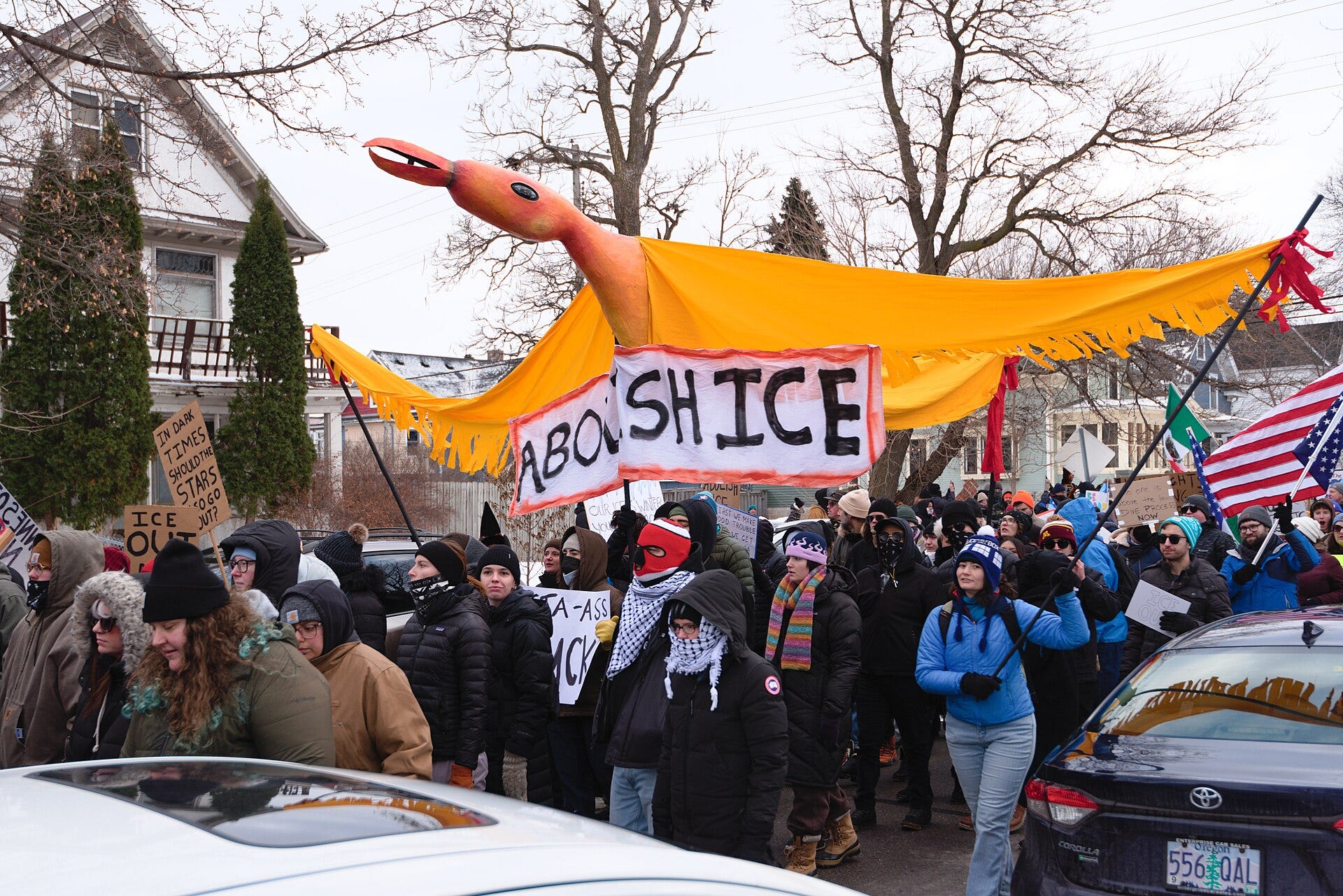
The Political Science Underneath Minnesota’s Defeat of ICE
I’m working on a thousand foreign policy-related things at once, but I didn’t want to miss briefly commenting on some good news with a dark lining: Minnesotans have shown the way in defeating ICE.
The good-news aspect is quite simply that Minnesotans—through mutual aid, popular opinion, and a vast repertoire of resistance—have forced a tactical retreat from ICE and the Trump administration. Multiple reports indicate the White House realizes it has lost public support for its paramilitary operations in Minnesota, leading to a partial retreat from the state under the guise of “draw down” following a “surge” (the words of border czar Tom Homan).
The dark lining is that the Minnesota case validates the best of what we know in the comparative literature about repression politics, which this sums up rather well:
Government violence can suppress rebellion, but only if that violence is sufficiently high to convince civilians that supporting the rebels is more costly than supporting the government. If the government is unable or unwilling to escalate to this point, it will only provoke reciprocal escalation by the rebels. This non-monotonic relationship holds in dozens of modern civil conflicts, across multiple datasets and units of analysis, and is robust to multiple estimation strategies. These findings help illuminate the wartime origins of autocracy: efforts that governments take to reduce the amount of violence needed to stay in power (e.g., surveillance, travel restrictions, and censorship) are also ones that make its citizens less free.
Violent repression of a citizenry is sometimes effective, sometimes not. When it is, it’s because the government doing the repressing snuffed out its own citizens’ freedoms and imposed irrationally heavy costs on supporters of resistance. Repression, in other words, is incompatible with democracy.
Two conclusions, then.
One, Minnesotans had to resist to make repression fail, but a key condition of possibility for failure was the Trump administration imposing only a moderate level of repression. The methods of resistance deployed in Minnesota, which we’ve only barely been able to glean so far, would be less effective if Trump’s paramilitary surge had the capacity and willingness to start a pacification campaign, including killing people at scale. In that case, Minnesotans could still mount an effective resistance, but the modes of resistance would have to dramatically shift.
Hey, friend! You might have noticed that I’m offering more of Un-Diplomatic without the paywall; I’m trying to keep as much as possible public. But to do that requires your help because Un-Diplomatic is entirely reader-supported. As we experiment with keeping our content paywall-free, please consider the less than $2 per week it takes to keep this critical analysis going.


