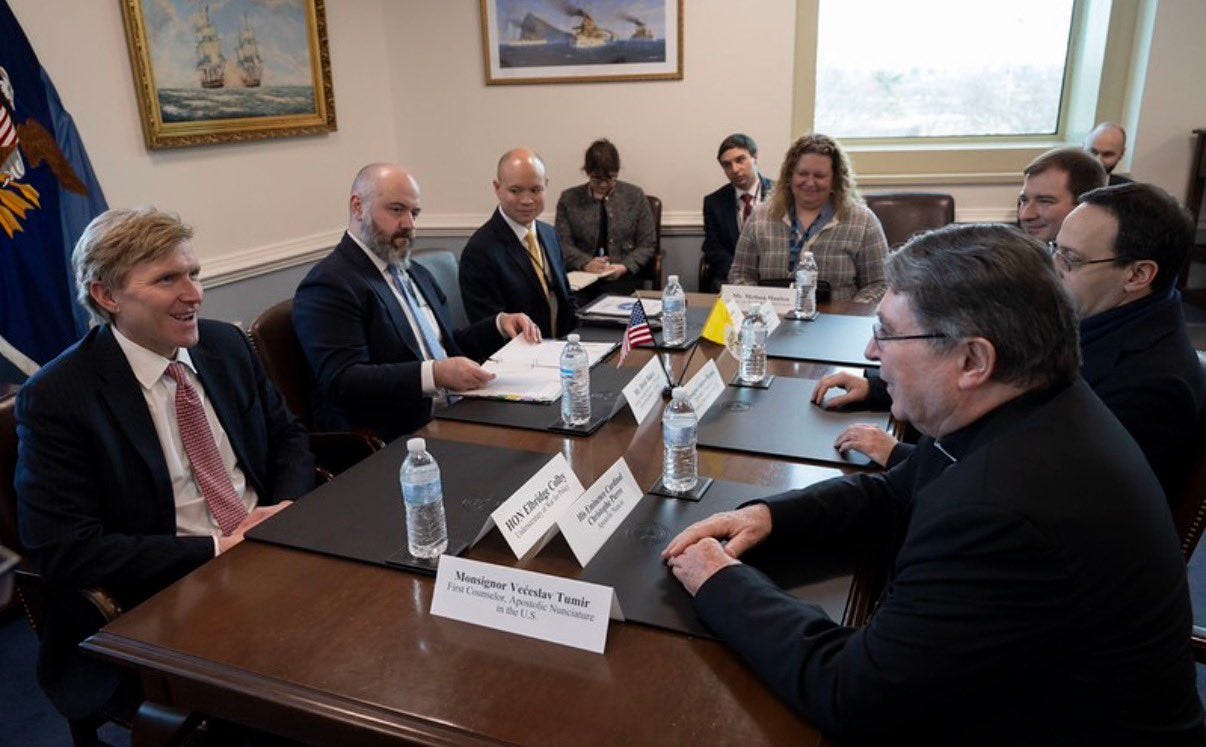
The Pope and The Pentagon
This story hits weirdly close to home.
In January, Elbridge Colby, the Undersecretary of Defense for Policy, summoned a top Vatican diplomat to both rebut a recent peace-forward, anti-imperialist speech the Pope gave and—according to multiple accounts—threaten the freaking Pope. You can’t make this stuff up.
The Pope’s speech called for disarmament, critiqued nationalism, and bemoaned
the growing violations of hard-won treaties, at a time when what is needed is the strengthening of supranational institutions, not their delegitimization.
The Pope even criticized imbalances of power in the world.
The Trump administration had been hoping to have the Pope visit the US and to co-opt his religious authority for electoral gain (a Vatican official said that’s not happening). But the meeting between Colby and the Pope’s representative was also a clash of worldviews and Colby wanted to deliver what witnesses describe as a “bitter lecture” inveighing against peace and in favor primacy, nationalism, and military force.
The right-wing Free Press reported that Colby conveyed the US could do “whatever it wants” with military power and “picked apart the pontiff’s January speech” as a challenge to Trump’s Monroe Doctrine. As tensions escalated, either Colby or one of his staffers (almost certainly Colby given how these meetings work) invoked the Avignon Papacy, a 14th-century parable in which the French King threatened force to physically relocate the papacy to Avignon, where France controlled it for 67 years. The threat implied that force, not religious teaching, was the supreme authority and that the Vatican “better take our side.”
All of this has a taste of the personal. In a previous life, I worked collegially with Colby at a DC think tank, when he was a Mitt Romney republican and I was an Obama democrat. We both evolved in obviously opposing directions. But the office he now presides over in the Pentagon is also the office where I worked during the Obama administration. The table depicted in the picture above is one I sat at many times.
And while I’m no longer religious, I studied for my PhD at the Catholic University of America, where I was exposed to two radically different tendencies within the Catholic Church. One was the religiously inflected paleoconservative Catholicism that became MAGA—an ideological strand of the Trump administration (Newt Gingrich took Sunday service on my campus whenever he was in town). The other tendency was what you might call Christian socialism. Any straightforward reading of the bible and Jesus’s teachings would have us fight for peace, help the poor, and condemn the rich.
And it’s this latter tradition—which runs counter to the distorted Catholicism that prevails within MAGA—that Pope Leo XIV tapped into with his disarmament speech. So there’s a deep antagonism underneath the surface when it comes to how we should understand the Catholic faith and what we owe our fellow human beings. Because JD Vance—who helped Colby get confirmed to his current position—is a late-convert to Catholicism, one way of understanding this entire episode is as a battle for the soul of the Catholic Church and its 1.6 billion followers.
But there’s something else, more geopolitical. While it’s extraordinarily unusual for a Pentagon official to summon a representative of the Vatican, in this instance it made sense because Colby knows his Reagan-era history.
In the 1980s, the Reagan administration incubated a bunch of warmongers who would later be identified as neocons—Paul Wolfowitz being their leading avatar. They were the reason the military budget doubled under Reagan, they fought against detente with China, and they steered Reagan toward a containment strategy and nuclear superiority against the Soviet Union. Needless to say, it was these proto-neocons who were vehemently opposed to arms control. This is the genealogy that Colby himself emerges from and carries the torch for.
The Catholic Church figures into this history because, as we all know, Reagan eventually pursued summit diplomacy with Gorbachev and undertook some arms control initiatives with the Soviet Union—moves that helped end the Cold War peacefully. But Reagan would not have made that pivot—which went against the advice of most of the staff surrounding him—if not for the popularity of the Nuclear Freeze movement. And one very important constituency in the Nuclear Freeze movement was the Catholic Church.
An excellent book on this period by Henry Maar recounts how a large portion of the Republican base was Catholic and the Pope’s authority resonated much more powerfully at that time than today. When the Pope came out in favor of the Nuclear Freeze—which demanded halting all production, testing, and deployment of nukes—Reagan officials were boxed into a corner. The Reagan administration did not want to be seen opposing the Catholic Church because it would divide the Republican base. But the hawks could not stomach arms control as a threat to their fantasies of nuclear domination and Chuck Norris-style military adventurism.
Colby knows all this, and from his vantage point, sees it as a cautionary tale—keep papal authority aligned with state power or put the project of militarism and religious ethnonationalism at risk. Colby rightly fears the Pope’s moral authority, and appears to have summoned a Vatican diplomat in hopes of coercing Catholicism’s subordination to the Trump administration.
He failed miserably. The Pentagon-Pope saga became public only against the backdrop of the Iran War. And the papacy’s position in that war could not be more opposed. In response to Trump’s message a few days ago that “A whole civilization will die tonight, never to be brought back again,” the Pope decried the war as unjust:
Today, as we all know, there was this threat against all the people of Iran. This is truly unacceptable…we have a worldwide economic crisis, energy crisis, situation in the Middle East of great instability, which is only provoking more hatred throughout the world.
Hey, friend! You might have noticed that I’m offering more of Un-Diplomatic without the paywall; I’m trying to keep as much as possible public. But to do that requires your help because Un-Diplomatic is entirely reader-supported. As we experiment with keeping our content paywall-free, please consider the less than $2 per week it takes to keep this critical analysis going.


