

Democratic Socialists of America (DSA) represents the most organized section of what The Nation praised this week as a “progressive insurgency” sweeping the US. Easily one of the most consequential political shifts in my lifetime.
DSA is a power base for the kinds of policies I advocate. It complicates the simple binary of America’s two-party system in ways that are good for democracy. And it is the only political force in American politics that understands hegemonic decline as both an existential danger to the world if managed improperly and an opening to make a different kind of world.
DSA is already reshaping the Democratic Party in small ways. When we look back on the coming years, we could see the rise of DSA as either the beginning of a democratic renewal in the world’s imperial Core or the object of a MAGA-led red scare that heralded America’s total mutation into not just an oligarchy but a dictatorship.
DSA Defines The Future…
The Democratic Party will not be able to police DSA back to the margins of politics without enlisting in MAGA’s counter-revolution (which could happen).1 Alternatively, it’s possible the Democratic Party will somehow co-opt DSA’s life force like a billionaire to a blood boy…but the only conceivable way of neutering the movement is to become it; like Bismarck inventing social security in 1889.
But suggesting that DSA has a future in Democratic politics, or that it poses a real threat to far-right control of the state, assumes that whatever fuels DSA’s rise will persist. So what propels DSA toward power?
The short answer should also be the obvious one: Worsening economic immiseration, state tyranny, and reactionary political culture swells DSA’s ranks within a large left-populist wave. We can be confident of DSA’s consequentialness one way or another because the material conditions that give rise to DSA are only going to get worse in the coming years.
The Theory
But economic insecurity and state repression explain the trend (DSA’s rise), not the variation within the trend—DSA performs better in some places (big cities) than others. That variation is the puzzle in a new journal article called “Why now, why here: a conjunctural theory of socialist advance in big city America.”
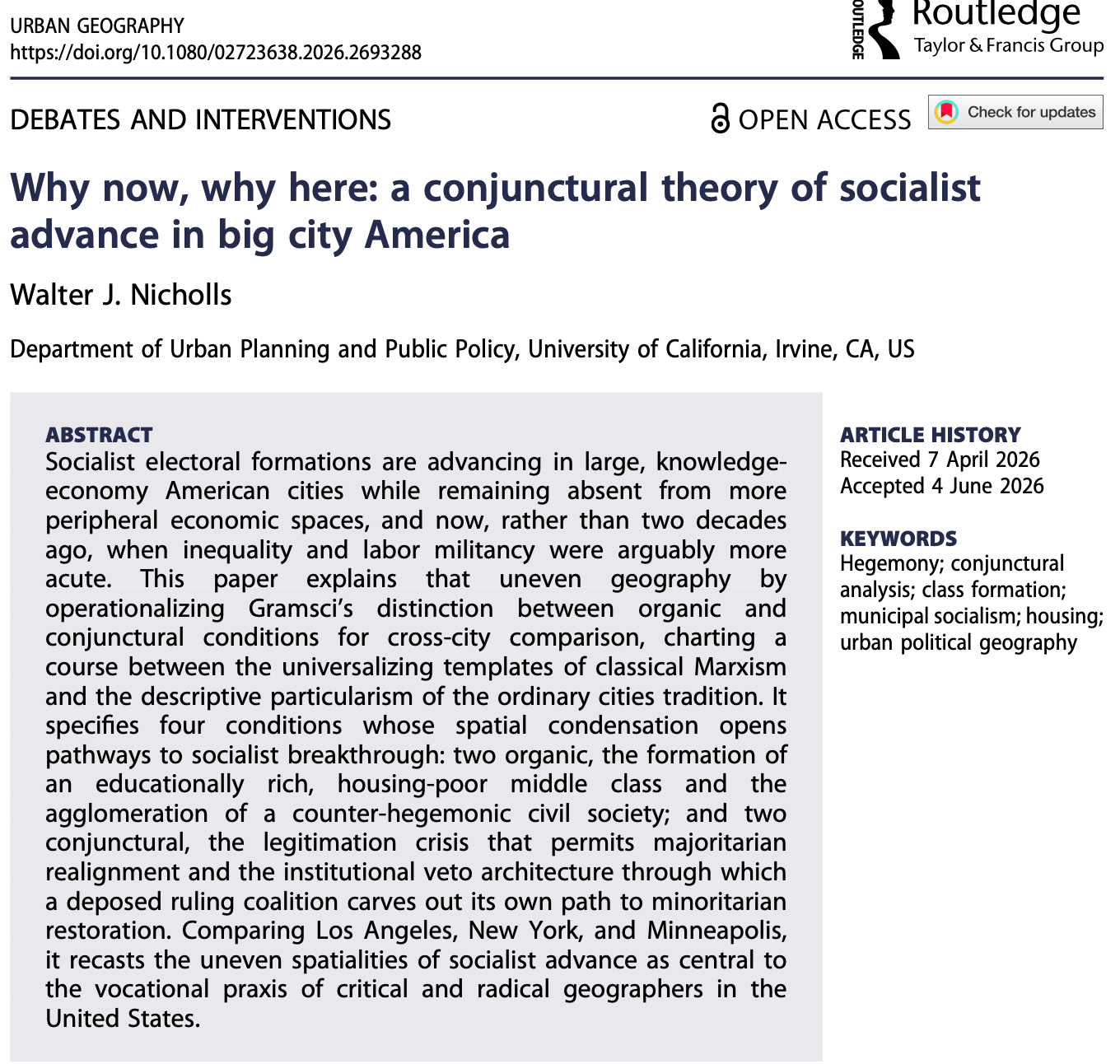
The author asks both why DSA is winning in big cities and why now as opposed to 20 years ago. He identifies four factors that help account for where and when DSA is winning, not just the general trend:
Education-rich, housing-poor workers: The DSA base isn’t just economically precarious; it’s also highly educated. The stereotype of a barista who’s read their Marx and Gramsci has a ring of truth, but it’s not just about downward mobility or economic insecurity—they’re specifically unable to get on the property ladder in what is primarily an asset economy in high cost-of-living big cities.
Counter-hegemonic civil society: The ability to spend time, money, labor, and leisure in ways that deviate from ruling-class hegemony (ie, mainstream politics and culture) depends on civic density: Big cities “concentrate advocacy organizations, labor unions, legal organizations, faith institutions, and philanthropic capital in dense proximity.” Dense urban areas give people and movements autonomy and resources to pursue alternative political ideas.
Legitimation crisis: During certain conjunctures, nothing you do politically can seem to matter, and the boundaries of legitimate politics are very narrow. Challenging those boundaries can feel fruitless. The ‘90s were a bit like that. But there are moments when the door opens for a major political realignment because the old order has lost legitimacy. The New Deal Coalition. The “Southern Strategy.” We’ve been in one of those moments for a decade, held back only by AIPAC money and the Biden presidency.
Institutional veto architecture: This factor is something DSA must overcome as it governs. The structure of American politics makes it easy for a deposed ruling class (former majority turned minority) to play a spoiler role in governing. When DSA becomes part of a majority coalition with progressive and left-liberal Dems, minority Republicans and conservative Dems will be able to stifle socialist change without much difficulty (this happened in Spain during the 2010s). And if DSA can’t perform, then the minority will find its way back to the majority.
I think this is basically right.
There is a legitimacy crisis of the ruling order, and that creates an opportunity for a once-in-a-generation political realignment.
Big cities are sites of densely concentrated activism, mixed with high levels of education mixed, with house-poor economic precarity—the perfect combination to build party cadre committed to fixing the economic plight facing the working class.
And American politics does empower savvy ousted politicians with the ability to paralyze government, thereby making a new ruling party appear ineffective.
The author summarizes his findings this way:
DSA is not winning council seats in Los Angeles because of charismatic candidates but because a decade of organizational work in tenant unions, mutual aid networks, and electoral infrastructure had already been done before any electoral opening appeared (Nicholls & Uitermark, 2016). The same logic applies in New York, where DSA’s advances from Alexandria Ocasio-Cortez’s 2018 congressional victory through Zohran Mamdani’s 2025 mayoral campaign were built on years of prior accumulation in housing justice coalitions, democratic clubs, and labor formations. Minneapolis tells the cautionary version: the infrastructure was sufficient to produce 2020 breakthroughs but not deep enough to withstand the veto architecture of the residual regime once victories were secured. In all three cities, the decisive variable was the depth and durability of the organizational infrastructure that preceded the electoral moment, organizational depth accumulated through positional struggle meeting the conjunctural rupture produced by regime crisis.
He’s saying metropolises incubate real organizational base-building, and that organizational capacity can be favorably mobilized when the political winds blow in a favorable direction. Preparation meets opportunity.
Beyond the Theory
My only reservations relate to how the author frames his analysis: “They [DSA] are nearly absent from deindustrialized mid-sized cities, suburbs, and rural areas.” That’s not true, or at least it’s an overstatement.
Detroit is the preeminent de-industrialized city and DSA candidate Donovan McKinney just won the Democratic nomination to represent it in Congress. And while that only just happened in August 2026, Rashida Tlaib—who’s been in Congress since 2019—is also a DSA member and part of Detroit is in her district.
In Wisconsin, which four years ago had no socialist caucus in the state assembly, there are now four democratic socialists. And Francesca Hong, a democratic socialist, came within 1% of winning the Democratic nomination for governor.
In Maine, the Democratic nomination for the Senate belongs to Troy Jackson, who received the endorsement of Maine DSA.
Meanwhile, in Florida—a least-likely location for a socialist politician to thrive—DSA candidate Oliver Larkin has been in a statistical tie for most of his primary race (August 18).
In all of these places, DSA is vastly overperforming despite the areas being a mix of rural, suburban, and de-industrialized. In other words, DSA is winning more seats and getting more votes than it was a few years ago in every type of geography, even in places political math say should be impossible. At current count, nine Democratic congressional incumbents have lost their seats to this ongoing left-populist insurgency. As Ken Klippenstein points out, that’s the biggest anti-incumbent wave since 1970, and the primaries aren’t even over yet. It’s triple the right’s “Tea Party wave” during Obama’s second term.
What that means is the four factors the article identifies tell us where DSA breakthroughs are most likely, but breakthroughs can happen—and are happening—in every kind of locale. Places where DSA has built organizational capacity reap more from the harvest, but that capacity only converts to political power during certain moments that are not the product of organizational capacity building.
The Crux of the Problem is the Opportunity
The root source of DSA’s rise is the depraved material conditions bearing down on growing numbers of unemployed, underemployed, and economically insecure (from student debt as much as from housing unaffordability). That’s also what aggravates the legitimacy crisis. We shouldn’t lose sight of that.
As for the question of why DSA’s rise did not happen 20 years ago, think about where the US was in 2005: Binging on the oppressive, manic, dizzyingly violent War on Terror, which truly was a terror for Muslims in America. The country was still in the early stages of the current legitimacy crisis, and all manner of political censorship made left movements non-existent. The culture was impossibly reactionary. Any clear-eyed fascist will look back at that for a model of how to kill DSA’s momentum. That’s what NSPM-7 and the “far-left terror” stuff is really for…
Hey, friend! You might have noticed that I’m offering more of Un-Diplomatic without the paywall; I’m trying to keep as much as possible public. But to do that requires your help because Un-Diplomatic is entirely reader-supported. As we experiment with keeping our content paywall-free, please consider the less than $2 per week it takes to keep this critical analysis going.
I’m willing to bet that state tyranny will target DSA before it becomes too big, at which point America’s mutation into dictatorship will be complete.