Troops Are Cheaper Than Missiles
Three reasons “boots on the ground” against Iran are inevitable.
Reports abound that the Trump administration may soon order troops to deploy inside Iran. It’s going to happen. US “boots on the ground” are inevitable. Here’s three reasons why.
No Troops, No Control
Coercive bombing doesn’t work. You can destroy targets, but you can’t control anything. Nobody has ever achieved regime change from the sky, and you can’t determine what happens on the ground from the air. So, if the US wants to compel or control anything specific inside Iran, it will require the deployment of combat units.1
Troops Are Already On The Ground!
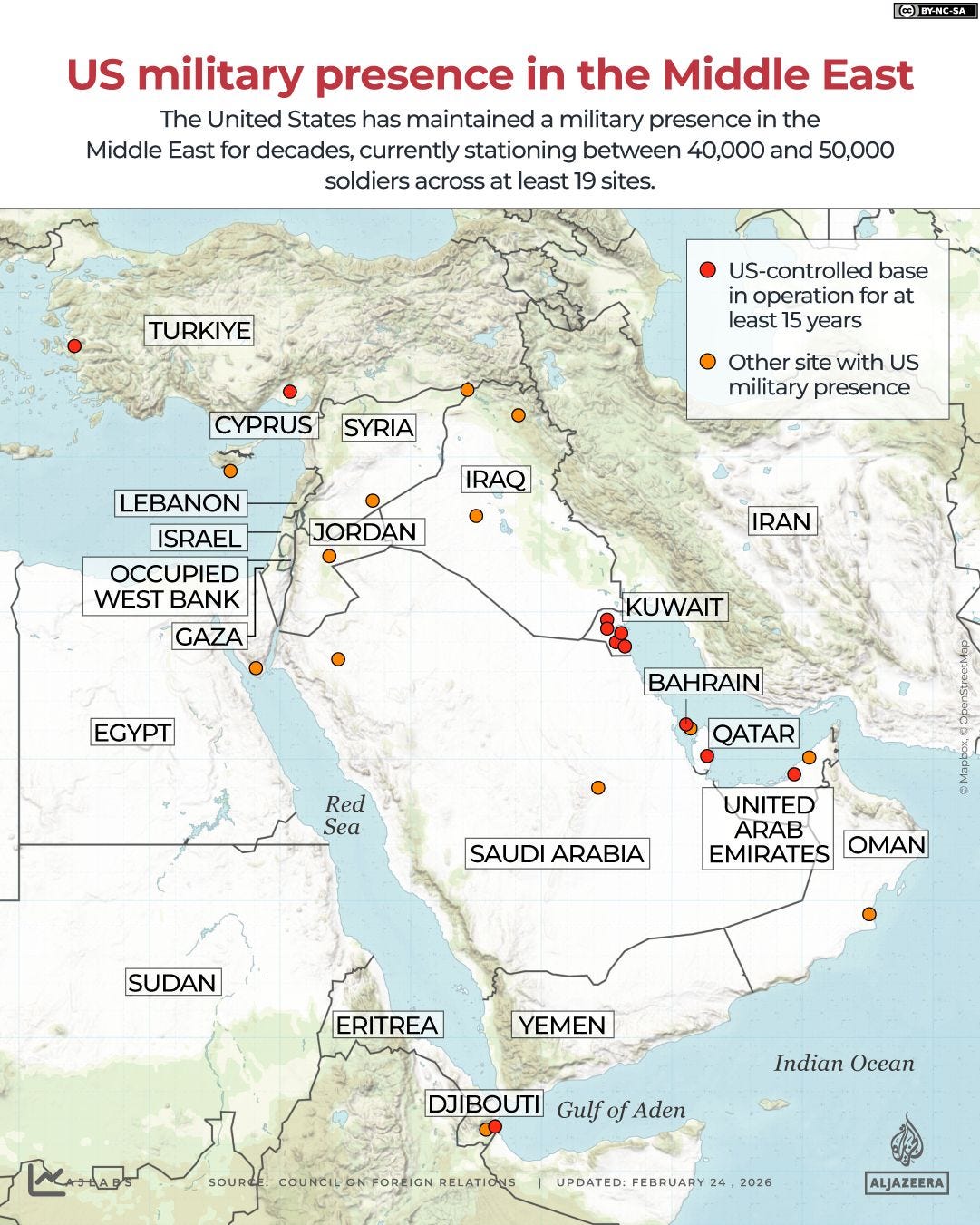
Look at the map above. The US has upwards of 50,000 troops already deployed to every country in the Middle East except Yemen and they’re primarily there supporting combat operations against Iran. That’s boots on the ground! They’re even being targeted by Iranian drones and rockets, just like boots on the ground would be. So it’s kind of splitting hairs to treat troops inside Iran as some rubicon. The rubicon was launching a preventive war illegally. (also if you know the US way of war, you know special forces units are already operating in the combat zone even when it’s just aerial bombardment).
Troops Are Cheaper Than Missiles
It’s gross but true—troops are cheaper than missiles.2 We have a massive stock of service members but a dwindling stock of munitions—close to 1.4 million active-duty personnel and maybe 1,000-2,000 interceptors.3 And the Trump administration does not care about the lives of its men and women in uniform. After all, it launched an illegal war of aggression fully anticipating casualties, and within days it got them (as I write this, six troops killed, 18 injured—many more guaranteed).
This infuriates me Fuck these motherfuckers. Every American war disproportionately sacrifices the working poor and ethnic minorities. So a decision to do war is a decision to exacerbate inequality in the most lethal way. Which is why it’s all the more galling that this particular war on Iran will cause (is already causing) an oil shock, food price inflation, and monetary tightening, all of which will induce a financial crisis. The permanent economic recession that has existed for the middle class since the last financial crisis will expand to encompass even more people.
How do you ask someone to die for the vanity of a leader committing war crimes? Anyone who believed “the military will save us” from tyranny must understand that the military is the pointy end of the tyrant’s machine—every US service member in the Middle East is part of an illegal war operation according to both domestic and international law. They’re required to refuse illegal orders. And yet…
Hey, friend! You might have noticed that I’m offering more of Un-Diplomatic without the paywall; I’m trying to keep as much as possible public. But to do that requires your help because Un-Diplomatic is entirely reader-supported. As we experiment with keeping our content paywall-free, please consider the less than $2 per week it takes to keep this critical analysis going.
I’ve explained already that the goal of this war is state collapse, not regime change per se. Civil war is what the US and Israel are fomenting. You can obviously create civil war without “boots on the ground.” But if you have any other goals beyond civil war, you almost certainly need a military presence.
This is a bit sensational to drive a point home, but a staff sergeant earns roughly $48k/year, whereas a Tomahawk cruise missile costs around $2 million. The US spends a lot on troop healthcare, facilitates, and training, but it spends a lot more on the weapons platforms and fuel used to actually use Tomahawk cruise missiles. The human-lives-don’t-matter math of our ruling class will realize this soon, if they don’t already.
It’s hard to calculate this because numbers are classified, but when you piece together SM-3, Patriot interceptors, and THAAD interceptors, deduct for missiles use for last year’s 12-day war, and deduct what might have already been used, we’re somewhere around a thousand interceptors left globally.


