

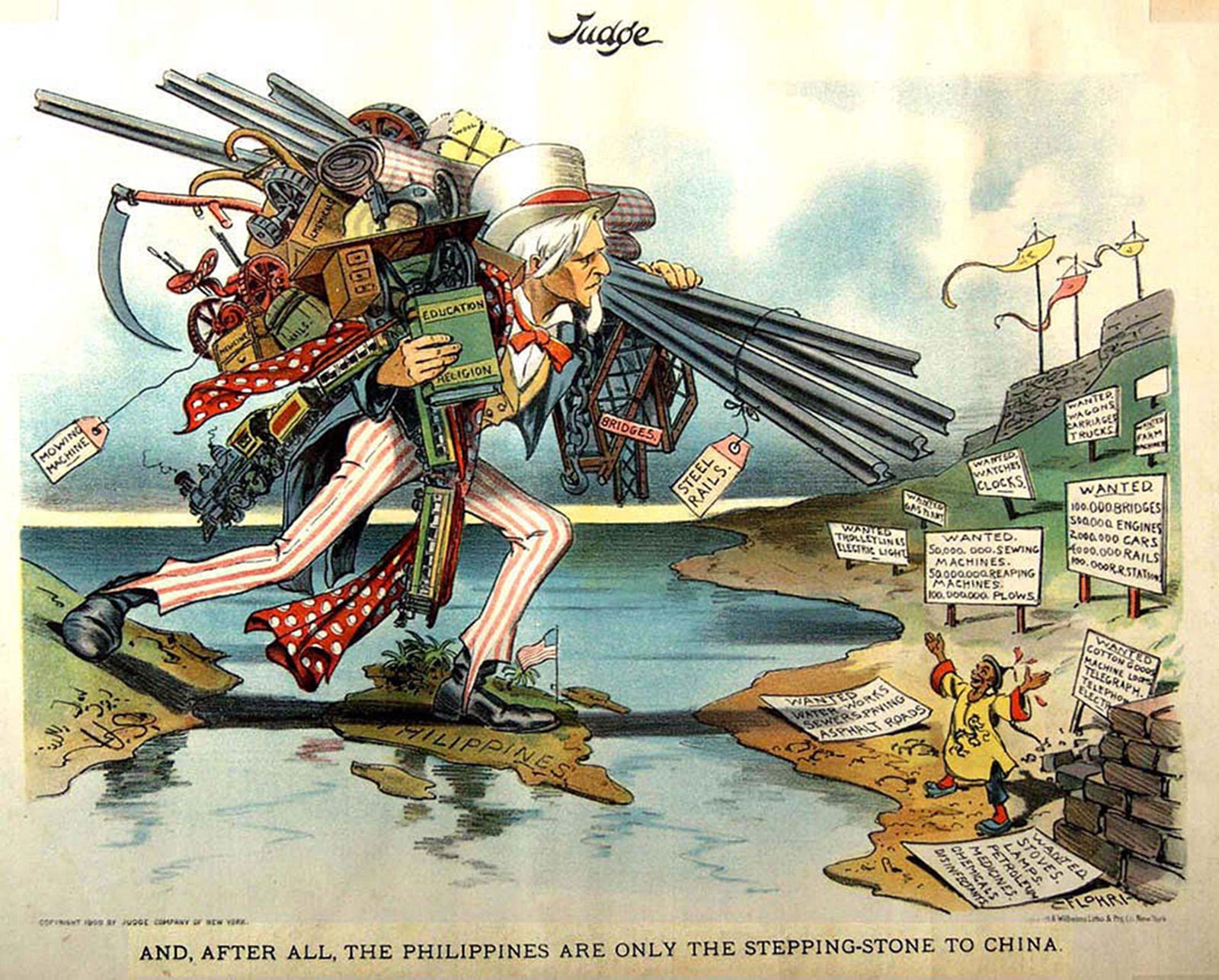
The past few days have made visible something that typically goes unseen: American colonialism. And I don’t mean historical wrongs; I mean active wrongs, US colonial relations that endure in 2026.
Darializa Avila Chevalier (DAC), the DSA candidate who will soon be headed to Congress as New York’s newest representative, posted a short video on Instagram trying to raise awareness about America’s 128-year history of colonizing and pillaging Puerto Rico. And boy did she succeed.
The clip went viral on every social media platform, kicking off not-especially-productive debates within the online left. But its virality exerted a gravitational pull on every other part of the political spectrum too, eliciting reactions from liberals and reactionaries who (based on how they got rage-baited by the entire thing) had little-to-no prior knowledge that the US even had colonies in 2026.
Within left circles, at issue was DAC’s call for Puerto Rican independence and self-determination. Any unfree territory has three post-colonial choices: independence, statehood, or a semi-sovereign relation of formal dependence called “free association.” Self-determination is the process of realizing one of those choices. A process that the US has denied Puerto Ricans up to now.
Statehood is a Fake Option
If you reduce DAC’s position to a soundbite, it sounds like she’s foreclosing on self-determination for Puerto Rico by prescribing independence for Puerto Rico—especially because a majority of Puerto Ricans voted in 2024 in favor of statehood, not independence.1 But that’s the thing about a soundbite—stripping anything of its context changes its meaning.
DAC moves in some of the same circles I do, where the coloniality of modern empire is a familiar subject, as are the pathways out of it. Statehood should be a choice. But in the context of all we know and discuss, we spend little time on statehood for the obvious reason that US politics refuses the possibility and always has. During the 2024 election, one of Trump’s popular MAGA lines of attack against Florida governor Ron DeSantis was that he supported Puerto Rican statehood. Senator Mitch McConnell called the idea of Puerto Rican statehood “full-bore socialism.” The House has passed multiple bills granting Puerto Rico self-determination (why those bills exclude America’s other colonies is another matter) but they go nowhere because the Senate will not vote on them.
In this context, pushing for statehood is like pushing for Lucy to hold the football for Charlie Brown. “If you be a good little territory and don’t cause trouble, one day you might get to be like Hawai’i”—exploited and dispossessed in a thousand different ways, but you can at least get the rights and obligations of a state in the US federal system.
If only.
Compounding the statehood-as-fantasy problem is the reality of America in 2026—a declining hegemon actively seeking to impose imperialist relations on more, not fewer, countries. The United States itself is fractured, descending into tyranny, and actively Peripheralizing in places like Texas, thanks to the forces of both militarism and global financial capital. Not a lot of liberation on that horizon.
But my point is not about arguing the merits of statehood versus independence; it’s that statehood is not an available option because America remains an empire (a point I unpack below). And as long as people pretend like statehood is an option while neither the senate nor the president will allow it, the depraved circumstance of colonial limbo will prevail.
But there are two larger issues that the Puerto Rico question brings to the fore: America’s other imperialist relations, outside Puerto Rico, and what MAGA policymakers think about sovereignty and “the nation.”
Where is the Non-Sovereign Pacific?
The US denies self-determination to not only Puerto Rico, but also Guam, American Samoa, and the Commonwealth of the Northern Mariana Islands. The US holds the partial sovereignty of Palau, the Republic of the Marshall Islands, and the Federated States of Micronesia, forming the largest share of what I call the Non-Sovereign Pacific. The US has additionally imposed ongoing informal imperial relations on several other countries (Iraq, Venezuela, Ecuador, Afghanistan, and a half-dozen more)…but to prevent this from getting unwieldy I want to zero in on Guam—the most predatorily valuable of America’s colonies from the perspective of the military strategist’s imagination.
Both Puerto Rico and Guam became US colonies as the result of the Spanish-American War. Both have longstanding and large independence movements. Both have lobbied the US government over the decades for the right to self-determination. Both host a US military presence, Guam much more so than Puerto Rico.
Given the historical and structural similarities, any demand made against the US government on Puerto Rico’s behalf must logically apply to Guam too. And yet, in both the lefty and the centristy hot takes about DAC’s demand for Puerto Rican independence, I saw nothing from anyone about Guam. AOC’s prior attempts to seek self-determination for Puerto Rico also excluded any mention of Guam.
There’s no excuse for Guam’s absence—How to Hide An Empire was a bestseller. I’ve written about Guam’s plight in a popular magazine. An amicus brief was recently filed with the US Supreme Court that exposes the harm that befalls Guam as a result of its non-sovereignty. The Guam blind spot persists all the same because the US security state finds exploitable value in having Guam function as both a shield against and a platform for power projection. It has a vested interest in refusing Guam’s consent to functioning as a sacrifice zone in military strategy.
Guam’s great elder statesman, Dr. Robert Underwood, explained recently that statehood for Guam is a pipe dream. Current political reality sees the MAGA US House of Representatives voting to strip people born in Guam of US citizenship. How can anyone expect (or want) statehood in that context?
It’s not in the interest of the colonies to get free (or assimilate) at the expense of the others. That’s classic divide-and-rule shit.
Holding self-determining demands together is logical but also strategic—Puerto Rico shares everything in common with the Non-Sovereign Pacific. Acting and making demands accordingly shouldn’t be that hard considering the empire isn’t really serious about permitting self-determination anyway.
MAGA’s Nazi-like Definition of Sovereignty
And that actually raises the other problem here—the MAGA conception of sovereignty and “the nation.”
The United States under Trump 2.0 is shrinking the circle of who gets to be included in their view of the nation. The empire is expanding abroad and consuming itself at home. The way the far right thinks about geopolitics would seem to make the constitutional question of self-determination moot. Treasury Secretary Scott Bessent said recently:
The nation that depends on its adversaries for critical inputs is not truly sovereign…We have rediscovered at great cost what Hamilton taught us around the time of our founding: that every nation ‘ought to endeavor to possess within itself all the essentials of national supply.’ That our strength, in other words, is derived from what we can build, for the nation that cannot produce what it needs is not truly secure…semiconductors, AI, quantum computing, advanced manufacturing, shipbuilding, critical minerals, and pharmaceuticals…More than sectors of the economy, these are the sources of national power. And America must lead in each of them.
Bessent is articulating a conception of sovereignty that not only insists on American global primacy under conditions where that is simply impossible. It also insists on controlling, to the exclusion of others, the resources and economic sectors that US elites believe are necessary to be functionally sovereign. A redefinition of sovereignty is happening here where empires alone have it, and that should recast how we see the entire question of A) American democracy but also B) struggles for self-determination and the unrealism of wanting or demanding statehood from people whose brains are Lebensraum-addled.
So back to where we began.
DAC wants self-determination for Puerto Rico. Everyone on my side of the line does. But statehood is not and will never be an option until something fundamental about US politics changes, and that is not in the offing. Independence is probably the most realistic alternative to being a colony but the only liberatory alternative to the status quo is an anti-imperialist existence, regardless of whether you encase it in the language of “independence,” “statehood,” or “free association.” And that means confronting the decaying empire or routing around it, not allowing it to be your pimp.
I have no doubt that Puerto Ricans would prefer to have full autonomy plus substantial reparations and continuing US federal support, regardless how you package it. At some level, haggling over the constitutional or legal form obscures the basic question of justice and decency. And you know what they say about No Justice…
Hey, friend! You might have noticed that I’m offering more of Un-Diplomatic without the paywall; I’m trying to keep as much as possible public. But to do that requires your help because Un-Diplomatic is entirely reader-supported. As we experiment with keeping our content paywall-free, please consider the less than $2 per week it takes to keep this critical analysis going.
Puerto Rico’s 2024 vote on statehood was not exactly what it seems. Puerto Rico has its own oligarchs who corrupt local politics and they are the vectors through which transnational capital exploits Puerto Rico’s non-sovereign status—eg, allowing a non-local company to own the electricity grid, which charges usurious prices and routinely experiences power outages. Moreover, Puerto Ricans know that their territory receives substantial federal assistance from the US government, and the operating assumption is that independence would jeopardize that financial support.
Great piece. For an added perspective on the long-standing official American position that conquest is the legal basis for sovereignty, especially our own, Greg Grandin's "America, América" is a sobering, eye-opening read. It is not surprising that Bessent cites Hamilton, or that Trump has spoken openly of our next "conquest." Might makes right has always been the core of our engagement with the world. We are reaching back to our roots when we more openly support colonial and neocolonial exploitation (indeed, while fostering greater division at home, as well).