Why Illegal Wars Make Markets High
“K” is both the shape of immiseration and the permanent war economy.
We’re living in a moment where flagrantly illegal wars are ravaging the human condition. And I don’t just mean in the places where bombs rip through the flesh of the innocent. I also mean in the places in whose name savagery is waged. The ability to secure a decent, stable life in even the bosom of empire has been declining precipitously. And while Trump and the counter-revolutionary project he’s unwittingly carrying out is accelerating immiseration, it is, by various measures, a secular trend:
These circumstances have aroused the curiosity of the business press. Markets are doing well and corporate profits are high, yet human insecurity is growing amid globe-ruining imperial wars of choice. How to explain this?
A recent piece in the Financial Times did a surprisingly good—but incomplete—job of exploring this question. The upshot:
the paradox of 2026. War in the Gulf has created “the biggest energy crisis in history”…Violence has consumed other parts of the Middle East, as well as Sudan and Ukraine; populism, nationalism and angry polarisation are rising in the west; debt burdens are sky-high; climate change is accelerating; and the AI revolution that so thrills Silicon Valley titans is also threatening to destroy jobs. Meanwhile, American consumer confidence has slumped to its lowest level on record. But that is only one side of the story…The global economy is still growing by more than 3 per cent a year. And perhaps most surprisingly, America’s stock market has recently been hitting record highs…
What FT has come around to realizing is that market prices no longer reflect either consumer sentiment, employment levels, or expectations around wage growth or productivity. I wrote last year for Labor Notes about how the most politically influential sections of the capitalist class no longer require a healthy economy. Troublingly, the oligarchic class is positioned to actually benefit from an economic recession, whether caused by war or other circumstances.
There’s more than one reason for this disconnect between the market and the economy, and some of those reasons are explored in the FT piece.
First, stock markets are not representative of how the economy or its population is doing as a whole. Big Tech’s seven major firms—NVIDIA, Apple, Alphabet, Amazon, Meta, Microsoft, Tesla—make up more than half of the S&P’s total returns and one-third of its total value. In 2025 alone, 80% of all stock market gains were traceable to AI-related purchases, investments, and production. And as FT reports, “the wealthiest 10 per cent of Americans own 88 per cent of equities, by value.”
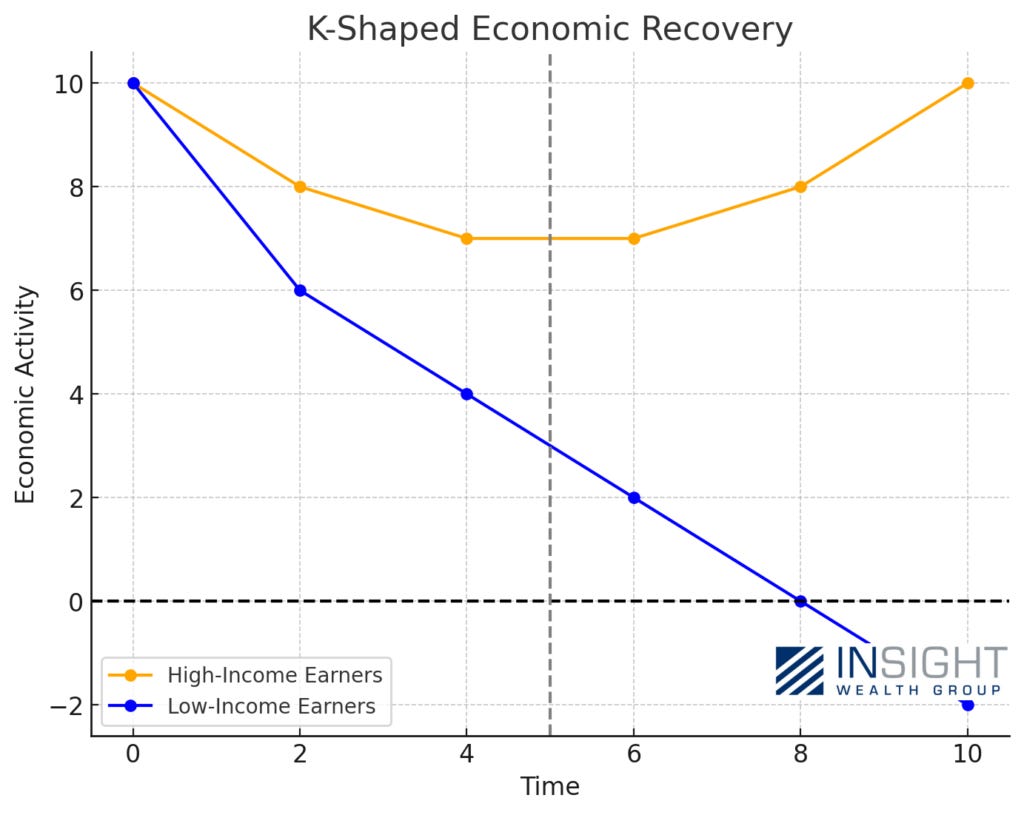
As long as the AI bubble doesn’t pop and Big Tech turns in high profits, the market should be frothy, even though most people are living on the misery side of the K-shaped economy that results from this brutal reality:
Second, tech has infiltrated the trading process itself:
60 per cent to 80 per cent of all trading flows are driven by computer programs and algorithms. This reflects the rising prominence of exchange traded funds (which automatically buy stocks to reflect the overall index) and high-speed algorithmic trading by hedge funds (to exploit gaps in asset prices before humans have any chance of seeing them with the naked eye).
So most market activity is being moved by robotic herd dynamics, arbitrage, and previously programmed decisions to automatically buy and sell under specified conditions. Thus, market movements, even when they are tenuously connected to the real economy, are heavily mediated by techno-decision-making not correlated to real-world events in any predictable way.
Third, it’s early days and, unlike Asian and European countries, the US economy is not directly exposed to supply shocks from the current war with Iran. Scott Bessent said as much last month. What this means, though, is not that Americans are fine while the world burns; that is merely the myth of divisible security. What it means is that markets will “correct downward”—shit themselves—when they have to start pricing in reduced global oil supply, higher global prices, higher global interest rates, and fiscal recessions among America’s many trading partners. So America’s on a lag.
Ultimately, though, America runs on a permanent war economy, and it’s the oligarchs—not normal people—who benefit from that.1 Private equity and venture capital are increasingly vested in military-tech industries. 80% of the discretionary budget is slated to go to the Pentagon now. For a certain section of the capitalist class, forever wars are a precondition for growing wealth in a depressed fiscal environment. As Shana Marshall concluded in a recent report: “The cycle of militarization, violence, public austerity and private accumulation is self-reinforcing.”
The K-shaped economy is the sterile, economistic way to talk about a nation with two economies—one where regular people eat shit, another where oligarchs distort public policy while renting blood boys and buying bunkers. Illegal wars are demonstrably bad for people who need affordable food or energy or access to cheap credit, but those are not the people the state cares about.
I’m writing a big thing about oligarchy and the permanent war economy that I’ll publish soon enough. It’s needed because I sense that many people don’t understand the connection, even when they can intuit it.


