You Can’t Sleep Through a Nuclear War
The guy from outer space / and the guy with orange face / make it easy for the comrades to shake y’all asses awake.
—“November to Remember,” Bambu
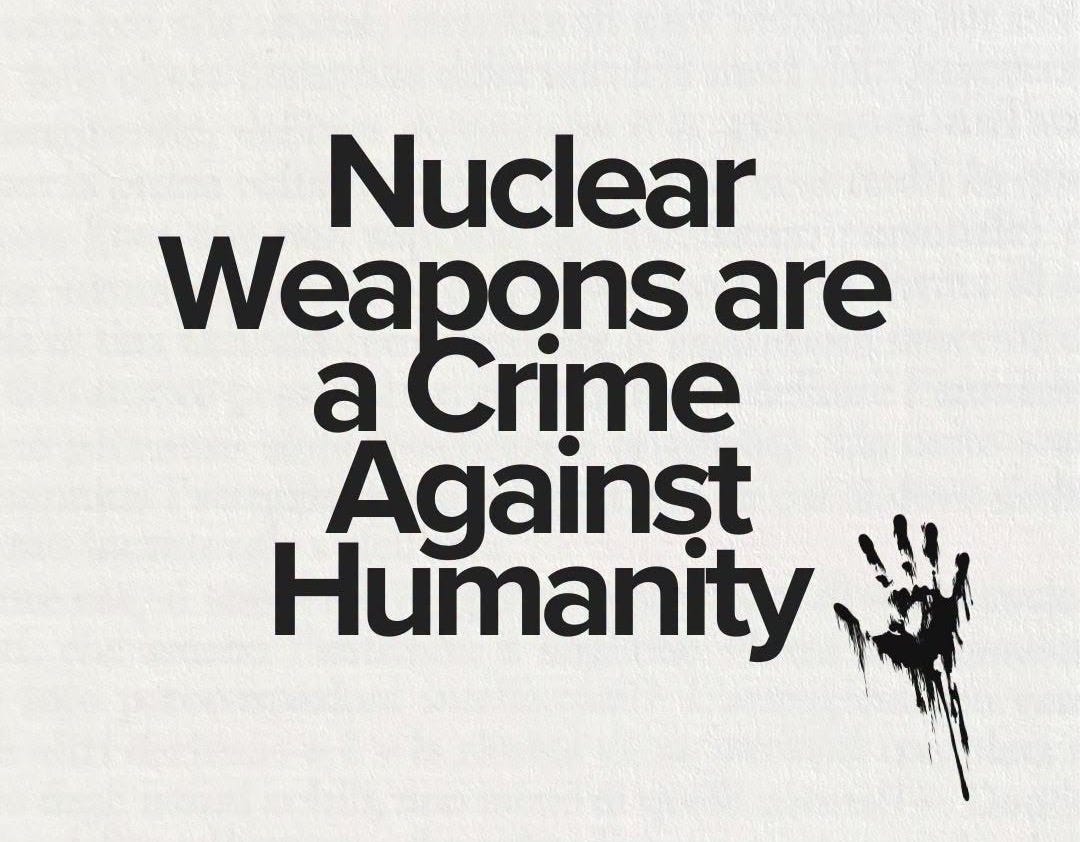
One of the most important books ever written about nuclear weapons came from the pen of a philosopher and literary critic, not a nuclear scholar. Elaine Scarry’s 2014 Thermonuclear Monarchy is ignored by 95% of the people who consider themselves nuclear experts—to the disrepute of their profession. Scarry argues in a dozen persuasive ways that nuclear weapons are fundamentally anti-democratic.
Who can deny it?
In recent years, I’ve found myself coming to the same conclusion—nukes are “despotic weapons of terror whose existence perpetuates all kinds of insecurity.” And I suppose that puts my view of nuclear weapons in dialogue with not only Scarry but also George Orwell, who wrote in October 1945, just after the US nuked Hiroshima and Nagasaki, that:
ages in which the dominant weapon is expensive or difficult to make will tend to be ages of despotism, whereas when the dominant weapon is cheap and simple, the common people have a chance.
So long as we remain in a “nuclear age” at all, we remain under the thumb of tyrannical national security states capable of erasing us—without consent—in a New York minute.
In an interview with Scarry that I share with my students each year, she says, consistent with Orwell:
Every new weapon changes the nature of warfare, but nuclear weapons have changed the nature of government. And changed what we can do. So much follows from the powerless position we’ve been put in.
Indeed.
My only asterisk would be that nukes are the most gratuitous version of the disempowerment that all things “national security” does to us now. The common person has no voice whatsoever on matters of war, genocide, or dispossession—especially when it’s done in their name. That’s plain for all to see when it comes to nuclear war, but is equally true of non-nuclear war-making and military buildups too.
Our forced helplessness came up when I spoke last week at The Public Advisory Committee on Disarmament and Arms Control. An audience member, frustrated at a feeling that nuclear experts and policy elites are simply presiding over a world moving further away from nuclear disarmament, asked what could be done to thwart the Nuclear Extremists and the lanyard-class lackeys who normalize them. How can anyone in that room—or any room where people ask “two-finger” questions—stop the drift toward nuclear abyss?
My off-the-cuff reply was that we need a mass movement, which means a popular consciousness against nuclear weapons and militarism (which are interdependent—the argument I was there to present). The Nuclear Freeze Movement during the 1980s was in the streets by the millions and saturated popular culture. Politicians must be made to feel like they have to do something about the problem; that they lack legitimacy and risk political instability unless they do something.
All of that is missing today. Why?
The hollowing out of what people think of as the middle class has destroyed the socio-economic base of activism in the global North. The project of nuclear disarmament itself got 1) professionalized and removed from popular conversation, and 2) decoupled from the problem of militarism of which it’s inherently a part. And popular art about nuclear weapons these days usually has some weird cultural militarism baked in, as if to say, “Yes, nuclear weapons are horrible but geez, there is no alternative. Maybe the answer is more missile defense.”
We do need to bring back the Nuclear Freeze Movement, or its spiritual kin.1 But something else that Scarry said in her interview makes me worry that even that is no longer enough:
In his autobiography Gandhi says, “You can wake a man only if he is really asleep; no effort that you may make will produce any effect upon him if he is merely pretending sleep.” And I think the big question for nuclear activists is, is the American population asleep or is it pretending to be asleep?
If it’s asleep, I think everybody can be awakened by just tapping—certain true facts put in front of them, such as the overwhelming fact that nuclear weapons are not a residue of the Cold War. These weapons are being modernized and kept up and replenished at every moment. If the country is pretending to be asleep, then some other strategies have to be found, and I don’t know what they are.
Everyone is aware of the grand existential problems facing humanity—the climate crisis, genocides, pandemics, and nuclear war. It doesn’t seem to matter. Are people so self-interested that they’re incapable of enlightened self-interest?
It might be that they need the story of nuclear threat told differently, or that they need to be awakened to how nuclear-related harms already impose on their life. There are a hundred ways that nukes make the life of the average person worse and they probably don’t realize it. Perhaps if somebody connects those dots, the nuclear-disarmament imperative will land differently than it has the past 40 years.
But if, as Scarry implies, the American population is only pretending to be asleep—if they mistakenly believe that nuclear war can be quarantined “over there,” or that perpetually living on the cusp of extinction is, perversely, the only way to prevent extinction—then we are beyond consciousness-raising.
In that case, nuclear disarmament activists have only two recourses.
One would be to confront the things that have held back the disarmament movement: Economic inequality, the technocratization of nuclear concerns, cultural jingoism, and above all militarism.
The other, complementary path requires muscles that the nuclear movement never fully developed—noncooperation. A politics of refusal aimed at the machinery of death. We must withdraw our labor and consumption from systems that hold our existence at risk without our consent.
We must, in other words, give “nuclear strike” an entirely different meaning. The fight for a world without nuclear weapons is a fight to recover democracy. If you don’t win the former, you shouldn’t expect the latter.
Hey, friend! You might have noticed that I’m offering more of Un-Diplomatic without the paywall; I’m trying to keep as much as possible public. But to do that requires your help because Un-Diplomatic is entirely reader-supported. As we experiment with keeping our content paywall-free, please consider the less than $2 per week it takes to keep this critical analysis going.


