A Gilded Navy for Imperialist Conflict
The enshittification of the military is accelerating too fast to build a strategy around it.
Happy holidays! You might have noticed that I’m offering more of Un-Diplomatic without the paywall; I’m trying to keep as much as possible public. But to do that requires your help because Un-Diplomatic is entirely reader-supported. As we experiment with keeping our content paywall-free, please consider the less than $2 per week it takes to keep this critical analysis going.
The enshittification of the military is happening so fast that the US can no longer hope to prevail in a great-power war that was already going to be disastrous anyway.
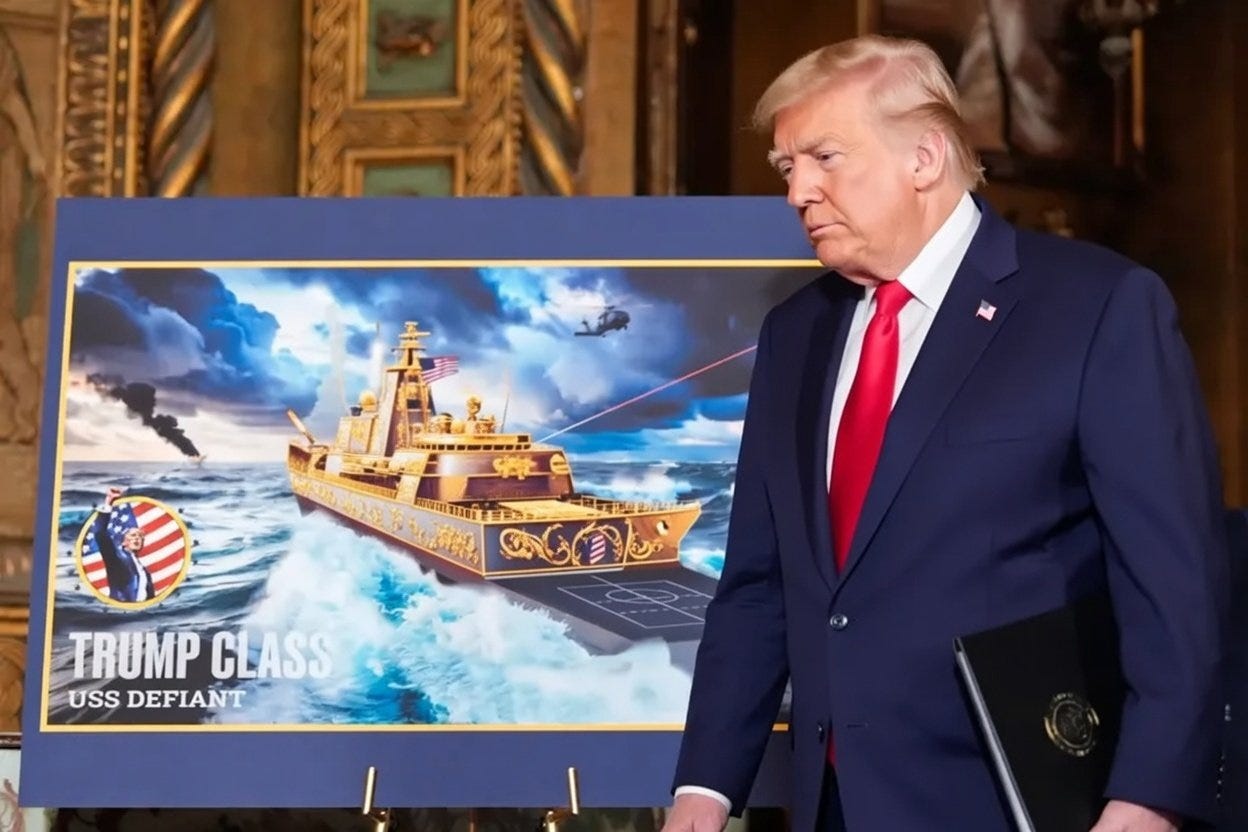
On December 22, Trump held a grand press conference to announce the forthcoming construction of 25 “Trump-class Battleships,” which the White House touted as the “largest surface combatant” ever constructed. Like most Trump announcements, it’s an assemblage of half truths and whole lies.1
But where some might see only the narcissistic promotion of a stupid naval procurement decision, I see a signal flare that reveals the shape of our conjuncture.
Before I get to that, here are the reported specifications of the new “battleship”:
If you’re not a military wonk, this probably looks like gobbledygook. And 99% of the debates about this gilded battleship amount to angels dancing on pinheads anyway. But there are a couple profound reasons this deserves critical attention.
The Ghost of Wars Past
Most people in the national-security world aren’t happy about the battleship announcement. Here’s Republican congressman Don Bacon, a retired Air Force general, summarizing their grievance in strategic language:
If what you care about is war-winning weapons, then the battleship is a loser. The US decommissioned its battleships long ago because they were more liability than asset—huge, slow, and vulnerable to sea- and air-based attacks.
The conventional wisdom among people who think seriously (but often uncritically) about war is that its future resides in small, distributed, and cheap “attritable” weapons like drones (ie, overmatch through sheer numbers). By contrast, the battleship, as the Trump administration conceives it, is to be a maritime center of gravity, which is just stupidly perilous. If an enemy takes out the battleship, they’ve effectively taken out the Death Star. To prevent that, the military will have to produce weapons and doctrine specifically meant not to “win” war but to defend this Hooverville of the sea, much like how the modern navy thinks about aircraft carriers.
Put differently, the battleship does not fill some requirement in a war-winning strategy; such a strategy does not exist. What it does is put capability before concept, which is in keeping with both a corrupt national security state and a techno-centric way of thinking about war.
But strategy-based criticisms of the battleship fall short of their logical conclusion. We live in an age where short bursts of global power projection (eg, missiles) are no longer a monopoly of the “great powers.” And if anyone can do it, we ought to exercise a lot more caution in imagining force as a solution to our problems. At the same time, sustained power projection is no longer possible except at great cost in blood and treasure. This is why there is no military solution to Taiwan. The battleship does not make Taiwan any more defensible and yet it massively simplifies what an enemy needs to do to defeat US power projection.
Shitting Gilded Bricks
The battleship as announced is a floating Christmas tree, a bottomless container for military-industrial corruption.
The plan as specified above is to arm the battleship with directed energy weapons, vertical launch systems for hypersonic missiles, rail gun, nuclear-capable cruise missiles (!), air defense radars, counter-UAV and -USV systems, and a V-22 Osprey. So basically every type of bell or whistle that has a possible use-case at sea is to be packed onto this battleship. As future niche capabilities attract funding, they’ll surely end up hanging off this tree as well.
While it’s unlikely this battleship will ever actually be built, it doesn’t have to be for its makers to profit. The navy has a tremendous track record of pushing money out to contractors and a terrible history of getting naval capacity in return. The Washington Post estimates that these larded whales will cost $10-$12 billion each, before cost overruns.
That suggests you could pack at least six times as much graft into the production process compared with a normal surface ship. Lest you think $12 billion each is a cost ceiling, a gentle reminder that the Navy’s recent experience with building Zumwalt-class destroyers (much smaller and less fitted out surface ships) is a cautionary tale. The Navy started out commissioning 32 Zumwalt destroyers at $1.3 billion each. They ended up receiving three—three—at the price of $7.5-$10 billion each.
Everyone wins, except for the bill-payers (US taxpayers) and the users (the military). And while actual funding for Trump’s battleships could start as early as next year, construction won’t even begin until the 2030s. But that doesn’t matter; what matters is that a capitalist class facing a real systemic crisis permits no solution other than doubling down on the permanent war economy. The battleship grift is merely one gratuitous expression of that truth.
An Imperialist Pivot?
I’ve been skeptical of Washington alarmism that Trump is abandoning Asia and Europe in favor of Western Hemispheric dominance for one simple reason: US military strategy and the trillion-dollar budget it justifies is hostage to threat mongering about China.
No matter how well Trump gets on with Xi Jinping, no matter what deals get made, the national security state cannot justify its obesity without great-power competition. Most of America’s trillion-dollar force has no purpose but fighting China. In fact, the Trump-endorsed military budget submitted on December 12—less than two weeks prior to the battleship announcement—designated $42 billion for ship-building (not battleships) designed specifically to counter China in East Asia.
But this battleship idea might actually represent the Trump administration’s attempt to build a military fit for the far-too-many purposes outlined in its National Security Strategy (NSS). Overstretched ambitions is a sign of decline, but in context it’s also a sign of MAGA’s seriousness about imperialist worldmaking.
Two small data points evince what I’m saying. First, the Trump-class battleships are next-to-useless against modern great-power adversaries like China—one of the grievances of national-security liberals against the announcement. Second, Trump was asked at his press conference whether this new battleship was meant “as a counter to China” and he demurred:
It’s a counter to everybody. It’s not China. We get along great with China.
Now, maybe you can interpret Trump as trying to be diplomatic, since he doesn’t want to end up on Xi Jinping’s bad side.
But the NSS emphasized in text and subtext that foreign policy would be guided by imperialist imperatives. It did not divest from war preparation against China—great-power competition, after all, is inter-imperial rivalry—but it seemed to prioritize imperialist conflict in every region outside East Asia above the China threat. The battleship might be far too expensive and never come to fruition anyway, but at least hypothetically, it has plausible use cases on behalf of imperialist wars against weaker enemies, both small nations and non-state actors.
So this imperialist transformation of US foreign policy seems to really be happening, and it’s being driven by the needs of a corrupt oligarchy that would rather plan for permanent war than the economic security of its people.
The US is not “building” these ships; the US state has to contract private corporations to do it, which leaves the fate of the project itself open to the same price manipulations and delays facing every attempt to build up the US navy in my lifetime. Neither will these ships be “made in America” in any meaningful sense; much of the construction will be outsourced to South Korean ship-builder Hanwha. I counted a dozen other misstatements, large and small, throughout Trump’s speech, but litigating them is pointless.


