Anticipating AOC’s Munich Security Conference Speech
What to look for from a left-populist counter to imperialism, fascism, white supremacy, and oligarchy.
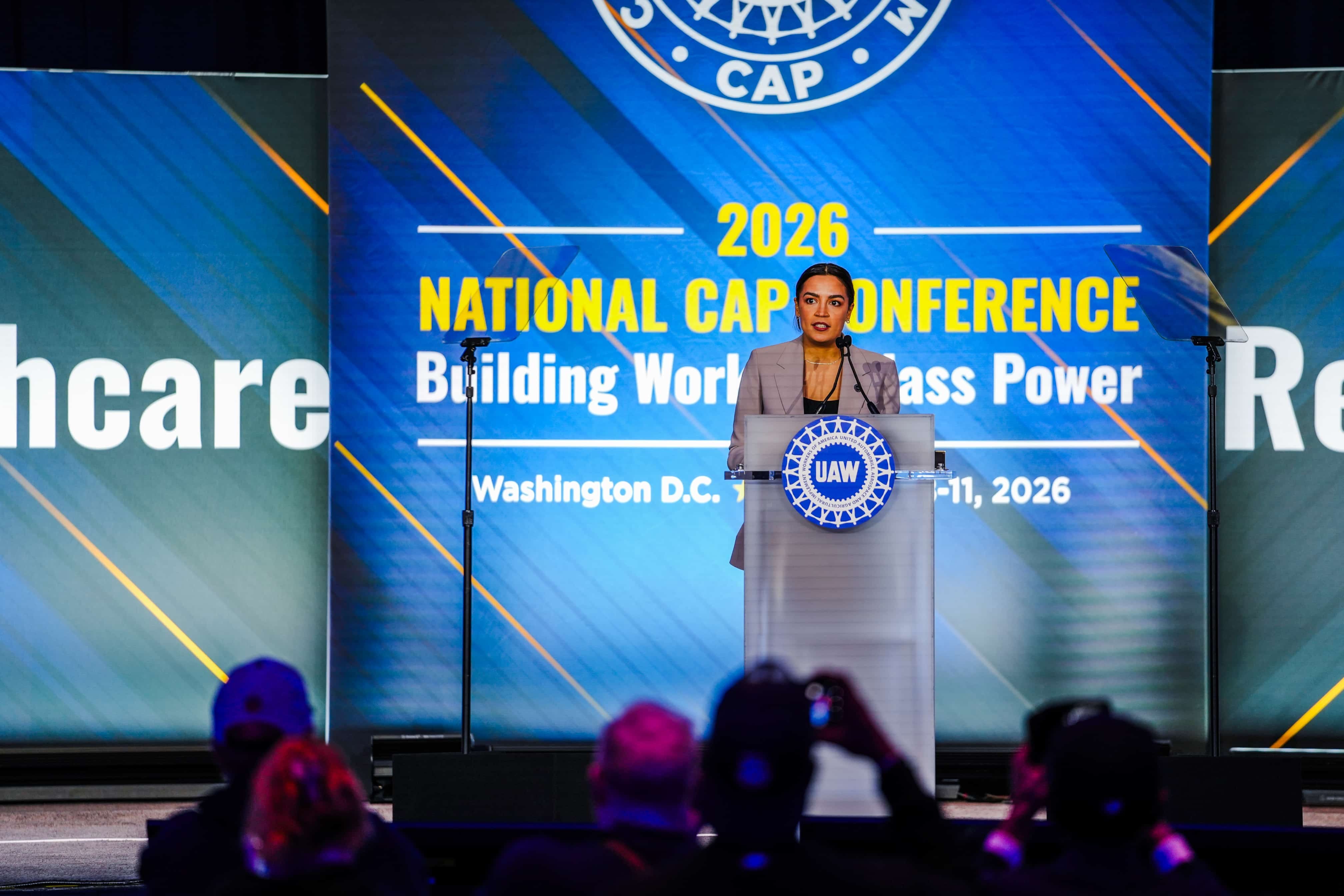
The big news in my world is that Alexandria Ocasio-Cortez (AOC) is in Europe to speak at the Munich Security Conference. It’s being billed as her big moment to establish a foreign policy vision ahead of running for president in 2028.
Ordinarily, AOC would be walking into the lion’s den. The Munich Security Conference is famous for its hawkishness, long seen as a premier venue for neocons and NATO-philes—a place where everyone has an imperialist blind spot, venerates American power, and inaccurately invokes “deterrence” to talk about militarism. Her progressive foreign policy instincts clash with the prejudices of wealthy, cultured liberals who’ve spent the last generation simultaneously believing that force is the true arbiter of politics and yet somehow that it’s also best to leave such power to the US.
We’re obviously not in ordinary times. The world is broken, and the US is a direct threat to Europe, not its patron or security guarantor. Even European elites seem to grasp that now. Nothing would provide them sweeter relief than restoring predictability and not having to worry about a politico-military threat from Europe’s western flank. And so, in these respects, even Euro-hawks are likely to find AOC quite appealing.
But pandering to Europe’s politicians and military minds should not be a priority. Not only is it the wrong constituency for a presidential candidate to court; those same European elites have an inglorious history of poor strategic judgment. They’ve played a major role in their own current security predicament and are making the rise of the European far right all but inevitable if nothing changes. Merely doing what they want would amount to accelerationism.
So what is to be done, from an AOC perspective? What’s she likely to say, and why?1 Well, AOC is a leading proponent of what everyone now calls progressive foreign policy.
It’s a root-cause way of thinking about insecurity that is necessarily anti-militarist in its disposition, and critical of America’s track record in foreign policy. It seeks peace, democracy, and equality—not simply the maintenance of a status quo or American power for its own sake—as the visionary aims of state power. It recognizes that those aims are, in the long run, interdependent. No peace, no democracy.
Within those broad outlines, many different configurations of policy are possible. The particulars that make sense depend on the conditions the world gives us, and how we explain the causes of those conditions.
Given my association with the progressive foreign policy world, here are a few key elements I would expect in the context of the Munich Security Conference in 2026:
US support for an independent, even post-NATO, European defense force.
Cautioning against arms-racing or a permanent war economy. A European military buildup should be based on 1) a realistic strategy that 2) does not merely build national militaries and 3) does not impose austerity on Europe’s citizens.
Prioritizing the rule of law, international institutions, and accountability for politicians. Putting some respect on the ICC’s name again. Rejoining the 66 institutions the Trump administration just set on fire.
Calling to re-establish the New START treaty, and to undertake a new global arms control regime, including with Russia (and China, but not necessarily together).
Showing some willingness to unilaterally bridle American military excesses.
Connecting Ukraine’s fight for self-determination against Russian imperialism with the Palestinian, Chamorro, and Puerto Rican fight for the same—an admonition against hypocrisy when it comes to resisting imperialism.
Scaling up investments that would facilitate the end of fossil capital; a green transition undermines the material basis of Russia’s permanent war economy.
Keeping Europe focused on Europe, not threat-inflation about China and exacerbating Sino-US rivalry.
Addressing economic imbalances between the global North and global South, as well as within the global South. Economic insecurity is at the root of military insecurity.
It’s unlikely that AOC could fit all of this in one speech, and the European context of this particular moment might require a narrower scope. Moreover, how AOC speaks to these issues might require more…diplomatic…language than I might use. But the above points still serve as a reliable scorecard for the degree to which AOC’s analysis of world politics maps onto that of the “progressive” foreign policy tradition.
Hey, friend! You might have noticed that I’m offering more of Un-Diplomatic without the paywall; I’m trying to keep as much as possible public. But to do that requires your help because Un-Diplomatic is entirely reader-supported. As we experiment with keeping our content paywall-free, please consider the less than $2 per week it takes to keep this critical analysis going.
Want to go deeper on “progressive” foreign policy? Some resources in addition to Grand Strategies of the Left:
The flip answer is to pay attention to the Center for International Policy and listen to The Un-Diplomatic Podcast, because Matt Duss is part of both and he’s been a prominent adviser to AOC in the lead-up to her Europe trip.


As an in-person veteran of a few MSCs, including Putin's 2007 warning and McCain's "rebuttal" (?), this was very fun to read. You make great points for AOC to consider. I think advising Europe to focus on Europe is the best advice of all; lots of good stuff would come from that.
Assuming someone with a progressive vision for foreign policy is elected, where are all the do-ers going to come from—the technocrats that share this worldview?