


When I worked as a Pentagon strategist, I was taught that our job was to design a force that could prolong global primacy. When I asked what that meant, I was told global military superiority. When I asked what that meant, I was told the answer had been the “two-war construct”—that is, the ability to fight and win two conventional wars against mid-sized adversaries (Iran and North Korea) in different regions (the Middle East and Asia) in overlapping time frames.
But because the “pivot to Asia” had been announced only a month or so earlier, my job was to help figure out how to ensure the US could also defeat a technologically advanced great power (China) too. That meant something more…lethal…than the two-war construct.
I had been a true believer in the cult of American primacy, but even for me, translating what primacy meant in practice seemed a bit rich. Why in the hell did we ever need to plan to fight two mid-tier wars simultaneously? It made no sense. And now we were adding China to the mix?
I shared my skepticism to the guy showing me the ropes (a friend who would become a senior official in the Biden administration a decade later). But he brought me around with one word: Options.
He told me we were trying to give a future president maximum optionality, up to and including the option to launch multiple wars simultaneously, or even nuclear Armageddon. Through the procurement, research, and budgeting decisions we made in the present, we were, quite self-consciously—making possible the use of overwhelming lethal power in the future.
I didn’t think too hard about it; there was work to be done. But if you bought into the premise that 1) even bad US presidents were rational actors, and 2) American primacy underwrote a US-centered hegemonic order whose alternative was surely chaos, then the “give the president options” principle made sense. I mean, shouldn’t I want the president to have more options for statecraft rather than fewer?
So I got on with the pivot to Asia.
But after about a year had passed, I came across a long essay by the OG nuclear strategist, Bernard Brodie (I was finishing my PhD at night). Written in 1978, Brodie’s prose was in the impenetrably boring, I-dare-you-to-keep-reading style common in international security studies. It’s a tough, even confusing read for anyone who’s not a nuclear scholar.
But he also wrote it at a time when scholars just didn’t allow political variables into claims about strategic theory. Neither did Brodie. But amid his numerous, sometimes meandering points, he took issue with the arguments of defense intellectuals associated with the far-right Committee on the Present Danger—nuclear hawks who blended warmongering, conspiracy theory-level anti-communism, and advocacy for military buildups.
Those lunatics relied on a logic of ever-expanding attack options as the prerequisite for deterrence against an ever-shape-shifting Soviet menace—if the US couldn’t attack the Soviets in a bevy of ways with a constantly growing arsenal of weapons, then the Soviets would somehow hold freedom hostage and/or launch a preventive nuclear war.
Brodie thought this was nonsense, and his intervention made me rethink the merits of “giving the president options.” His most memorable point was that the nuclear lunatics’:
readiness to spend billions of dollars to cover a contingency that most of his peers would regard as extremely dubious is a little breath-taking…the thinking up of ingenious new possibilities is deceptively cheap and easy, and the burden of proof must be on those who urge the payment of huge additional premiums for putting their particular notions into practice.
I grew less comfortable with the optionality logic of military strategy. Eventually, I came to see imperialist military strategy as a total dead end.
Nuclear wonks in Washington hold up Brodie as a totemic figure while ignoring most of what he had to say. Looking at what’s transpired since Brodie’s 1970s admonition, it’s clear the lunatics won. In Washington, they usually do.
Nobody inside the Beltway under age 50 could tell you anything about the Committee on the Present Danger, and it’s not their fault; the progeny of the Committee run policy schools like SAIS now. People once seen as crackpots like Colin Gray and Paul Wolfowitz came to be seen as serious thinkers. And the post-McGovern Democratic Party had been so obsessed with not appearing “weak” on national security that it normalized most of the nuclear-hawk shit that had once been exceedingly controversial. Defense strategy from the ‘80s onward—a train wreck of epic proportions—has been predicated on giving the president options.
Fast forward to Trump 2.0, whose Department of War now argues with a straight face that “credible nuclear options” would “expand the president’s option space by providing him with realistic and credible options and therefore strengthen deterrence.” Last month, Elbridge Colby, one of Hegseth’s underlings, reiterated the nuclear strategy he’s in charge of will be expanding the types and quantities of US nuclear lethality, including the development of tactical nuclear weapons for limited nuclear war fighting—a move that spits on Brodie’s grave. And Colby’s reasoning, surprise, is “giving the president options”:
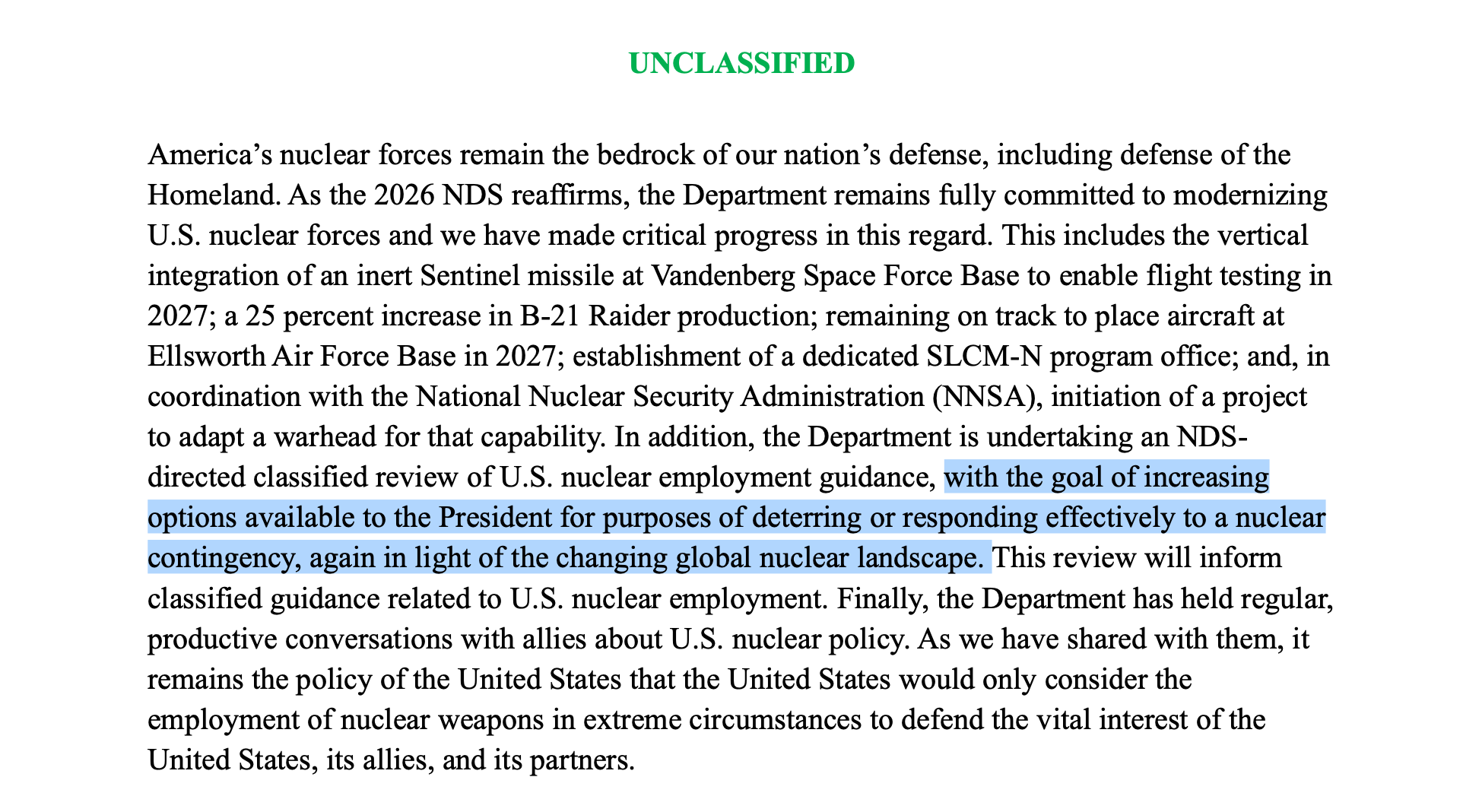
Who, in the age of MAGA counter-revolution and Democratic Party support for genocide and illegal war making, thinks that the US president should have push-button nuclear launch authority, to say nothing of giving him the options to “take decisive action against any target, anywhere, at any time?”
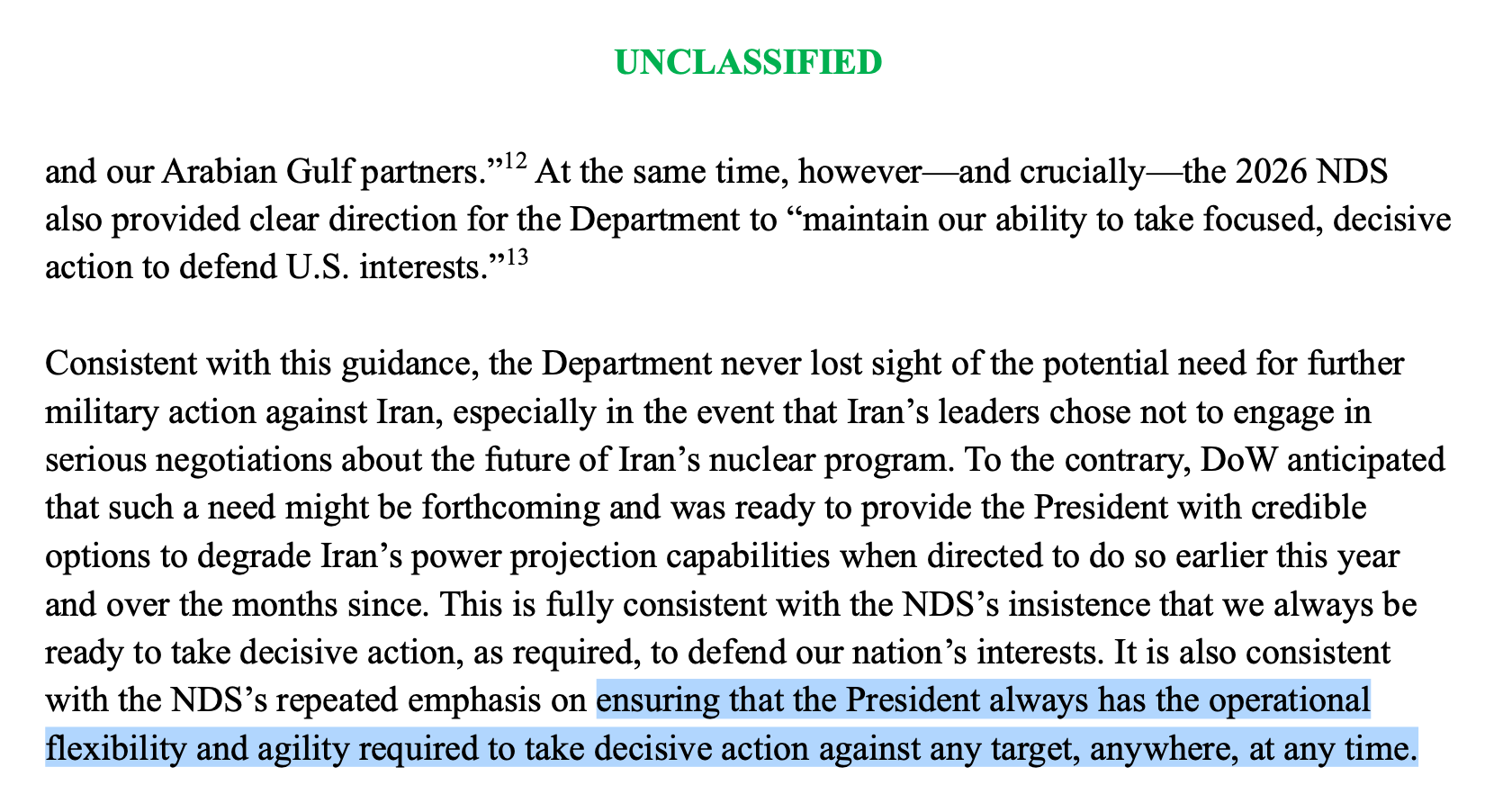
We live in an age where rationality does not govern force. At least not in the sense that strategic theorists assert. Instead, force is an instrument for a politics of counter-revolution and oligarchy—a politics powered by conspiracy theory, racial and gender resentments, and outright corruption.
If the Iran War teaches us anything, it should be that bullshit wars are proliferating; and if they are possible, they are also inevitable. The only way to guard against bullshit wars, and to maybe tamp down on their prevalence, is to tie the hands of future presidents, not give them the ability to annihilate us all.
Hey, friend! You might have noticed that I’m offering more of Un-Diplomatic without the paywall; I’m trying to keep as much as possible public. But to do that requires your help because Un-Diplomatic is entirely reader-supported. As we experiment with keeping our content paywall-free, please consider the less than $2 per week it takes to keep this critical analysis going.
ICYMI:
Nuclear Extremists, Militarism, and Arms-Control Conservatism

I rocked up to the Ministry of Foreign Affairs and Trade today to deliver remarks at The Public Advisory Committee on Disarmament and Arms Control (PACDAC)—an entity mandated by anti-nuclear legislation in New Zealand from 1987. As far as crowds go, this was a friendly one—plenty of government workers, but ones trying as best they can to advance disarma…
Bullshit Wars in a Multipolar World

Why does the United States keep waging one bullshit war after another? Especially when it can’t seem to win any of them?