


My credentials as a former member of Washington’s foreign-policy Blob are beyond dispute.1
I spent five years in the Office of the Secretary of Defense under Obama. I had been a “prestigious” CFR International Affairs Fellow (along with Condoleezza Rice, Kurt Campbell, and Samantha Power). I worked at the notorious think tank most known for staffing the Obama and Biden administrations. I was an unpaid policy advisor on four Democratic presidential campaigns in 2019/2020. I’ve testified before Congress as an expert witness. I’ve spoken at events hosted by every “non-partisan” think tank in Washington. Every. Single. One. And I wrote for every mainstream media outlet you can imagine: The Atlantic; New York Times; Washington Post; Politico Magazine.
Depending on when you discovered my work, this might be an unpleasant surprise. It saddles me with a lot of emotional baggage, to be sure. But it’s also my critical edge. With the exception of Daniel Ellsberg, RIP, I don’t know of any anti-imperialists in the peace movement who have the experience of being a defense intellectual, a part of what C. Wright Mills called the “power elite.”2
My Blob background matters because the Blob is back in the (mainstream) discourse.3
Obama’s deputy national security adviser Ben Rhodes coined the term “Blob” in 2016 to describe a section of Washington’s lanyard class that had uniformly opposed and sought to subvert the Iran nuclear deal in favor of either coercing, bombing, or coercively bombing Iran.
Who is the Blob? Mostly think tankers, mainstream media, and Congressional staff. But a heap of bureaucrats, military officers, and even political appointees serving the Obama presidency were sympathetic to the kill-not-cooperate impulse of state power too.
For advocates of progressive foreign policy—the space in Washington where I still make moves—the Blob names the opposition to peace, democracy, and equality. In Grand Strategies of the Left, I had a chapter explaining why. The TL;DR was that the Blob represents a stable set of preferences that are militarist, primacist, and worsen inequality. You identify the Blob based not on where they went to school or where in Washington they work, but rather 1) how they think about history, 2) whether they are American exceptionalists, and 3) what they think should be done with state power.
For foreign-policy progressives and socialists, then, the Blob is the label for agents of imperialist group think whose policies benefit Wall Street, Big Tech, and war profiteers at the expense of the working class. That’s why the Blob is never not in the discourse. An express goal of progressive foreign policy is to disempower the Blob, to replace it.
So Thanassis Cambanis, one of my colleagues at the Center for International Policy (the DC home of progressive foreign policy), wrote a short missive this week calling for the end of the Blob. It’s a recurring call from the left that many who read this newsletter have probably also made. But “end the Blob” is as uncontroversial for us as it is controversial for agents of Blob-think.
Cambanis said:
candidates and voters are breaking the blob’s shackles. They don’t want a foreign policy imposed on them which savages the world and leaves Americans worse off too. The blob’s consensus left no one safer or better off. The raw and open discourse about Gaza, Israel, the Iran war, and America’s destructive addiction to militarism and military spending suggests that the blob’s monopoly might finally be collapsing.
Dan Drezner, a centrist former Republican political scientist who has long dreamed of running the State Department’s Office of Policy Planning, took issue with calling out the Blob’s role in Iran policy.4 Ben Rhodes, and all of us, find that pretty fresh:
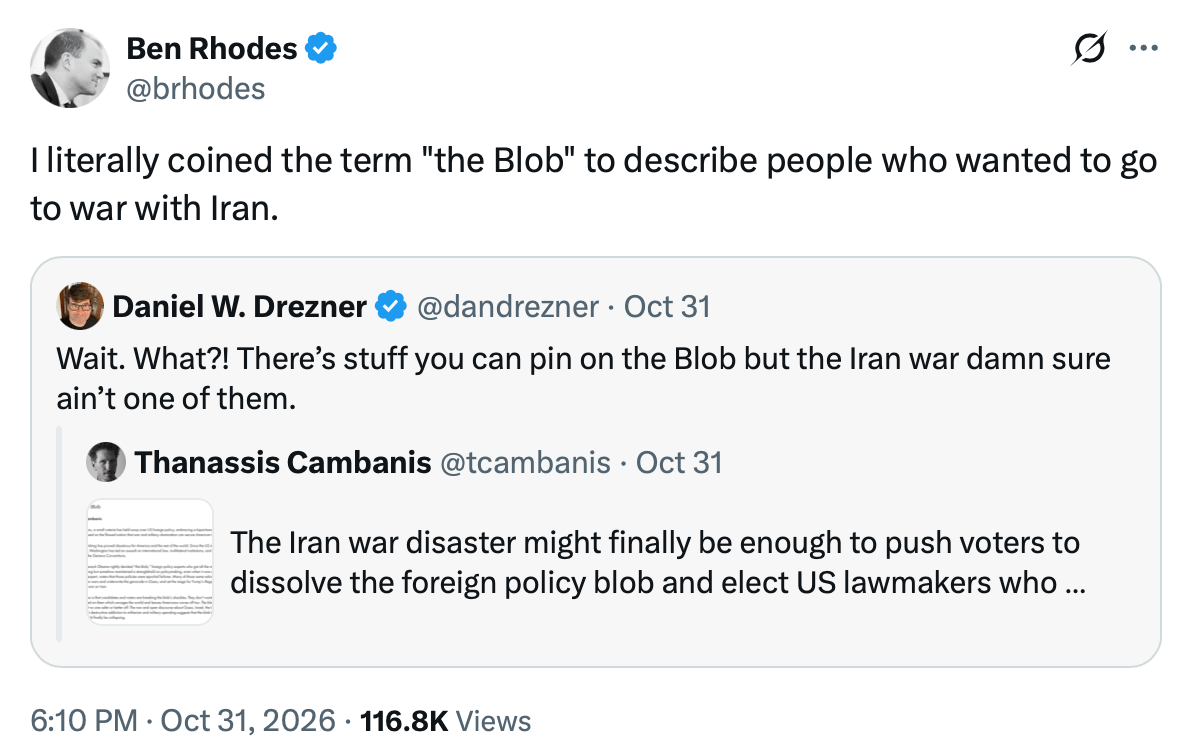
The issue with Drezner here is about proximate versus root causes.
It’s unquestionably true that the Blob’s decades-long prejudice favoring some version of maximum pressure on Iran created the conditions of possibility for Trump to merely say the word and cause a world-alteringly, very bad, no good, illegal war to unfold. The 2025 bombing of Iran ripened Washington for the 2026 invasion, and it was decades of sanctions combined with planning and agitating for war with Iran that made the 2025 bombing a readily available option. You can call the agents of this militarism the Blob or the Establishment or something else, but it’s all very real and crucial historical context that leads to Trump pulling the stupid trigger on war.
And it’s this willingness to think in root causes that separates progressive foreign policy from stock Blob-think.5 It’s not just that American exceptionalism means never having to assume responsibility for the world’s ills, which progressives find grotesque; it’s primarily that the left historicizes and the Blob romanticizes. Rather than seeing foreign policy from the standpoint of its victims, the Blob sees only good-evil distinctions—a reductionism that lends itself to a pathology of military solutionism.
For what it’s worth, I resented the label “Blob” when I was part of the Blob, and that’s to be expected. 100% of the people who criticize or deny the appellation identify with the targeted class of elites it describes. That’s revealing.
In the specific context of Iran, Blob-denial functions as backdoor advocacy for Israel…which is why it attracts so much attention right now, a moment when Israel policy has never been more politically contentious.
Hey, friend! You might have noticed that I’m offering more of Un-Diplomatic without the paywall; I’m trying to keep as much as possible public. But to do that requires your help because Un-Diplomatic is entirely reader-supported. As we experiment with keeping our content paywall-free, please consider the less than $2 per week it takes to keep this critical analysis going.
I’m also an Air Force veteran and worked in intelligence, but for reasons that this post relays, I don’t know if that should count as part of the Blob.
Although my life arc is unique, there is a growing network of foreign policy practitioners who’ve become similarly alienated from and antagonistic to the Blob—some because of Gaza, others because of DOGE, still others out of a refusal to be part of fascist empire. They’re my people!
Henry Farrell, Dan Drezner, and Jonathan Guyer (who will soon be on the pod) have all weighed in on the Blob in the past few days.
Drezner is a very good scholar and I don’t have any ill will toward him, even if his worldview frustrates me. I’m identifying his political traits here because it directly associates him with the Blob he’s defending by denying.
Progressive foreign policy 1) attempts to diagnose and respond to root causes of insecurity, 2) interprets military threats as symptoms of deeper sources of insecurity, and 3) commits to a principle of least-harm in prescribing what is to be done.
Are Working-Class Interests Progressive?

A properly progressive foreign policy is a working-class foreign policy. The complication is that working-class demands on foreign policy are capable of breaking in radically different political directions.

Peace and Economic Democracy as Preeminent National Interests

This piece (by me) is cross-posted at Blue Blaze, as part of a roundtable on progressive foreign policy.
A Progressive Reformation Against War

I have an essay out in Dame Magazine calling for a progressive reformation against war. In it, I try to jar us into updating our priors about America and its role in the world by exposing the reader to bits of the often un-narrated brutality of US foreign policy. The US security state is like a child incapable of admitting wrongdoing. In its refusal of …