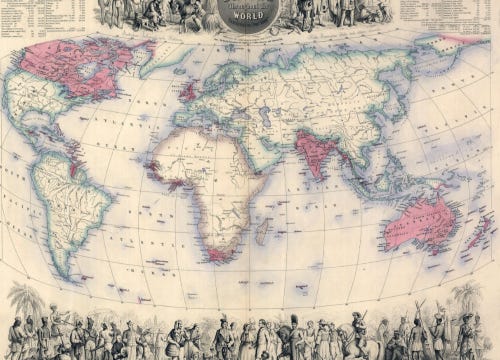
The Imperial Epithet in the Liberal Imagination
On imperialist statecraft, Edward Luce, pundit beef, and my refusal to acknowledge American imperialism in a previous life.
I spent the first half of the 2020s on a lonely island, shouting about the imperialist, militarist drift of US foreign policy.1
Of course, almost everyone I knew in Washington was having none of it, considering empire (and primacy) an epithet without taking seriously the analytical claim. Long ago, I similarly refused efforts to describe the US as an empire even while recognizing that it retained some imperialist relations. And I’ll grant that not everything America does warrants the imperialist label, even now (you might’ve said the same about Edwardian England).
But today’s pundit class is no longer able to deny the imperialist logic driving our reality, because it’s screaming at us through a Trumpian bullhorn:
Accordingly, the mainstream-ers are finally catching up. Sort of.
A couple weeks ago, I noticed that the Washington Post had begun talking about America’s imperialist foreign policy with a curious descriptive embrace but analytical disavowal. They can’t help but use the term because it conveys something crucial about what’s going on, but they nevertheless put it in quotes—“imperialism,” as if to say, “There is no better word than this but we also reject what this term implies.”
Then, earlier this week, I saw a story in the Financial Times titled “The New Era of Resource Imperialism.” It narrates a new epoch with familiar plot points, insisting on what only a year ago was considered a fringe leftist position: Imperialist reasoning dominates US foreign policy and geopolitics. How quickly fads change in national security.
The FT piece walks through familiar narration: Globalization is the past, resource extractivism is the new driver of state action, a world of conflict, Monroe Doctrine, Rubio wanted Maduro gone but also oil, imperial ricochet hits Greenland, spheres of influence are a thing again etc. etc.
Sure.
But missing from the piece, and from every liberal-coded attempt to grapple with the “new imperialism,” is an explanation for the supposedly epochal shift. You can describe it; we all can. But can you account for it? Not in any newspaper of record or Establishment zine. This is ironic because, for materialist readings of our conjuncture, the reasons for US choices are what make US statecraft imperialist; US choices themselves are simply evidence confirming as much.
But the failure to account for the now-dominant imperial mind is bound up with a failure to see the imperialism that was already present in Western policies prior to Trump. In effect, we’re going through the foreign policy version of what happened during Trump 1.0. Back then, liberal pundits decried Trump’s every decision as if they shared no continuity or DNA with past US choices. The greatest (and most personally radicalizing) sin committed by commentators during Trump 1.0 was offering no meaningful account of how Trump was possible, of the system that made him viable. In lieu of that, they treated MAGA ideas as the fruits of one world-historically bad apple who just bumbled into the presidency.
Enter Edward Luce.
Hello, friend! You might have noticed that I’m offering more of Un-Diplomatic without the paywall; I’m trying to keep as much as possible public. But to do that requires your help because Un-Diplomatic is entirely reader-supported. As we experiment with keeping our content paywall-free, please consider the less than $2 per week it takes to keep this critical analysis going.
An FT-style liberal who, in my estimation, is capable of swerving from critically aware capitalist to ruling-class jingo in the space of a paragraph; a conflicted liberal mind. The venerable New Left Review has just published a fascinating beef between Luce and Grey Anderson, who scathingly reviewed Luce’s new book (a biography of Zbigniew Brzezinski (“ZBig”). Luce wrote a reply in New Left Review insisting Anderson put some respect on his name. Anderson clapped back. You can judge it all for yourself (the review is paywalled, the replies are freely available), but I found Anderson’s final word to be more damning of Luce than the initial review; makes you wonder why Luce would rise to defend his name in the first place if his counters lacked merit.
Some of you already know about this NLR beef, because it’s making its rounds on social media. But the reason I share it is not for its deliciousness. Rather, it’s that where Luce most erred in his indignation was in denying empire, and in so doing, exposing himself as someone who sees its invocation as an epithet.
The Luce book that Anderson ripped apart was about the life of ZBig, Jimmy Carter’s national security adviser and father of MSNBC talking head Mika Brzezinksi. ZBig made many questionable choices during his career, but it was his 1997 book The Grand Chessboard that made him notorious among anyone who wasn’t part of America’s ruling class. In that book, ZBig argued strenuously for American global primacy, an extremist strategy of power-hoarding by all means (not just military), done in a manner that might preserve and extend US global hegemony for as long as possible. It reflected the way many Washingtonians thought at the time, and it influenced a subsequent generation of policy practitioners, most of whom you could identify by whether they supported the 2003 invasion of Iraq (ironically, ZBig opposed that war).
Luce denied that ZBig was an imperialist, and claims that ZBig didn’t use the term to describe the US. That’s risible, and Anderson has receipts—ZBig wrote and spoke frequently (and uncritically) about American imperialism, going back to the 1960s. A biographer of the man should’ve known that.
While ZBig scarcely used “empire” in The Grand Chessboard, it’s because he no longer needed to. Primacy was the new watchword in a world without imperial rivals and where the global architecture of unequal economic exchange replaced traditional imperialism with what Kwame Nkrumah called neocolonialism, sometimes neo-imperialism or “informal” empire.
Liberal commentators like Luce are right to be scandalized by empire. It should be seen as an epithet! But they’re dead wrong to think that empire hasn’t been part of how the US has related to the world during—and especially since—the Cold War.2
There are some crucial things to understand about empire today. One, empires are tightly linked to a geopolitics of white supremacy. Two, empires always include spheres of influence but not all spheres of influence involve empires. Three, while imperial forms of political ordering have a particular relational structure, imperialist statecraft per se is what produces that structure. And imperialist statecraft is what we’re seeing now:
Hierarchical relations that dictate the terms on which others engage in global trade and finance;
Expansionism and revisionism that not only seeks the ability to dominate others, but also covets others’ lands regardless of the means used to acquire them;
Spheres of influence that decide the fates of third parties.
The final thing to note is why I was ahead of the mainstream in calling out American empire in a manner that was distinct from merely empire-as-epithet. Trump’s imperialism simply wouldn’t be possible without the groundwork laid by Sino-US rivalry, which itself became the clearest sign of imperialist statecraft by about 2020. I laid out my account of American empire in a public speech I gave just prior to the 2024 election:
Rivalry between the US and China should be understood as an inter-imperialist rivalry. It is an ethnonationalist competition within capitalism.
Until the 1970s, advanced economies had been producerist, manufacturing economies. That became less profitable as manufacturing became more competitive. And as profits fell, investment capital in advanced economies looked for profits through services more than production.
The era we now call neoliberal globalization has been an era of financialization and de-industrialization in the West. The latter was a spatial fix to a crisis of profitability; the former was a fix of method to that same crisis. As it happens, China was a major beneficiary of the financialization and de-industrialization process, which is how it became the world’s factory.
I think most people know that much. But less obvious is that what we’ve seen over the past half century: Financialization of the economy—neoliberal globalization itself—has had diminishing returns and is unacceptably volatile…especially since 2008.
We keep ending up in these cycles where investment capital floods into a sector, creates a speculative bubble, and then too much capital chasing too little profit leads to overproduction. Overproduction drops prices, drops profits, and that creates a fiscal crisis.
So neoliberal globalization (which started as a fix to a crisis in industrial capitalism) began facing its own crisis of capital accumulation—and we see evidence of that crisis in economic stagnation. Global growth has slowed, and in many places it’s stopped altogether. The previous economic order wasn’t delivering the goods like it used to.
The response has been imperialist foreign policy: The US, China, and rich nations that can afford it have decided that the answer to an era of low growth is zero-sum economic nationalism, bolstered by military power. Operating in this particular “nation-first” mode justifies primitive modes of capital accumulation; the security and economic imaginations braid together in a way that leads to predatory state choices that we can only call imperialism.
And again, this is in response to a global tide that’s no longer lifting all boats. So now the US and China have turned to using the power of the state to secure a competitive advantage in strategic sectors of the economy. In fact, China was doing this first and the US decided to emulate China.
One long-term problem with this is that we’re already overproducing relative to demand in the so-called strategic sectors of the world economy. And looking out 5-10 years, we’re actively building toward yet another fiscal crisis, but this time in these strategic sectors—semiconductors, AI, green tech, and military hardware.
But that’s long term. The more immediate problem is that in order to do state-driven political economy, you end up having to exploit nationalism—use state power to build national power, strengthen yourself and weaken your competitors. But nationalism is a dangerous force. It’s prone to a politics of reaction—it’s inherently exclusionary, it often assumes scarcity, and it becomes a justification for violence. And in the US and China in particular, it’s ethnically charged—it’s ethnonationalism.
In both countries, nationalism has an exceptionalist quality—they both talk and act as if they’re special…as if their behavior is exempt from the rules that everyone else plays by. And when powerful nations do that, it leaves the rest of us in a world where the great powers are competing for a greater share of global growth while that same growth is declining in relative terms. And that relative decline of growth intensifies what starts to look like an inter-imperial competition.
So great-power exceptionalism is not new but it could co-exist in a high-growth world—it wasn’t a source of WWIII in a high-growth world. We’re not in that world anymore. So what we’re left with is imperialism, militarism, and economic nationalism. And who benefits from that? Not lovers of peace. Not lovers of democracy. And definitely not workers.
Ironically, my screams into the abyss brought me out of isolation. Most of you found me by following the sound. There’s something beautiful and lesson-y in that. Be real; your people will find you.
One of the ways I’ve tried to reconcile a narrow definition of empire that accommodates the accounts of imperialist logic today is to refer to imperialist foreign policy or statecraft. Where imperial-ism can be a relational structure or a form of political ordering, an imperialist geopolitics is the making or practicing of such hierarchies of domination; imperialist foreign policy is a statecraft that prefigures imperialism.


