The Old Wager in The New China Bargain
Hey, there! You might have noticed that I’m offering more of Un-Diplomatic without the paywall; I’m trying to keep as much as possible public. But to do that requires your help because Un-Diplomatic is entirely reader-supported. As we experiment with keeping our content paywall-free, please consider the less than $2 per week it takes to keep this critical analysis going.
When it comes to China and the Trump administration, I see lot of both wish-casting and doom-casting from the commentariat.
I already tried to explain the what and the why of Trump’s China policy, but maybe people were distracted by the photo I used of Jean Claude Van-Damme punching that Asian guy in the nuts in Blood Sport, so I’ll excerpt it:
The Trump administration is making a grand bet…On the one hand, it’s still using China as the “pacing threat,” in so many words, to justify the world-historical grift that makes the war machine a trillion-dollar siphon on taxpayers. At the same time, it doesn’t want the smoke from an unwinnable war. The real wager, then, is that the US can arms-race without tipping into war by toning down the anti-China histrionics, decelerating decoupling, and perhaps even coming to a sphere-of-influence arrangement—a “G2.”
But even the most competent statesman would struggle to manage that contradiction.
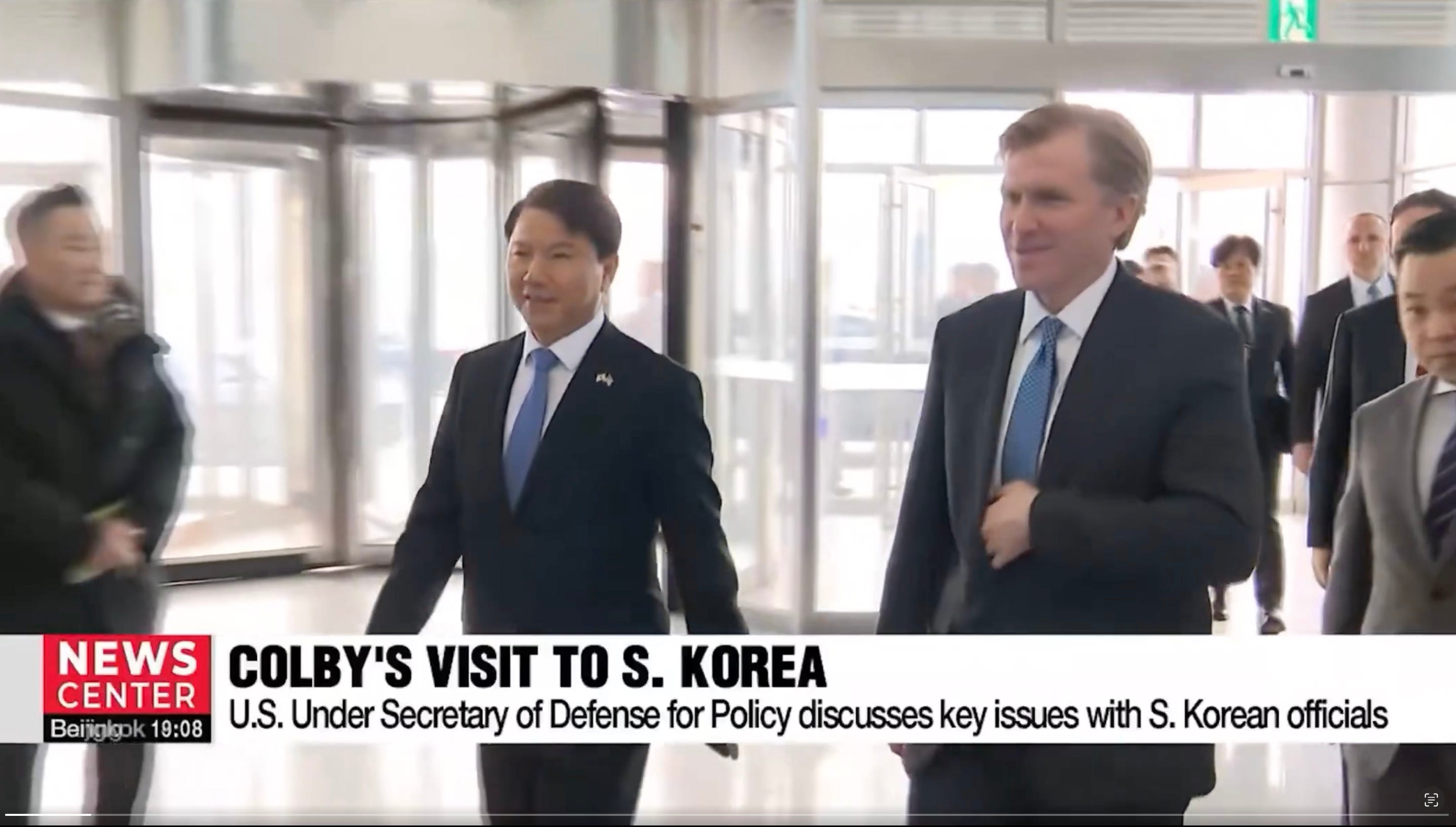
I made that evaluation based on the National Security Strategy in December. When the National Defense Strategy dropped last week, it validated that assessment. And now, the Pentagon’s top policy official, my sort-of nemesis Elbridge Colby, just gave a speech in Seoul—the clearest statement to date of how the Trump administration is thinking about China. It again confirms my assessment, which is very different from both the wish- and doom-casting about China among the expert class.
The tone of Colby’s remarks were rather conciliatory toward China (a good thing!). But there’s a deeper problem. Here’s the key portion from Colby:
A satisfactory stability in Asia will not be gained and preserved by lofty rhetoric, putative norms, or ostensibly good intentions. It will not be guaranteed by economic interdependence or diplomatic symbolism. Rather, it will be preserved by power intelligently and rightly applied—and specifically by a durable favorable balance of power that, as the National Security Strategy lays out, prevents domination of this crucial region by any single state.
…a favorable balance of power in which no state can impose its hegemony.
I’m told Colby has read Pacific Power Paradox. In this passage he’s certainly jousting with its claims about the “Asian peace.” He says neither diplomacy nor economic interdependence nor norms (nor alliances) will keep the Asian peace…only US military primacy (“favorable balance of power”). That is, of course, the opposite of what Pacific Power Paradox shows.
The historical evidence indicates that Colby is describing a very bad theory of stability in Asia—one that risks bringing on the war that unsettles the “Asian peace.” But neither he nor the Trump administration seek confrontation with China. And it’s that tone of non-confrontation that has led so many commentators to judge Colby’s remarks as somehow conceding something to China.
But if you know Colby or read his book, you know that’s not true. He believes that China controlling Taiwan would change the balance of power unfavorably for the US—and therefore China can never be allowed to control Taiwan, and therefore the US must perpetually arms-race and grow the trillion-dollar war machine. This is not correct, but it’s what he believes. The Trump administration’s obsession with the “first island chain” is a geopolitical euphemism for Taiwan, and it’s based on the incorrect belief that Taiwan somehow shifts the balance of power.1
In Colby’s book and his remarks, he preaches a “stable equilibrium” and a “favorable balance of power”—this is a contradiction. The idea that you can perpetually maintain a favorable balance of power is a reactionary myth; an evidence-less logic that justifies arms-racing. Colby’s remarks also put the Pentagon at odds with the Trump administration’s own rhetoric using the “China-peril” for re-activating the Monroe doctrine in Latin America and threatening to invade Greenland. China surely pays attention when the US treats China as a bogeyman to steal and kill and coerce others, and Colby does not reckon with any of that.
So if you’re a person who wishes for peace and stability in Asia, you should find small comfort in how the Trump administration is approaching China. Rhetorically, Colby is an improvement over the all-too-hawkish Biden administration—cool. But the basic wager on military primacy and competitive power-hoarding remains the explicit theory of victory for the US, and that risks becoming a self-fulfilling prophecy, especially for a presidency that is actively dismantling all the other real sources of peace and stability.
It’s worth noting this is all very bad for Taiwan. The Pentagon, and Colby in particular, have been very clear that Taiwan means nothing to them except as a measurement of military primacy inside the first-island chain and a site of semiconductor production. If that’s all Taiwan is worth to MAGA, then Taiwan is very exposed. People have memory-holed that in 2023, Colby supported the idea that if China invaded Taiwan, the first thing the US should do is bomb Taiwan (to prevent China from securing their chip-making capacity).


