The Geopolitics of White Supremacy
On knowing foreign-policy racecraft when we see it.
Hey, there! You might have noticed that I’m offering more of Un-Diplomatic without the paywall; I’m trying to keep as much as possible public. But to do that requires your help because Un-Diplomatic is entirely reader-supported. As we experiment with keeping our content paywall-free, please consider the less than $2 per week it takes to keep this critical analysis going.
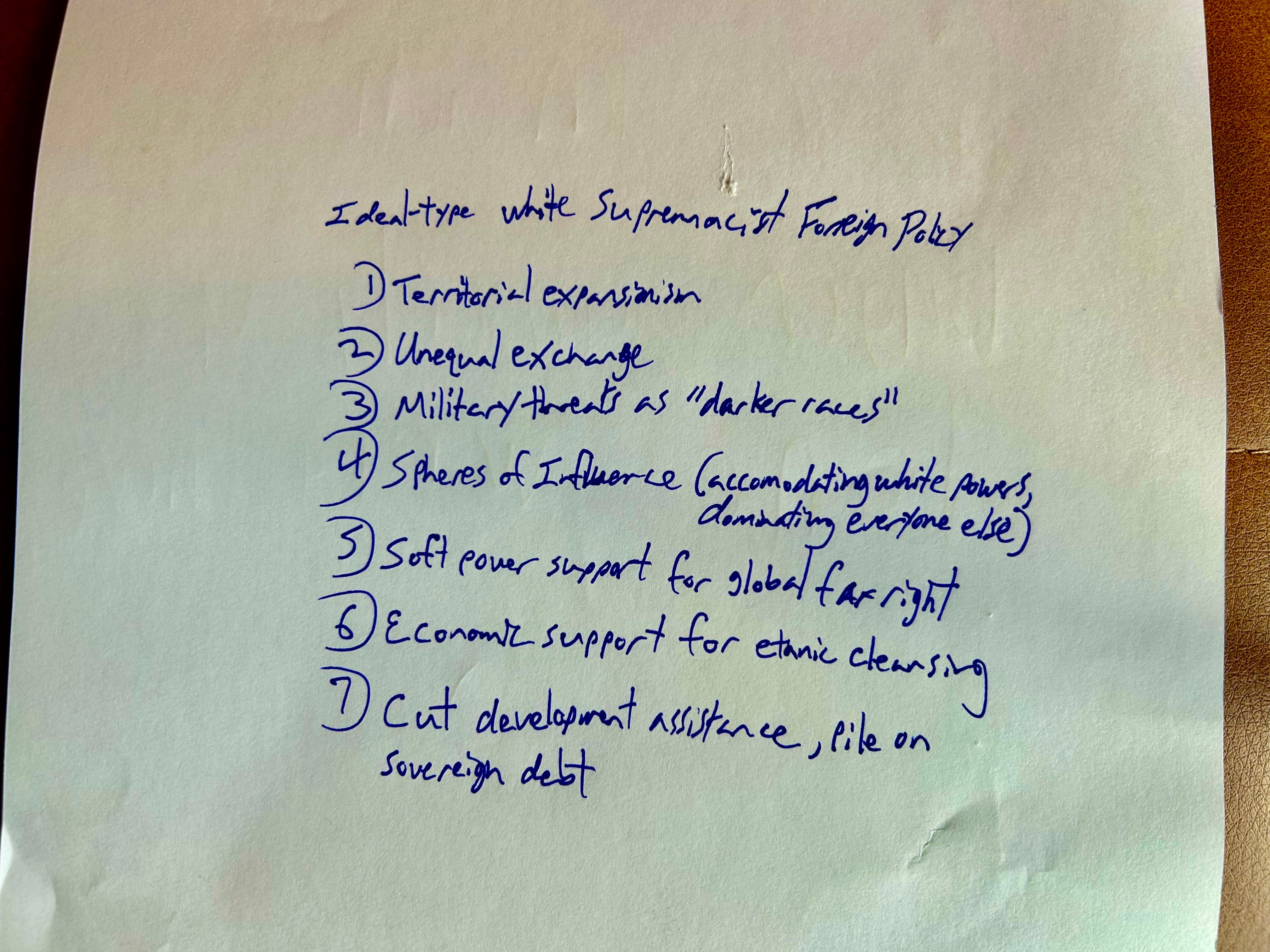
I was on a plane back to New Zealand in late 2019 when I pulled out a scrap of paper mid-flight. On it, I scribbled at the top “Ideal-Type White Supremacist Foreign Policy.”
I had just discovered that, in 2016, Gideon Rose (the editor of Foreign Affairs at the time) wrote a bullshit review of Robert Vitalis’s White World Order, Black Power Politics. Rose’s critique was essentially that what’s past is past; that it’s fine to admit that international relations has a racist and imperialist genealogy but it’s not okay to sully today’s “liberal international order” with that brush.
I reacted viscerally to Rose’s reflexive defense of the Establishment. So with a blank sheet on my cramped tray table, I started working through what it would look like for state power to be used in geopolitics the way it was used in settler colonial regimes, the Jim Crow South, Nazi Germany.
I sketched out some indicators, evidence that would stand as a white-supremacist’s fantasy geopolitics:
Territorial expansionism;
Unequal exchange (ie, rich countries should be white, poor countries should be “darker races,” rich countries should be where capital flows, “darker nations” should be where resources are extracted);
Military threats as the “darker races” that obtain nukes or achieve “great-power” status;
Spheres of influence suborning “darker races” and accommodating culturally white powers;
Soft power support for far right movements;
Economic support for immigration policing, expulsion, and relocation (ethnic cleansing);
Cut development assistance, pile on sovereign debt.
I stared at the list of indicators, trying to transpose them in my mind onto Trump 1.0’s foreign policy. The closer the fit, the more powerful the claim that US foreign policy was a white supremacist’s dream.
You never saw me publish this as research, though, because I had a horrific epiphany when I clicked my way through this mental process: 80% of what we could identify as evidence of Trump’s white supremacist foreign policy had been present under Obama (and Bush and on and on).
Every place we happened to deploy military force since the start of the War on Terror just happened to be not-white. The patterns of unequal exchange that separated global North from South—and made the former a net appropriator of labor and natural resources—stretched back decades, sometimes centuries. Nuclear nonproliferation had a subtle color line running through it well before Trump. The US had a formal sphere of influence in the Pacific but was mobilizing to deny China one in Asia. The rise of first Japan and then China were treated as existential threats by the national security community, and the former only dissipated when Tokyo fell into generation-long economic stagnation.
My point is, under the universalist auspices of liberal hegemony, we were practicing a statecraft that was also racecraft, producing predictable wealth-poverty and security-insecurity outcomes that broke along racial lines. This was often unintentional, a byproduct of thinking in a predatory way about a world inherited from historical imperialism. But the fact that we weren’t willing to interrogate structural racism within our sometimes well-intended policies sat in my belly like yogurt that had passed its expiration date.
Anyway, the realization was at once correct and too simple: Racial bias features as cause and effect in many aspects of US foreign policy, especially Sino-US rivalry, where it drives a security dilemma. But even circa 2019 (when I was working through some existential shit intellectually), I knew we needed to think about race intersectionally,1 not just as a variable.
The insight was just too radical to act on at the time. I wasn’t (yet) ready to alienate everyone I knew with an argument about foreign policy that would be easily misconstrued as “race-reductionism.” And I hadn’t yet read deeply enough to be able to reconcile my insight with an understanding that race articulates itself through both class relations and the intersection of race with other forms of identity experience like gender.
So I shelved the racecraft project in favor of others. Then Covid hit. Then Trump lost the election. A Biden-dominated “we’re back” triumphalism would ensure deaf ears to even evidence-based claims of racial hierarchy in US foreign policy.
I’m recalling this now-buried project for four reasons.
One, I’ll be referring back to this post in the future when I analyze current events where concepts of race, racial capitalism, or empire are leitmotifs.
Two, white supremacy and democracy are incompatible. Logically, of course, but also in the sense that a guiding ideology of white Christian nationalism—which is lightly intellectualized white supremacy—has no majoritarian base of support:
So to do a white supremacist foreign policy is to declare yourself an enemy of democracy.
Three, the Trump administration is now openly doing white supremacist foreign policy in every respect, lighting up every indicator, even more than during Trump 1.0. I was totally on the right fucking track in 2019 and I really wish I would’ve published that damn research. There’s no escaping the white supremacy conclusion now, from the National Security Strategy to the nine places we bombed in 2025 to DHS openly posting fascist crap like this on New Year’s Eve:
Finally, white supremacist geopolitics is imperialist geopolitics. These are not mutually exclusive ways of reasoning about foreign policy. Acknowledging the way that white supremacy is baked into imperialism and vice versa involved a consciousness leap I just hadn’t made in 2019.
While race is clearly a motivating factor in Trump foreign policy, it’s often playing a subordinate role in what is better explained as imperialist designs (which are usually racialized!). A while back, I tried to outline elements of an imperialist foreign policy by writing:
I can think of no better covering term than empire for a foreign policy that is:
both expansionist and revisionist;
that not only seeks the ability to dominate all others, but also covets others’ lands regardless of the means used to acquire them;
that brokers spheres of influence with other great powers about the fates of third parties; and
that aims to dictate the terms on which others engage in global trade or finance.
While these aren’t exactly the same as white supremacy, you see a lot of commonality with the racist indicators above.
Hello, friend! You might have noticed that I’m offering more of Un-Diplomatic without the paywall; I’m trying to keep as much as possible public. But to do that requires your help because Un-Diplomatic is entirely reader-supported. As we experiment with keeping our content paywall-free, please consider the less than $2 per week it takes to keep this critical analysis going.


